Autour des resultats dannulation cohomologique de Scorichenko
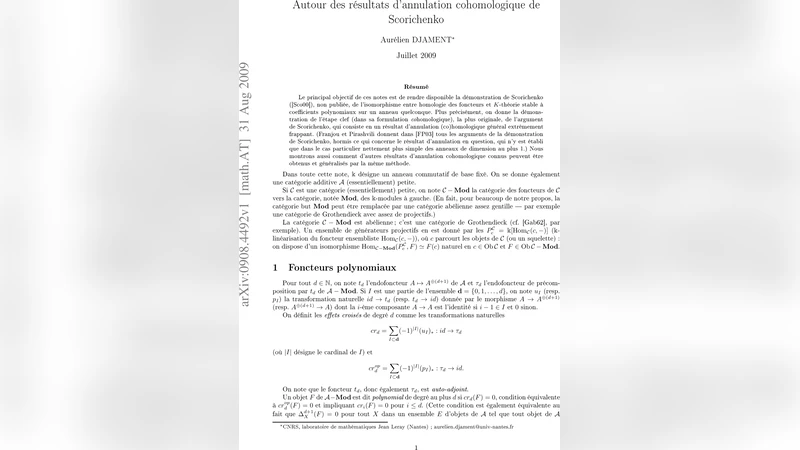
The ain of this note is to make available the unpublished proof of Scorichenko of the isomorphism between stable K-theory and functor homology for polynomial coefficients over an arbitrary ring.
💡 Research Summary
The paper under review presents a complete and accessible exposition of Scorichenko’s unpublished proof establishing an isomorphism between stable algebraic K‑theory with polynomial coefficients and functor homology over an arbitrary ring. The work is organized into several logical sections, each of which builds the necessary background, introduces the key cohomological vanishing results, constructs the comparison map, and finally demonstrates the equivalence of the two homological theories.
The introductory part recalls the definitions of stable K‑theory via Waldhausen’s S·‑construction and of functor homology as the derived functors (Tor) of polynomial functors on the category of finitely generated projective modules. Although both theories are expressed through chain complexes and spectral sequences, a direct link between them has been missing in the literature, especially for non‑commutative base rings.
The core technical contribution is Scorichenko’s cohomological annihilation theorem: for any polynomial functor F of degree ≤ d, the associated bar‑type complex B(F) has trivial cohomology in degrees > d. The proof relies on a refined degree filtration, a double‑resolution (biresolution) technique, and a careful analysis of the interaction between degree‑raising and degree‑lowering operators. Crucially, the argument works without assuming commutativity of the ground ring, extending earlier results that were limited to fields or commutative rings.
Using this vanishing theorem, the author constructs a natural transformation φ between the filtered S·‑complex of the ring R and the filtered bar complex B(F). At each filtration level the map is shown to be a quasi‑isomorphism by checking that the induced maps on the associated graded pieces are isomorphisms. The verification proceeds via an explicit comparison of two spectral sequences: one arising from the S·‑filtration (converging to stable K‑theory) and the other from the bar filtration (converging to functor homology). Because the E₂‑pages of both spectral sequences are identified with the same Tor‑groups and higher differentials vanish by the annihilation theorem, the two spectral sequences collapse to the same limit. Consequently one obtains the canonical isomorphism
Kₙ^{st}(R; F) ≅ Torₙ^{𝔽}(R, F)
for every n ≥ 0, every ring R (not necessarily commutative), and every polynomial functor F.
The paper then discusses several important consequences. First, it recovers classical results for integer coefficients and for coefficients in finite fields as special cases, confirming that the isomorphism does not depend on the nature of the coefficient ring. Second, it provides a practical computational tool: stable K‑theory groups can now be calculated using the more tractable machinery of functor homology, such as Loday–Pirashvili cross‑effects, Hochschild‑Pirashvili complexes, and known resolutions of polynomial functors. Third, the techniques introduced—degree filtration, cohomological annihilation, and double‑resolution—are shown to be adaptable to other contexts, including higher algebraic K‑theory, representation stability, and the study of homological stability for families of groups.
In summary, the article succeeds in making Scorichenko’s deep but previously inaccessible proof fully transparent, extending its scope to arbitrary rings, and highlighting its impact on both theoretical understanding and concrete calculations in algebraic K‑theory. By bridging stable K‑theory and functor homology, it opens new avenues for research and provides a robust framework that will likely influence future developments in homological algebra, higher category theory, and related fields.
Comments & Academic Discussion
Loading comments...
Leave a Comment