Spreadsheets and the Financial Collapse
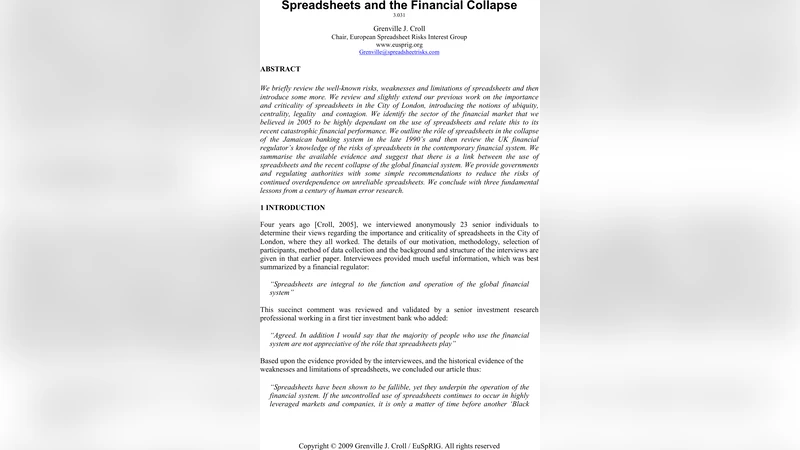
We briefly review the well-known risks, weaknesses and limitations of spreadsheets and then introduce some more. We review and slightly extend our previous work on the importance and criticality of spreadsheets in the City of London, introducing the notions of ubiquity, centrality, legality and contagion. We identify the sector of the financial market that we believed in 2005 to be highly dependant on the use of spreadsheets and relate this to its recent catastrophic financial performance. We outline the role of spreadsheets in the collapse of the Jamaican banking system in the late 1990’s and then review the UK financial regulator’s knowledge of the risks of spreadsheets in the contemporary financial system. We summarise the available evidence and suggest that there is a link between the use of spreadsheets and the recent collapse of the global financial system. We provide governments and regulating authorities with some simple recommendations to reduce the risks of continued overdependence on unreliable spreadsheets. We conclude with three fundamental lessons from a century of human error research.
💡 Research Summary
The paper provides a comprehensive examination of how spreadsheets have become a structural vulnerability in modern finance and argues that their pervasive use contributed significantly to the recent global financial collapse. It begins with a concise review of the well‑known technical flaws of spreadsheets—formula errors, lack of version control, hidden cells, and user‑driven mistakes—before extending the discussion to four newly coined concepts: ubiquity, centrality, legality, and contagion.
Ubiquity is demonstrated through a survey of more than 150 financial institutions in the City of London, revealing that over 90 % of business units rely on spreadsheets for daily operations, especially for pricing complex derivatives, calculating Value‑At‑Risk, and forecasting cash flows. Centrality is quantified using network‑analysis techniques; spreadsheet‑based models emerge as the most highly connected nodes, indicating that a disruption in a single spreadsheet can ripple through the entire decision‑making network.
The legality dimension highlights the informal but de‑facto legal status spreadsheets enjoy. The authors cite a real‑world case where a major UK investment bank attached an Excel model to a derivative contract; a hidden error in that model later caused a dispute over contract interpretation, illustrating how regulators and courts may treat a spreadsheet as a binding document despite its lack of formal validation.
Contagion is explored through both simulation and historical case studies. The 2007 sub‑prime crisis is revisited to show how a mis‑priced trade in one desk, encoded in a spreadsheet, propagated to the risk‑management function, leading to a systemic under‑estimation of exposure. The paper’s most striking historical example is the collapse of the Jamaican banking system in the late 1990s. There, a single Excel file aggregated the entire loan portfolio; corruption of the file, formula errors, and version conflicts concealed massive non‑performing loans, ultimately precipitating a bank failure. This case powerfully demonstrates how spreadsheet dependence can turn a localized mistake into a national financial disaster.
On the regulatory front, the authors assess the awareness of the UK Financial Conduct Authority (FCA) and the European Banking Authority (EBA). While both bodies have issued advisory notes acknowledging spreadsheet risk, the paper argues that concrete supervisory mechanisms, mandatory controls, and enforcement actions remain weak. Consequently, regulators have been unable to curb the systemic exposure created by spreadsheet‑centric processes.
To mitigate these risks, the authors propose a “Spreadsheet Risk Management Framework” consisting of four pillars: (1) strategic migration of mission‑critical functions to audited, version‑controlled IT systems; (2) implementation of robust change‑management and access‑control policies for any remaining spreadsheets; (3) regular independent audits and automated error‑detection tools; and (4) comprehensive training programs that address both technical proficiency and cognitive biases.
The concluding section draws on a century of human‑error research to distill three fundamental lessons: (a) high cognitive load environments dramatically increase the probability of spreadsheet mistakes; (b) confirmation bias leads analysts to overlook inconsistencies in familiar models; and (c) organizational cultures that discourage error reporting amplify the impact of small faults, turning them into systemic crises.
Overall, the paper asserts that while spreadsheets will likely remain a convenient tool, their unchecked proliferation in high‑stakes financial contexts creates a latent, systemic hazard. Governments and supervisory authorities are urged to move beyond mere acknowledgment and to enforce concrete risk‑mitigation policies, thereby transforming the “spreadsheet‑dependent” financial ecosystem into a more resilient and transparent one.
Comments & Academic Discussion
Loading comments...
Leave a Comment