Complex networks: A mixture of power-law and Weibull distributions
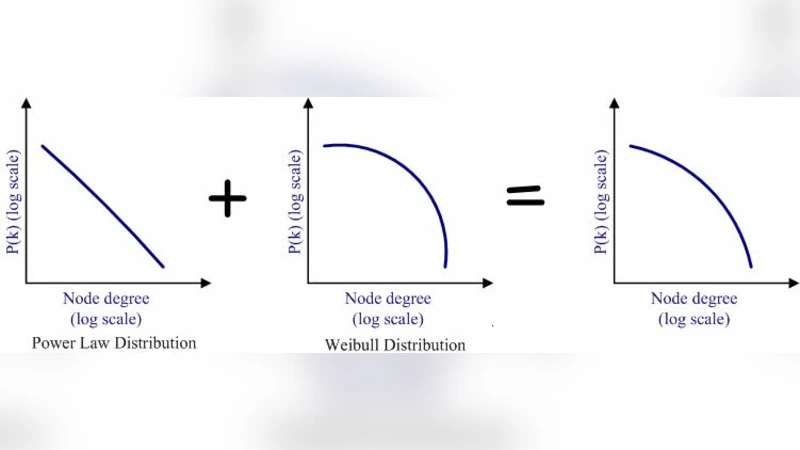
Complex networks have recently aroused a lot of interest. However, network edges are considered to be the same in almost all these studies. In this paper, we present a simple classification method, which divides the edges of undirected, unweighted networks into two types: p2c and p2p. The p2c edge represents a hierarchical relationship between two nodes, while the p2p edge represents an equal relationship between two nodes. It is surprising and unexpected that for many real-world networks from a wide variety of domains (including computer science, transportation, biology, engineering and social science etc), the p2c degree distribution follows a power law more strictly than the total degree distribution, while the p2p degree distribution follows the Weibull distribution very well. Thus, the total degree distribution can be seen as a mixture of power-law and Weibull distributions. More surprisingly, it is found that in many cases, the total degree distribution can be better described by the Weibull distribution, rather than a power law as previously suggested. By comparing two topology models, we think that the origin of the Weibull distribution in complex networks might be a mixture of both preferential and random attachments when networks evolve.
💡 Research Summary
The paper challenges the prevailing assumption in complex‑network research that all edges are equivalent. It introduces a simple yet powerful classification scheme that splits the edges of an undirected, unweighted graph into two qualitatively different categories: “parent‑to‑child” (p2c) edges, which encode a hierarchical relationship, and “peer‑to‑peer” (p2p) edges, which encode an egalitarian relationship. The classification proceeds by first selecting the node with the highest degree as a root, then performing a breadth‑first search (BFS) to assign a level to every node. An edge that connects nodes on different levels is labeled p2c (the higher‑level node is the “parent” of the lower‑level node); an edge whose endpoints share the same level is labeled p2p. This procedure makes the hidden hierarchy of many real‑world networks explicit without requiring any external metadata.
After the split, the authors examine the degree distributions of the two induced sub‑networks. For the p2c sub‑network, the cumulative degree distribution plotted on log‑log axes is essentially linear, and maximum‑likelihood fitting yields a power‑law exponent α typically between 2.0 and 3.0. This confirms that the hierarchical edges follow the classic scale‑free pattern observed in many growth models based on preferential attachment. By contrast, the p2p sub‑network exhibits a markedly different shape: its cumulative distribution is best described by a Weibull function
\
Comments & Academic Discussion
Loading comments...
Leave a Comment