Universal inequalities for the eigenvalues of Schrodinger operators on submanifolds
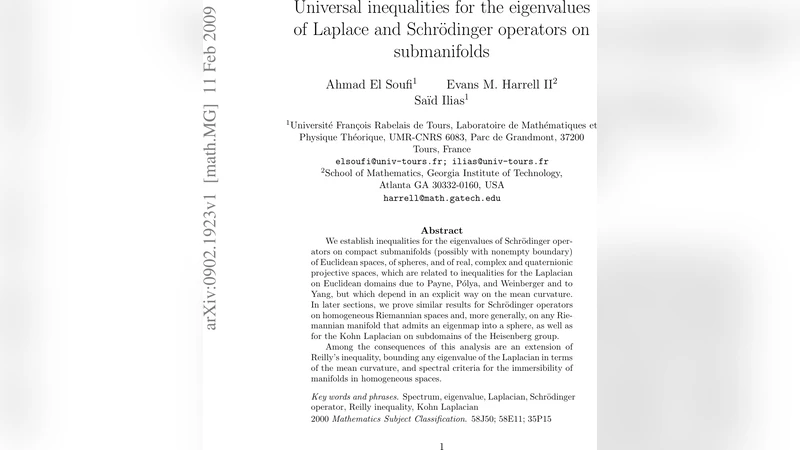
We establish inequalities for the eigenvalues of Schr"odinger operators on compact submanifolds (possibly with nonempty boundary) of Euclidean spaces, of spheres, and of real, complex and quaternionic projective spaces, which are related to inequalities for the Laplacian on Euclidean domains due to Payne, P'olya, and Weinberger and to Yang, but which depend in an explicit way on the mean curvature. In later sections, we prove similar results for Schr"odinger operators on homogeneous Riemannian spaces and, more generally, on any Riemannian manifold that admits an eigenmap into a sphere, as well as for the Kohn Laplacian on subdomains of the Heisenberg group. Among the consequences of this analysis are an extension of Reilly’s inequality, bounding any eigenvalue of the Laplacian in terms of the mean curvature, and spectral criteria for the immersibility of manifolds in homogeneous spaces.
💡 Research Summary
The paper develops a series of universal eigenvalue inequalities for Schrödinger operators of the form H = −Δ + V on compact submanifolds, possibly with boundary, embedded in Euclidean spaces, spheres, and the real, complex, and quaternionic projective spaces. Starting from the classical Payne‑Pólya‑Weinberger (PPW) and Yang inequalities for the Laplacian on Euclidean domains, the authors incorporate the mean curvature vector H of the immersion and an arbitrary potential V, thereby obtaining bounds that explicitly depend on geometric data.
The central technical tool is a commutator method applied to the operator H and to coordinate functions (or, more generally, to components of an eigenmap φ : M → S^m). For an immersion of codimension d, they prove
\
Comments & Academic Discussion
Loading comments...
Leave a Comment