Units of relativistic time scales and associated quantities
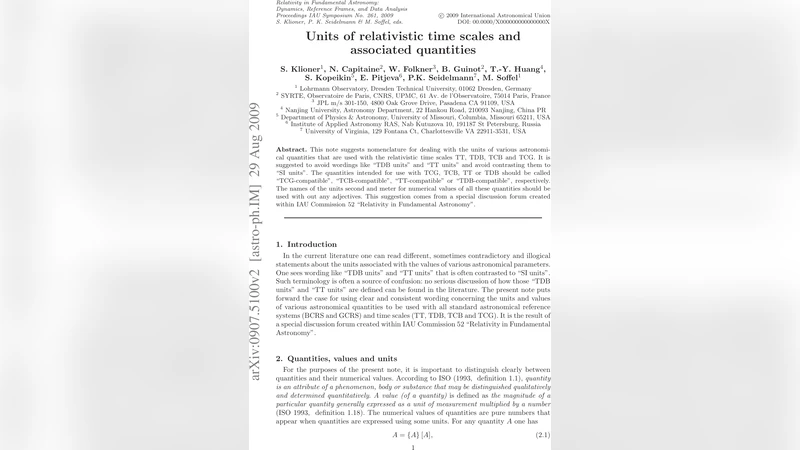
This note suggests nomenclature for dealing with the units of various astronomical quantities that are used with the relativistic time scales TT, TDB, TCB and TCG. It is suggested to avoid wordings like “TDB units” and “TT units” and avoid contrasting them to “SI units”. The quantities intended for use with TCG, TCB, TT or TDB should be called “TCG-compatible”, “TCB-compatible”, “TT-compatible” or “TDB-compatible”, respectively. The names of the units second and meter for numerical values of all these quantities should be used with out any adjectives. This suggestion comes from a special discussion forum created within IAU Commission 52 “Relativity in Fundamental Astronomy”.
💡 Research Summary
The paper addresses a long‑standing source of confusion in high‑precision astronomy: the way units are expressed for quantities that are tied to the four relativistic time scales currently in use—Terrestrial Time (TT), Barycentric Dynamical Time (TDB), Barycentric Coordinate Time (TCB), and Geocentric Coordinate Time (TCG). Historically, many authors and data providers have prefixed the unit name with the time‑scale label, speaking of “TT units”, “TDB units”, and so on. While this practice was intended to remind the reader that the numerical value has been reduced or transformed in a specific relativistic framework, it inadvertently creates the impression that a new, non‑SI unit system exists. In reality, the underlying physical dimensions remain those of the International System of Units (SI): seconds for time, meters for length, kilograms for mass, etc. The only difference lies in the coordinate transformation that maps a proper time measured by a clock onto the coordinate time of a chosen reference frame.
To resolve this inconsistency, the authors propose a simple, uniform nomenclature that separates the compatibility of a quantity with a given time scale from the unit itself. The recommended terminology is:
- “TT‑compatible” for quantities reduced to Terrestrial Time,
- “TDB‑compatible” for quantities reduced to Barycentric Dynamical Time,
- “TCB‑compatible” for quantities expressed in Barycentric Coordinate Time,
- “TCG‑compatible” for quantities expressed in Geocentric Coordinate Time.
Crucially, the actual unit symbols remain unchanged: the second (s) for any time interval, the meter (m) for any length, the kilogram (kg) for mass, etc. No adjectives such as “TT‑second” or “TDB‑meter” are to be used. Instead, the compatibility label is attached to the quantity (e.g., “TT‑compatible epoch”, “TCB‑compatible distance”), while the unit stays pure SI.
The paper justifies this approach on several grounds. First, it aligns with the SI definition that a unit is a fixed quantity of a given dimension, independent of the coordinate system used to describe the measurement. Second, it eliminates the need for a parallel “non‑SI” vocabulary that can cause misinterpretation when data are exchanged across institutions or software packages. Third, the compatibility label can be stored as metadata (e.g., in FITS headers, XML schemas, or database fields), allowing automated pipelines to apply the appropriate relativistic transformation (ΔTT, ΔTDB, etc.) without manual intervention.
The authors illustrate the proposal with concrete examples. Stellar positions and proper motions are routinely published in the ICRS (International Celestial Reference System) and are naturally TCB‑compatible; the numerical values are expressed in meters (or astronomical units) and meters per second, but the metadata would indicate “TCB‑compatible”. Laser ranging measurements to the Moon or to artificial satellites are often reduced to TT; the range values remain in meters, yet the accompanying header would read “TT‑compatible”. In all cases, the conversion between time scales is handled by well‑defined linear or relativistic terms (e.g., the TT–TCB offset and rate), not by redefining the unit itself.
The paper also discusses implementation implications. Software libraries such as SOFA (Standards of Fundamental Astronomy) and ERFA already provide functions to transform between TT, TDB, TCB, and TCG. By adopting the compatibility tags, developers can design APIs that accept a value together with its compatibility label, automatically invoke the correct transformation routine, and return a result in the desired target time scale. Data archives can enforce consistency by requiring the compatibility attribute for any stored epoch, distance, or velocity, thereby preventing accidental mixing of, for example, TDB‑compatible ephemerides with TT‑compatible observations.
Finally, the authors note that the proposal emerged from a dedicated discussion forum within IAU Commission 52 “Relativity in Fundamental Astronomy”. They recommend that the IAU formalize the terminology in future resolutions, encouraging journals, data centers, and software projects to adopt the “‑compatible” convention. By doing so, the astronomical community will achieve a clearer, SI‑consistent language for relativistic time scales, reduce the risk of unit‑related errors in high‑precision work, and facilitate seamless international collaboration.
Comments & Academic Discussion
Loading comments...
Leave a Comment