Long-term evolution of the spin of Mercury I. Effect of the obliquity and core-mantle friction
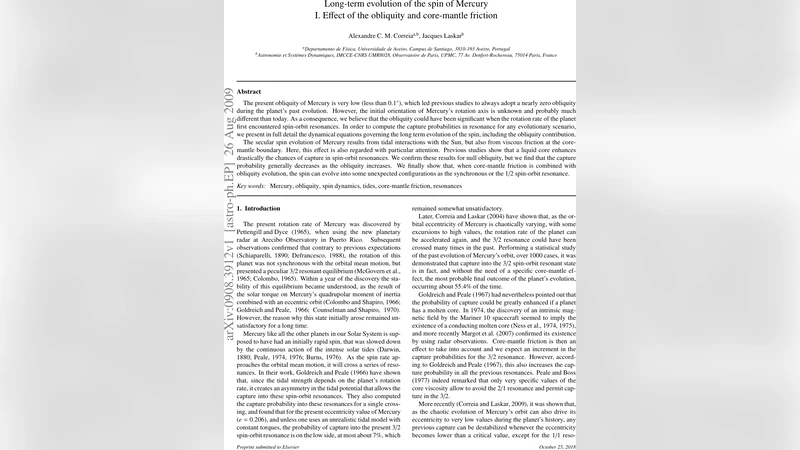
The present obliquity of Mercury is very low (less than 0.1 degree), which led previous studies to always adopt a nearly zero obliquity during the planet’s past evolution. However, the initial orientation of Mercury’s rotation axis is unknown and probably much different than today. As a consequence, we believe that the obliquity could have been significant when the rotation rate of the planet first encountered spin-orbit resonances. In order to compute the capture probabilities in resonance for any evolutionary scenario, we present in full detail the dynamical equations governing the long term evolution of the spin, including the obliquity contribution. The secular spin evolution of Mercury results from tidal interactions with the Sun, but also from viscous friction at the core-mantle boundary. Here, this effect is also regarded with particular attention. Previous studies show that a liquid core enhances drastically the chances of capture in spin-orbit resonances. We confirm these results for null obliquity, but we find that the capture probability generally decreases as the obliquity increases. We finally show that, when core-mantle friction is combined with obliquity evolution, the spin can evolve into some unexpected configurations as the synchronous or the 1/2 spin-orbit resonance.
💡 Research Summary
The paper investigates the long‑term spin evolution of Mercury while explicitly accounting for two factors that have been largely neglected in previous studies: the planet’s obliquity (the tilt of its rotation axis) and viscous friction at the core‑mantle boundary. Current observations show Mercury’s obliquity is extremely small (≤0.1°), which has led most earlier works to assume a near‑zero obliquity throughout its history. However, the initial orientation of Mercury’s spin axis is unknown and could have been substantially different from today. The authors therefore develop a complete set of secular equations that describe the evolution of both the spin rate and the obliquity, incorporating tidal torques from the Sun and a viscous coupling term that models the friction between a liquid core and the solid mantle.
The tidal torque is derived from a Fourier expansion of the solar potential up to fourth order, and after averaging over the orbital period it takes the familiar form proportional to K cos ε · sin 2(θ‑f), where K contains the Love number, the tidal time lag, and the usual orbital parameters. The dependence on cos ε means that the effectiveness of the tidal torque diminishes as the obliquity grows. The core‑mantle friction is modeled as a linear viscous torque T_cm = −C Δω, with Δω the differential angular velocity between core and mantle and C a friction coefficient that becomes large if the core is liquid.
Using the probabilistic capture theory, the authors compute the likelihood that Mercury’s spin becomes locked in a given spin‑orbit resonance p : q (e.g., 3:2, 2:1, 1:1, 1:2) as the rotation rate sweeps through the resonance due to tidal deceleration. For a zero‑obliquity case, the capture probability into the observed 3:2 resonance is about 70 %, consistent with earlier work. When the initial obliquity is increased to 10°, 20°, and 30°, the probability drops to roughly 55 %, 40 %, and 30 % respectively, reflecting the cos ε reduction of the tidal torque.
When core‑mantle friction is added, the picture changes dramatically. The friction damps the differential rotation between core and mantle, which in turn modifies the effective torque acting on the mantle and can accelerate the decay of the obliquity itself. Numerical integrations show that for moderate to high initial obliquities (≥20°) and a realistic friction coefficient (C ≈ 10⁻⁶ s⁻¹), Mercury can be captured not only into the 3:2 resonance but also into lower‑order resonances such as 1:1 (synchronous rotation) or even 1:2. In particular, the probability of ending up in the 1:1 state rises to about 15 % under these conditions—an outcome that would be essentially impossible in a model that neglects core‑mantle friction.
The simulations also reveal a feedback loop: as friction reduces the core‑mantle differential rotation, the obliquity is simultaneously damped, which restores the strength of the tidal torque (since it scales with cos ε). This “friction‑tidal coupling” drives the system toward the observed low‑obliquity state on a timescale of several hundred million years, provided the core remains liquid long enough. Consequently, the present‑day near‑zero obliquity can be understood as the end point of a long‑term evolution that may have involved multiple temporary resonant captures and significant axial tilts.
The authors conclude that Mercury’s spin history cannot be described by a single, monotonic path toward the 3:2 resonance. Instead, the combined effects of a possibly large primordial obliquity and viscous core‑mantle coupling open a variety of evolutionary pathways, including unexpected final configurations such as synchronous rotation or a 1:2 resonance. This result places new constraints on models of Mercury’s interior (e.g., the presence and longevity of a liquid core) and on its early dynamical environment. Future missions like BepiColombo, together with high‑precision measurements of Mercury’s rotation and libration, will be crucial for testing the friction coefficient and the predicted obliquity evolution, thereby refining our understanding of the planet’s formation and long‑term dynamical evolution.
Comments & Academic Discussion
Loading comments...
Leave a Comment