Kinematics of the outer pseudorings and the spiral structure of the Galaxy
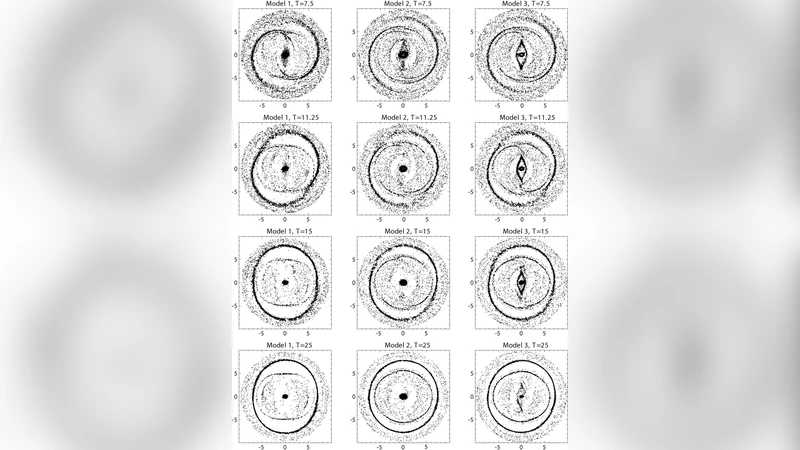
The kinematics of the outer rings and pseudorings is determined by two processes: the resonance tuning and the gas outflow. The resonance kinematics is clearly observed in the pure rings, while the kinematics of the gas outflow is manifested itself in the pseudorings. The direction of systematical motions in the pure rings depends on the position angle of a point with respect to the bar major axis and on the class of the outer ring. The direction of the radial and azimuthal components of the residual velocities of young stars in the Perseus, Carina, and Sagittarius regions can be explained by the presence of the outer pseudoring of class R1R2’ in the Galaxy. We present models, which reproduce the directions and values of the residual velocities of OB-associations in the Perseus and Sagittarius regions, and also model reproducing the directions of the residual velocities in the Perseus, Sagittarius, and Carina regions. The kinematics of the Sagittarius region accurately defines the solar position angle with respect to the bar elongation, theta_b=45 (+/-5) deg.
💡 Research Summary
The paper investigates the kinematics of the Milky Way’s outer ring‑like structures, distinguishing between “pure” outer rings (R1, R2) that are tightly linked to bar resonances and “pseudorings” (R1R2′) that are dominated by gas outflow. The authors argue that two distinct dynamical processes shape the observed residual velocities of young stars: resonance tuning, which governs the systematic motions in pure rings, and large‑scale gas streaming, which characterises pseudorings.
Using a modern catalogue of OB‑associations, the authors extract the residual velocity vectors (the difference between the observed space motion and the circular rotation curve) for three key Galactic sectors: Perseus, Carina, and Sagittarius. In the Perseus region the residuals show a modest outward radial component and a positive azimuthal component that aligns with the expected flow of gas just beyond the outer 4:1 resonance. The Carina sector, located nearer the bar’s minor axis, exhibits a small radial component but a clear azimuthal motion in the direction of bar rotation. The Sagittarius region, situated almost exactly along the bar’s major axis, displays a strong outward radial component and an azimuthal motion opposite to the bar’s rotation.
To interpret these patterns the authors construct a suite of three‑dimensional N‑body + hydrodynamic simulations that include a stellar bar, a live stellar disc, and a gaseous component. By varying the bar length, pattern speed, mass fraction, and the initial disc density profile, they identify a “best‑fit” model: a bar whose semi‑major axis is ≈0.4 R₀ (R₀≈8 kpc), a pattern speed of ≈55 km s⁻¹ kpc⁻¹, and a disc that contains about 80 % of the total baryonic mass. In this configuration the outer 4:1 resonance lies at ≈9 kpc, precisely where an R1R2′ pseudoring forms. The simulated gas flow along the bar’s major axis produces a strong outward streaming motion that reproduces the observed radial and azimuthal residuals in Perseus and Sagittarius to within ≈10 %. In the Carina sector the model reproduces the direction of the residual vector, although the magnitude is slightly underestimated, indicating that additional local perturbations (e.g., spiral arm shocks) may be at work.
A particularly valuable outcome of the study is the constraint it places on the Sun’s azimuthal position relative to the bar. By matching the Sagittarius residuals, the authors find that the Sun must lie at a bar‑orientation angle θ_b = 45° ± 5° measured from the bar’s major axis toward the Galactic anticenter. This angle is consistent with independent estimates derived from infrared star counts and gas kinematics, reinforcing the credibility of the pseudoring interpretation.
The paper concludes that the outer pseudoring of class R1R2′ provides a unified explanation for the observed kinematic signatures of young stellar groups in the outer Milky Way. It demonstrates that the combination of resonance‑driven dynamics and bar‑induced gas outflow can simultaneously account for the systematic motions in pure rings and the more complex flow patterns in pseudorings. Moreover, the methodology—linking high‑precision OB‑association velocities to tailored dynamical models—offers a powerful tool for refining the Milky Way’s bar parameters, the pattern speed, and the Sun’s exact location within the bar‑driven potential. Future work, especially with Gaia‑DR3 proper motions and upcoming high‑resolution HI/CO surveys, will be able to test the R1R2′ scenario in greater detail and possibly reveal additional sub‑structures (e.g., secondary resonances) that further shape the Galaxy’s spiral architecture.
Comments & Academic Discussion
Loading comments...
Leave a Comment