The structure of the allelic partition of the total population for Galton-Watson processes with neutral mutations
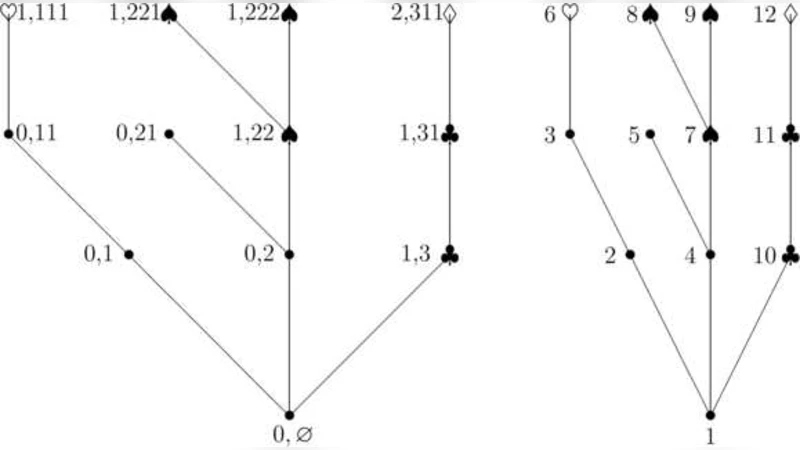
We consider a (sub) critical Galton-Watson process with neutral mutations (infinite alleles model), and decompose the entire population into clusters of individuals carrying the same allele. We specify the law of this allelic partition in terms of the distribution of the number of clone-children and the number of mutant-children of a typical individual. The approach combines an extension of Harris representation of Galton-Watson processes and a version of the ballot theorem. Some limit theorems related to the distribution of the allelic partition are also given.
💡 Research Summary
The paper studies a (sub‑critical) Galton‑Watson branching process in which each individual can produce two types of offspring: clone‑children that inherit the parent’s allele and mutant‑children that carry a brand‑new allele, corresponding to the infinite‑alleles model of neutral mutations. The authors aim to describe the full allelic partition of the population—that is, the random collection of clusters, each cluster consisting of all individuals sharing the same allele.
The first step is to formalise the reproduction law by a pair of non‑negative integer‑valued random variables ((C,M)). Here (C) denotes the number of clone‑children and (M) the number of mutant‑children produced by a typical individual. The joint distribution of ((C,M)) completely characterises the branching dynamics. By conditioning on ((C,M)) the authors obtain a natural extension of the classical Harris representation of Galton‑Watson processes: the total offspring generating function factorises into a “clone generating function’’ (F(s)=\mathbb{E}
Comments & Academic Discussion
Loading comments...
Leave a Comment