Foundations of a Multi-way Spectral Clustering Framework for Hybrid Linear Modeling
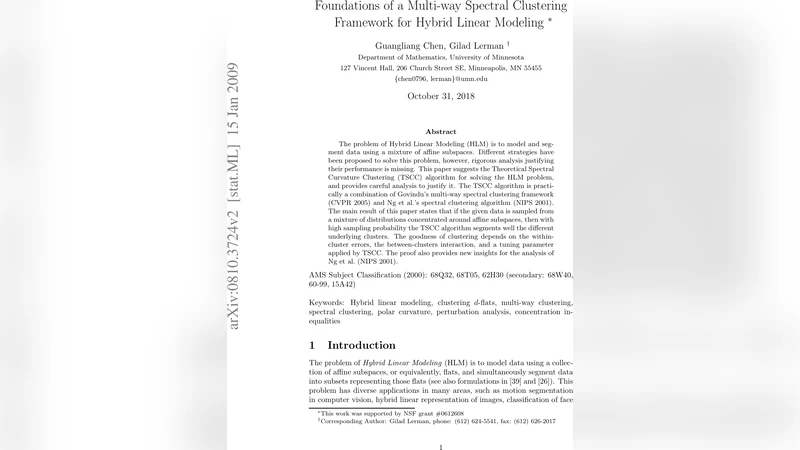
The problem of Hybrid Linear Modeling (HLM) is to model and segment data using a mixture of affine subspaces. Different strategies have been proposed to solve this problem, however, rigorous analysis justifying their performance is missing. This paper suggests the Theoretical Spectral Curvature Clustering (TSCC) algorithm for solving the HLM problem, and provides careful analysis to justify it. The TSCC algorithm is practically a combination of Govindu’s multi-way spectral clustering framework (CVPR 2005) and Ng et al.’s spectral clustering algorithm (NIPS 2001). The main result of this paper states that if the given data is sampled from a mixture of distributions concentrated around affine subspaces, then with high sampling probability the TSCC algorithm segments well the different underlying clusters. The goodness of clustering depends on the within-cluster errors, the between-clusters interaction, and a tuning parameter applied by TSCC. The proof also provides new insights for the analysis of Ng et al. (NIPS 2001).
💡 Research Summary
The paper tackles the Hybrid Linear Modeling (HLM) problem, where a data set is assumed to be generated by a mixture of affine subspaces (linear subspaces possibly shifted by a translation). While many practical algorithms such as K‑subspaces, GPCA, SSC, and LRR have been proposed, none of them come with a rigorous theoretical guarantee of correct segmentation. The authors introduce the Theoretical Spectral Curvature Clustering (TSCC) algorithm and provide a detailed probabilistic analysis that explains why and when TSCC succeeds.
Algorithmic construction
TSCC is essentially a hybrid of Govindu’s multi‑way spectral clustering framework (CVPR 2005) and the classic spectral clustering method of Ng, Jordan, and Weiss (NIPS 2001). It proceeds in four steps:
-
Curvature tensor formation – For every triple (or higher‑order tuple) of points a curvature measure κ is computed. This measure captures how well the three points can be jointly approximated by a low‑dimensional affine subspace. A Gaussian scale parameter σ weights the contribution of triples according to their spatial proximity, so that nearby points dominate the tensor.
-
Tensor‑to‑matrix unfolding and Laplacian construction – The third‑order tensor is unfolded into a symmetric similarity matrix W. Each entry W_{ij} aggregates the curvature values of all triples that contain i and j. A degree matrix D is formed, and a normalized Laplacian L = D^{‑α}(D‑W)D^{‑α} is built, where α∈
Comments & Academic Discussion
Loading comments...
Leave a Comment