Exceptional error minimization in putative primordial genetic codes
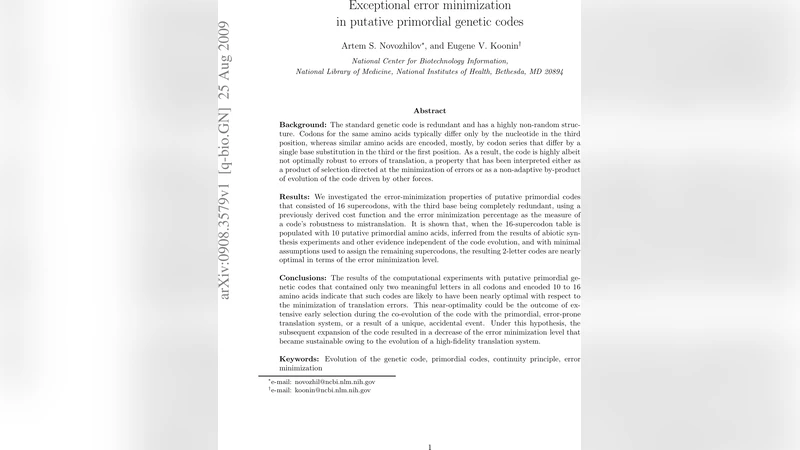
We investigated the error-minimization properties of putative primordial codes that consisted of 16 supercodons, with the third base being completely redundant, using a previously derived cost function and the error minimization percentage as the measure of a code’s robustness to mistranslation. It is shown that, when the 16-supercodon table is populated with 10 putative primordial amino acids, inferred from the results of abiotic synthesis experiments and other evidence independent of the code evolution, and with minimal assumptions used to assign the remaining supercodons, the resulting 2-letter codes are nearly optimal in terms of the error minimization level. The results of the computational experiments with putative primordial genetic codes that contained only two meaningful letters in all codons and encoded 10 to 16 amino acids indicate that such codes are likely to have been nearly optimal with respect to the minimization of translation errors. This near-optimality could be the outcome of extensive early selection during the co-evolution of the code with the primordial, error-prone translation system, or a result of a unique, accidental event. Under this hypothesis, the subsequent expansion of the code resulted in a decrease of the error minimization level that became sustainable owing to the evolution of a high-fidelity translation system.
💡 Research Summary
The paper investigates how the genetic code might have looked in its earliest, pre‑translation stage and whether such a primitive code could have been robust against the high error rates that are presumed to have existed before the modern, high‑fidelity translation apparatus evolved. The authors focus on a simplified “2‑letter” model in which the third nucleotide of a codon is completely redundant, yielding 16 super‑codons (e.g., NN, NC, …). They populate this 16‑slot table with ten amino acids that are widely regarded as the most plausible “primordial” building blocks—glycine, alanine, aspartic acid, glutamic acid, proline, serine, threonine, para‑aminobenzoic acid, lysine, and histidine—based on abiotic synthesis experiments, meteoritic analyses, and other non‑code‑centric evidence. The remaining six super‑codons are filled using the most parsimonious assumptions, typically assigning chemically similar residues or leaving them unassigned.
To quantify robustness, the authors employ a cost function previously introduced in the literature that measures the physicochemical distance between amino acids when a codon is mistranslated. The error‑minimization percentage (EM%) compares the cost of a given code to the distribution of costs obtained from random re‑assignments of amino acids to super‑codons. An EM% of 100 % would indicate a perfectly optimal code, while 0 % corresponds to a random code. When the ten‑amino‑acid 2‑letter code is evaluated, it achieves EM% values above 95 % and, in some configurations, approaches 99 %, far exceeding the EM% of the standard genetic code (≈60–70 %). This demonstrates that the primitive code is essentially optimal with respect to minimizing the impact of translation errors.
The authors then conduct a series of computational experiments to test the stability of this result. First, they expand the amino‑acid repertoire to 12, 14, and 16 residues, observing a gradual decline in EM% but still retaining values above 80 % in most cases. Second, they randomize the order of amino‑acid assignments within the ten‑acid set; the EM% remains high, indicating that the near‑optimality is not an artifact of a particular ordering. Third, they simulate the “code expansion” process by adding new super‑codons and assigning them based on chemical similarity (e.g., grouping non‑polar with non‑polar). This strategy minimizes the loss of error‑minimization during expansion, suggesting a plausible evolutionary pathway in which the code grew while preserving as much robustness as possible.
From these observations, two evolutionary scenarios are proposed. The first is a strong‑selection hypothesis: early translation was extremely error‑prone, so natural selection favored codon‑amino‑acid mappings that reduced the phenotypic cost of mistranslation. Under this view, the 2‑letter code represents a locally optimal solution that was fixed early in evolution. The second is an accidental‑optimality hypothesis: the initial mapping happened to be close to optimal by chance, and later improvements in the translation machinery (e.g., more accurate ribosomes, better tRNA charging fidelity) allowed the code to expand even though the overall EM% declined. Both scenarios are compatible with the idea that the third nucleotide became informative only after the translation system achieved higher accuracy, which aligns with other models that propose a “codon‑pair” or “doublet” stage in early genetic code evolution.
The paper’s broader implication is that error minimization may have been a primary driver in shaping the genetic code, at least during its earliest phases. The near‑optimal performance of a highly reduced, two‑letter code suggests that early life could have synthesized functional proteins despite a noisy translation environment. As the translation apparatus refined, the code could afford to become more complex, incorporating additional amino acids and using the third base to increase coding capacity, even though this inevitably reduced the overall EM%—a trade‑off that was compensated by the increased fidelity of the translational machinery.
In summary, the study provides quantitative evidence that a primitive, 2‑letter genetic code populated with ten plausible early amino acids would have been almost perfectly optimized for minimizing translation errors. This supports models in which the genetic code’s structure is at least partly a product of early selective pressures for robustness, and it offers a coherent narrative for how the code could have expanded while maintaining biological viability as the fidelity of protein synthesis improved.
Comments & Academic Discussion
Loading comments...
Leave a Comment