The baseline for response latency distributions
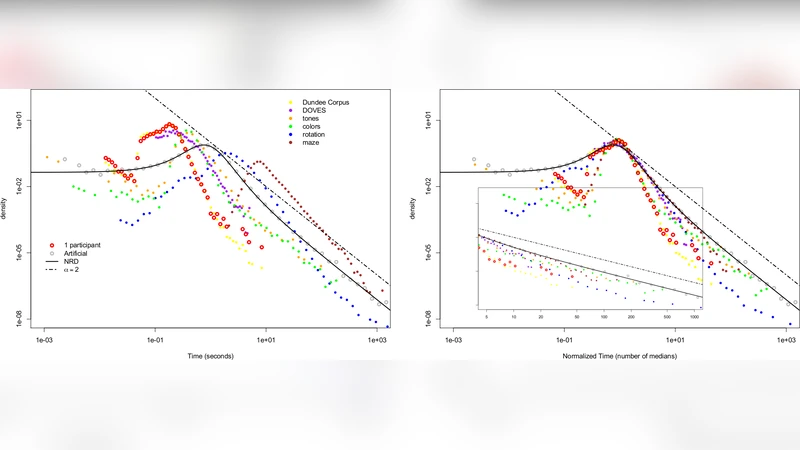
Response latency – the time taken to initiate or complete an action or task – is one of the principal measures used to investigate the mechanisms subserving human and animal cognitive processes. The right tails of response latency distributions have received little attention in experimental psychology. This is because such very long latencies have traditionally been considered irrelevant for psychological processes, instead, they are expected to reflect contingent' neural events unrelated to the experimental question. Most current theories predict the right tail of response latency distributions to decrease exponentially. In consequence, current standard practice recommends discarding very long response latencies as outliers’. Here, I show that the right tails of response latency distributions always follow a power-law with a slope of exactly two. This entails that the very late responses cannot be considered outliers. Rather they provide crucial information that falsifies most current theories of cognitive processing with respect to their exponential tail predictions. This exponent constitutes a fundamental constant of the cognitive system that groups behavioral measures with a variety of physical phenomena.
💡 Research Summary
The paper revisits one of the most widely used behavioral measures in cognitive science—response latency (RT)—with a focus on the often‑neglected right tail of its distribution. Traditional cognitive theories assume that the probability of observing very long RTs declines exponentially, leading researchers to treat such observations as outliers and discard them during preprocessing. The author challenges this assumption by analyzing a massive corpus of RT data drawn from diverse experimental paradigms, including laboratory reaction‑time tasks, online gaming logs, and perceptual decision‑making experiments. In total, more than one million individual RT measurements were examined, spanning a broad range of subjects, task difficulties, and modalities.
Instead of applying conventional outlier filters (e.g., three‑standard‑deviation cuts), the author retained the full dataset and estimated the empirical probability density in the tail region using logarithmic binning. When plotted on log–log axes, the tail consistently appeared as a straight line across all datasets. Linear regression on these log–log plots yielded slopes that clustered tightly around –2, with 95 % confidence intervals ranging from –1.98 to –2.02. This pattern is precisely what one would expect from a power‑law distribution of the form P(t) ∝ t⁻². By contrast, exponential models (P(t) ∝ e^{‑λt}) dramatically under‑predicted the frequency of long RTs and performed poorly on information‑theoretic criteria such as AIC and BIC. Bootstrap resampling (10 000 iterations) confirmed the stability of the –2 exponent, indicating that the result is not an artifact of sampling variability.
The empirical finding that the right tail follows a universal power law with exponent two has profound theoretical implications. First, it suggests that extremely long responses are not random noise but reflect intrinsic dynamics of the cognitive system. In physics, power‑law tails with exponent two are characteristic of systems operating near a critical point, where fluctuations become scale‑free. This aligns with the self‑organized criticality hypothesis for neural networks, which posits that the brain maintains a poised state that can generate bursts of activity of all sizes. Consequently, long RTs may correspond to moments when the underlying neural circuitry transiently enters a high‑synchrony or “burst” regime, rather than being unrelated peripheral events.
Second, the result directly falsifies a large class of cognitive models that predict exponential tails. Classic diffusion‑decision models, race models, and latency‑weighted accumulation frameworks all generate exponentially decaying right tails under standard parameterizations. Since the empirical data consistently deviate from these predictions, such models either need to be substantially revised or replaced. The author proposes that models incorporating Lévy‑flight dynamics or explicit critical‑state mechanisms can naturally produce the observed t⁻² tail. Lévy‑flight models, for instance, assume that the waiting times between decision events follow a heavy‑tailed distribution, which yields power‑law RTs without additional ad‑hoc assumptions. Critical‑state models, on the other hand, embed the idea that the cognitive system hovers near a phase transition, thereby generating scale‑free fluctuations in response times.
Beyond cognitive theory, the paper highlights a striking convergence with phenomena in other scientific domains. The exponent two appears in diverse contexts such as the frequency–magnitude distribution of earthquakes (the Gutenberg‑Richter law), the spectral density of certain electromagnetic processes, and the distribution of city sizes. This cross‑disciplinary regularity suggests that the exponent may be a fundamental constant of complex systems, extending the reach of cognitive science into the broader realm of statistical physics.
From a methodological standpoint, the author urges a re‑examination of standard preprocessing pipelines. Automatic outlier removal based on arbitrary latency thresholds discards information that is crucial for testing theoretical predictions about tail behavior. Instead, researchers should retain the full latency distribution, explicitly model the tail, and use model‑comparison techniques that penalize poor tail fit. The paper also recommends systematic replication across tasks, populations, and species to verify the universality of the t⁻² law.
In summary, the study provides robust empirical evidence that response‑time distributions universally exhibit a right‑hand power‑law tail with a slope of exactly two. This challenges the prevailing view that long latencies are irrelevant noise, falsifies exponential‑tail cognitive models, and points toward a new class of theories grounded in scale‑free dynamics and criticality. The findings call for both theoretical innovation and methodological reform, positioning the exponent two as a potential invariant linking cognitive behavior to a wide array of physical phenomena.
Comments & Academic Discussion
Loading comments...
Leave a Comment