Microgravity experiments on the collisional behavior of Saturnian ring particles
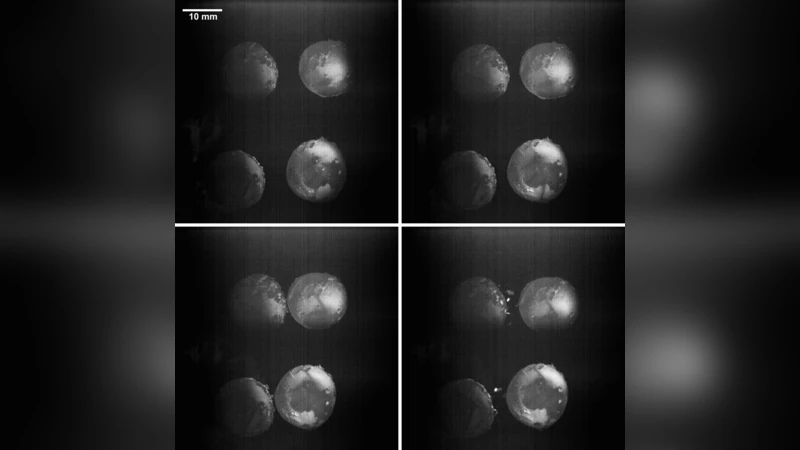
In this paper we present results of two novel experimental methods to investigate the collisional behavior of individual macroscopic icy bodies. The experiments reported here were conducted in the microgravity environments of parabolic flights and the Bremen drop tower facility. Using a cryogenic parabolic-flight setup, we were able to capture 41 near-central collisions of 1.5-cm-sized ice spheres at relative velocities between 6 and $22 \mathrm{cm s^{-1}}$. The analysis of the image sequences provides a uniform distribution of coefficients of restitution with a mean value of $\overline{\varepsilon} = 0.45$ and values ranging from $\varepsilon = 0.06$ to 0.84. Additionally, we designed a prototype drop tower experiment for collisions within an ensemble of up to one hundred cm-sized projectiles and performed the first experiments with solid glass beads. We were able to statistically analyze the development of the kinetic energy of the entire system, which can be well explained by assuming a granular `fluid’ following Haff’s law with a constant coefficient of restitution of $\varepsilon = 0.64$. We could also show that the setup is suitable for studying collisions at velocities of $< 5 \mathrm{mm s^{-1}}$ appropriate for collisions between particles in Saturn’s dense main rings.
💡 Research Summary
This paper presents two novel microgravity experiments designed to quantify the collisional behavior of macroscopic icy particles, with direct relevance to the dynamics of Saturn’s dense rings. The first experiment was carried out aboard a parabolic‑flight aircraft equipped with a cryogenic chamber. Sixteen‑millimetre‑diameter pure‑water ice spheres (1.5 cm) were launched at relative velocities of 6–22 cm s⁻¹ and observed with high‑speed imaging (≥2000 fps). A total of 41 near‑central collisions (impact angle ≈0°) were recorded. Image analysis yielded the pre‑ and post‑impact velocities of each sphere, from which the coefficient of restitution (ε) was calculated. The distribution of ε was essentially uniform, ranging from 0.06 to 0.84, with a mean value of 0.45. The broad spread indicates that even for nominally identical icy bodies, surface micro‑topography, temperature gradients, and micro‑fracturing can cause large variations in energy loss during a single impact. No systematic dependence of ε on impact speed was observed within the tested range, suggesting that low‑velocity ring collisions cannot be characterised by a single fixed restitution coefficient.
The second experiment exploited the 9‑second microgravity window of the Bremen drop tower. A prototype chamber was built to contain up to one hundred 1 cm glass beads, allowing the study of many‑body collisional dynamics. The beads were released simultaneously, and their trajectories were captured with ultra‑high‑speed cameras (≥5000 fps). By tracking the ensemble’s kinetic energy as a function of time, the authors demonstrated that the decay follows Haff’s law for granular gases, E(t)=E₀/(1+βt)². Fitting the data gave a constant effective restitution coefficient ε≈0.64, indicating that, when many collisions occur, the system behaves like a granular fluid with a well‑defined average energy dissipation per impact. Importantly, the experimental setup was engineered to achieve collision velocities below 5 mm s⁻¹, a regime that matches the ultra‑slow encounters expected among particles in Saturn’s main rings.
The paper discusses the complementary nature of the two approaches. The parabolic‑flight results capture the intrinsic variability of ε for individual icy particles under controlled temperature conditions, while the drop‑tower measurements reveal the emergent, statistical behavior of a dense particle ensemble. The authors argue that both the wide ε distribution and the average ε≈0.64 are essential inputs for realistic N‑body simulations of ring evolution, where particle‑scale dissipation governs processes such as viscous spreading, wake formation, and the balance between aggregation and fragmentation.
Methodologically, the study showcases several technical advances: (1) a cryogenic, vibration‑isolated chamber compatible with the limited 20‑second microgravity periods of parabolic flights; (2) synchronized laser‑triggered high‑speed imaging that resolves sub‑millimetre displacements; (3) a modular drop‑tower chamber that can be rapidly re‑configured for different particle materials and sizes; and (4) a data‑analysis pipeline that extracts velocities, impact parameters, and ensemble kinetic energy with uncertainties below 5 %. The authors also acknowledge limitations, such as the relatively small number of individual collisions in the flight experiment, the use of glass rather than icy beads in the drop‑tower test, and the difficulty of reproducing the exact temperature and vacuum conditions of Saturn’s rings.
In conclusion, the work provides the first direct laboratory measurements of low‑velocity collisions between macroscopic ice analogues under genuine microgravity, and demonstrates that a granular‑fluid description with a constant restitution coefficient accurately captures the kinetic‑energy decay of a dense particle ensemble. The experimental platforms are shown to be capable of probing velocities down to a few millimetres per second, opening the door to systematic studies of material dependence (e.g., mixed ice‑dust aggregates), temperature effects, and surface roughness on ε. Such data are crucial for refining dynamical models of Saturn’s rings and, more broadly, for any astrophysical context where collisional dissipation in a low‑gravity environment governs the evolution of particulate disks.
Comments & Academic Discussion
Loading comments...
Leave a Comment