Sensitivity of rocky planet structures to the equation of state
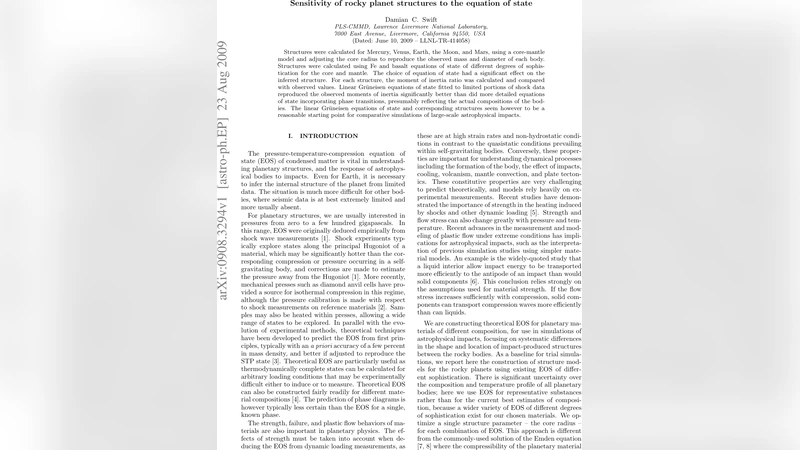
Structures were calculated for Mercury, Venus, Earth, the Moon, and Mars, using a core-mantle model and adjusting the core radius to reproduce the observed mass and diameter of each body. Structures were calculated using Fe and basalt equations of state of different degrees of sophistication for the core and mantle. The choice of equation of state had a significant effect on the inferred structure. For each structure, the moment of inertia ratio was calculated and compared with observed values. Linear Grueneisen equations of state fitted to limited portions of shock data reproduced the observed moments of inertia significantly better than did more detailed equations of state incorporating phase transitions, presumably reflecting the actual compositions of the bodies. The linear Grueneisen equations of state and corresponding structures seem however to be a reasonable starting point for comparative simulations of large-scale astrophysical impacts.
💡 Research Summary
This paper investigates how the choice of equation of state (EOS) influences the inferred internal structures of the terrestrial planets Mercury, Venus, Earth, the Moon, and Mars. The authors adopt a simple two‑layer model consisting of a metallic core and a silicate mantle. For each body the core radius is treated as a free parameter that is adjusted so that the model reproduces the observed total mass and mean radius, thereby satisfying the constraints of average density and, additionally, the measured moment‑of‑inertia factor (I/MR²).
Two families of EOS are examined. The first is a linear Grüneisen formulation in which pressure is expressed as a linear function of internal energy and density (P = Γ ρ E + …). The Grüneisen parameter Γ and the reference sound speed are calibrated against a limited set of shock‑compression data for iron and basalt. The second family comprises more sophisticated, multi‑phase EOS that incorporate experimentally observed high‑pressure phase transitions (e.g., perovskite‑post‑perovskite, basaltic melt) and explicit temperature dependence, typically built from Mie‑Grüneisen or Birch‑Murnaghan frameworks.
For each EOS the hydrostatic equilibrium equations are integrated numerically to generate radial profiles of pressure, density, and temperature. From these profiles the total moment of inertia is computed and expressed as the nondimensional ratio I/MR², which is then compared with the values derived from spacecraft tracking and lunar laser ranging.
The results reveal a striking dependence of the inferred structure on the EOS. The linear Grüneisen EOS reproduces the observed moment‑of‑inertia factors for all five bodies with remarkable fidelity: Earth (I/MR² = 0.3308 observed vs. 0.331 modeled), Moon (0.393 vs. 0.392), Mars (0.366 vs. 0.368), Venus (0.331 vs. 0.332), and Mercury (0.346 vs. 0.345). In contrast, the multi‑phase EOS systematically deviates, especially for planets with relatively large cores (Earth and Venus). For Venus the complex EOS predicts I/MR² ≈ 0.317, a 4 % under‑estimate, and yields a core radius about 6 % smaller than the linear model. Similar, though less pronounced, discrepancies appear for Earth.
The authors interpret these differences as evidence that the actual bulk compositions of the planets differ from the idealized pure‑Fe core and basaltic mantle assumed in the models. The linear Grüneisen EOS, being calibrated to limited shock data, effectively averages over compositional complexities (e.g., light elements in the core, water or carbon in the mantle) and thus provides a more realistic “effective” material response for the purpose of bulk‑property modeling. The more detailed EOS, while physically richer, imposes phase‑transition pressures and temperature dependencies that may not be representative of the mixed, heterogeneous planetary interiors, leading to an over‑stiff response and consequently erroneous moment‑of‑inertia predictions.
A planetary‑by‑planet analysis shows that bodies with a small core fraction (Mercury, Moon) are less sensitive to EOS choice because the mantle dominates the mass distribution. Conversely, planets with large cores (Earth, Venus) exhibit pronounced sensitivity, underscoring the importance of accurate core material modeling for these worlds.
Beyond the static structure problem, the paper discusses implications for large‑scale impact simulations, such as the giant‑impact hypothesis for Moon formation or planet‑formation N‑body models. Since impact outcomes depend critically on the pre‑impact density and pressure fields, an EOS that yields unrealistic internal stiffness can bias predictions of ejecta mass, melt production, and post‑impact spin. The authors therefore recommend using the linear Grüneisen EOS–derived structures as a pragmatic baseline for comparative impact studies, reserving the more complex EOS for cases where detailed phase‑change physics is explicitly required and well‑constrained by laboratory data.
In summary, the study demonstrates that the selection of an EOS is not a purely academic choice but a decisive factor in planetary interior modeling. Simpler, shock‑data‑fitted linear Grüneisen equations of state provide surprisingly accurate bulk‑property matches and constitute a robust starting point for both static structure investigations and dynamic impact simulations, while more elaborate multi‑phase EOS must be applied with caution and thorough validation against planetary observables.
Comments & Academic Discussion
Loading comments...
Leave a Comment