Rate Constrained Random Access over a Fading Channel
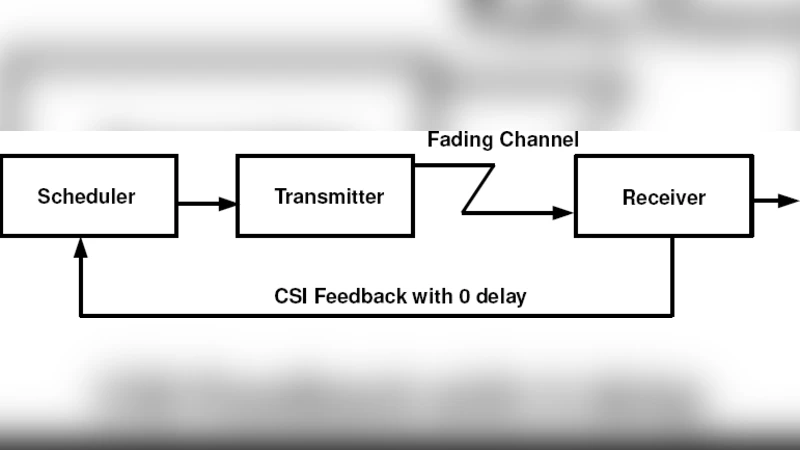
In this paper, we consider uplink transmissions involving multiple users communicating with a base station over a fading channel. We assume that the base station does not coordinate the transmissions of the users and hence the users employ random access communication. The situation is modeled as a non-cooperative repeated game with incomplete information. Each user attempts to minimize its long term power consumption subject to a minimum rate requirement. We propose a two timescale stochastic gradient algorithm (TTSGA) for tuning the users’ transmission probabilities. The algorithm includes a ‘waterfilling threshold update mechanism’ that ensures that the rate constraints are satisfied. We prove that under the algorithm, the users’ transmission probabilities converge to a Nash equilibrium. Moreover, we also prove that the rate constraints are satisfied; this is also demonstrated using simulation studies.
💡 Research Summary
The paper addresses the problem of uplink random access in a multi‑user wireless system where a base station does not coordinate the transmissions of the users. Each user experiences an independent fading channel and must satisfy a minimum long‑term data‑rate requirement while minimizing its average transmit power. Because users act independently and have only local information (their own channel state and ACK/NACK feedback), the interaction is modeled as a non‑cooperative repeated game with incomplete information.
The authors formulate each user’s optimization problem as minimizing the long‑term expected power
\
Comments & Academic Discussion
Loading comments...
Leave a Comment