Asymptotically Optimal Assignments In Ordinal Evaluations of Proposals
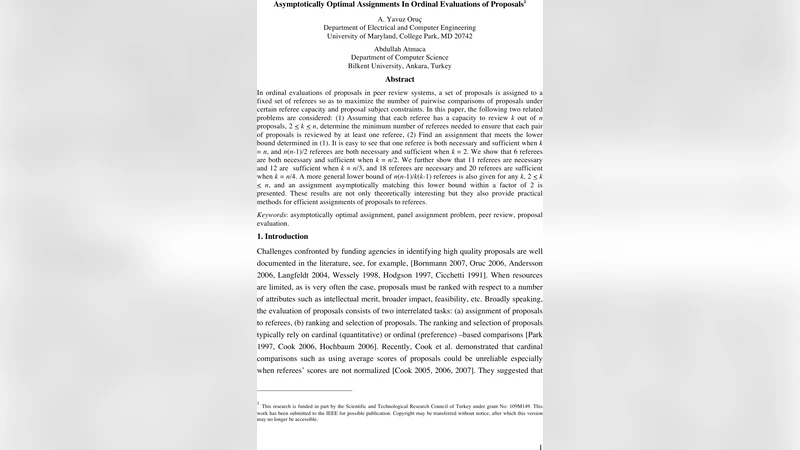
In ordinal evaluations of proposals in peer review systems, a set of proposals is assigned to a fixed set of referees so as to maximize the number of pairwise comparisons of proposals under certain referee capacity and proposal subject constraints. In this paper, the following two related problems are considered: (1) Assuming that each referee has a capacity to review k out of n proposals, 2 < k < n, determine the minimum number of referees needed to ensure that each pair of proposals is reviewed by at least one referee, (2) Find an assignment that meets the lower bound determined in (1). It is easy to see that one referee is both necessary and sufficient when k = n, and n(n-1)/2 referees are both necessary and sufficient when k = 2. We show that 6 referees are both necessary and sufficient when k = n/2. We further show that 11 referees are necessary and 12 are sufficient when k = n/3, and 18 referees are necessary and 20 referees are sufficient when k = n/4. A more general lower bound of n(n-1)/k(k-1) referees is also given for any k, 2 < k < n, and an assignment asymptotically matching this lower bound within a factor of 2 is presented. These results are not only theoretically interesting but they also provide practical methods for efficient assignments of proposals to referees.
💡 Research Summary
The paper addresses a fundamental resource‑allocation problem that arises in peer‑review systems where proposals must be compared pairwise in order to produce a ranking. Given a set of n proposals and a fixed pool of referees, each referee can review at most k proposals (2 < k < n). The objective is to assign proposals to referees so that every unordered pair of proposals appears together in at least one referee’s review list, while using as few referees as possible. This formulation captures the trade‑off between reviewer workload (capacity k) and the completeness of the comparison graph (all n choose 2 edges must be covered).
The authors first derive a universal combinatorial lower bound. A referee who receives k proposals can generate at most k(k‑1)/2 distinct pairwise comparisons. Since the total number of required comparisons is n(n‑1)/2, any feasible assignment must involve at least
r ≥ ⌈ n(n‑1) /
Comments & Academic Discussion
Loading comments...
Leave a Comment