Some bounds on the capacity of communicating the sum of sources
We consider directed acyclic networks with multiple sources and multiple terminals where each source generates one i.i.d. random process over an abelian group and all the terminals want to recover the sum of these random processes. The different sour…
Authors: Brijesh Kumar Rai, Bikash Kumar Dey, Sagar Shenvi
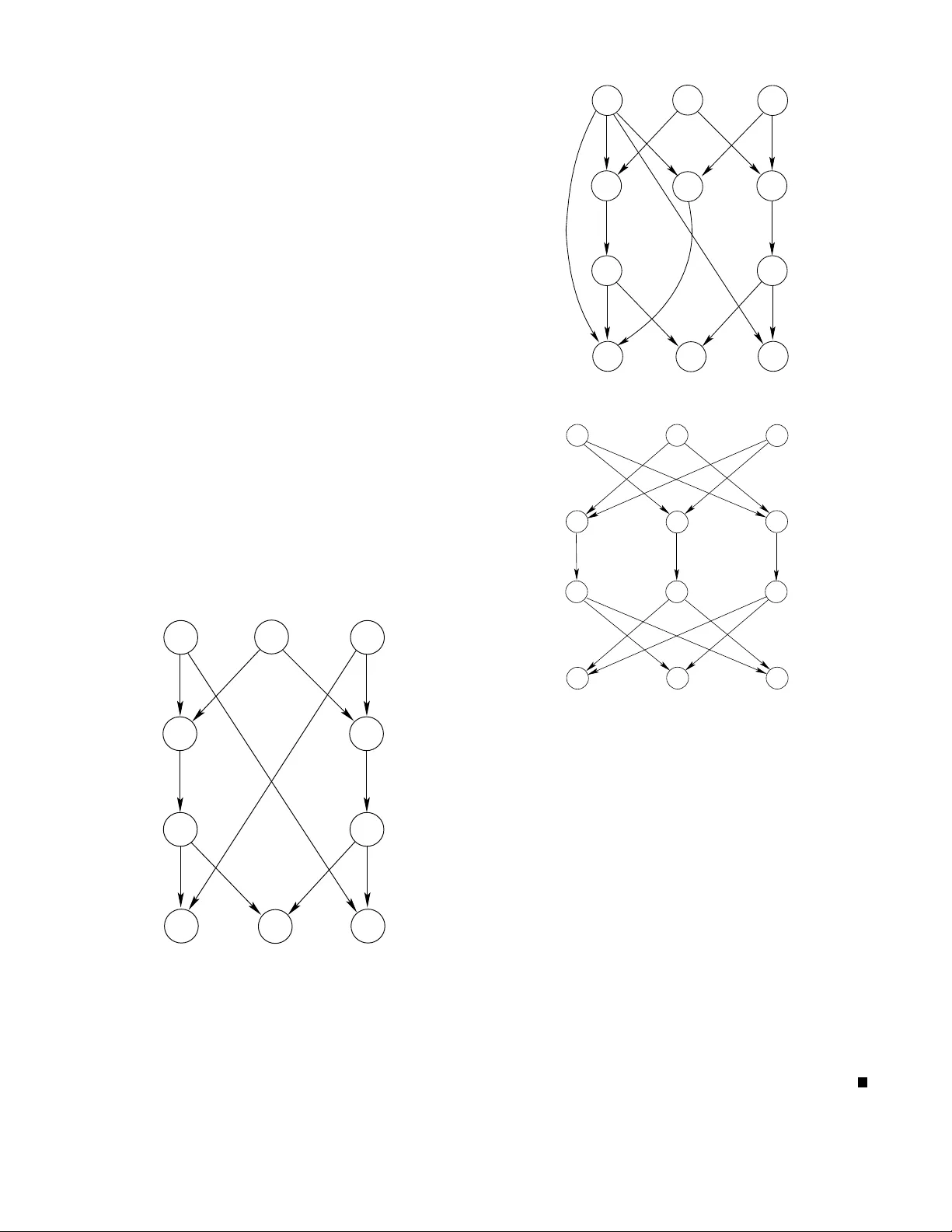
Some bound s on the capacity of communicating the sum of sources Brijesh Kumar Rai, Bikash K umar Dey and Sagar Shen vi Departmen t of Electrical Engineering Indian Institute of T echnolo gy Bombay Mumbai, India, 40 0 076 { bkrai, bikash,sagar s } @ee.iitb .ac.in Abstract — W e consider directed acyclic networks with multi- ple sourc es and multiple terminals where eac h sour ce generates one i.i.d. random process ov er an abelian gro up and all the terminals want to r ecover the sum of these random processes. The different source processes ar e assumed to be independent. The solvability of such networks has been considered in some prev ious works. In this paper we inv esti gate on the capacity of such n etworks, referre d as sum-networks , and present some bounds in terms of min-cut, and the numbers of sources and terminals. I . I N T RO D U C T I O N The seminal w ork by Ahlswede et al. [1] started a ne w regime of comm unication in a network where inter mediate nodes are allo wed to c ombine incoming information to construct o utgoing symb ols/packets. This has b een popu larly known as network coding. It was sh own th at the capacity of a multicast network un der network c oding is the min imum of the min- cuts o f the in dividual termina ls fro m the sourc e. The mu lticast capacity un der routing may b e strictly less than th at with co ding. The area has subsequen tly seen rapid developments. Lin ear coding was pr oved to be sufficient to ach iev e capacity of a m ulticast ne twork in [ 2]. Koetter and M ´ edard [3] proposed a dif ferent framew ork of rand om and determ inistic linea r network codin g, and Jag gi et. al [4] pr oposed a poly nomial time algo rithm for de signing a linear n etwork cod e for a multicast n etwork. Th e capacity of networks with routin g and network codin g was in vestigated in [5], [6], [7]. In this paper , we consider a directed ac yclic n etwork with multiple sources and terminals where the sources generate one rando m process each and the termin als r equire the sum of those pro cesses. W e call such a network as a sum-n etwork . The alphabet of the sourc e processes is assumed to be a finite abelian gr oup G , and the sum is defined as the oper ation in G . W e allo w frac tional vector network cod ing where the number k of sums communic ated to the terminals may be different fr om the vector d imension l . The ca pacity is then defined natur ally as the suppremu m of all rates k /l wh ich are achiev able. Wh en the alphabet is a field or more generally a module ov er a commu tativ e r ing with iden tity , the capacity achieved by using only linear cod es over tha t rin g is referred as the linear cod ing ca pacity . The pr oblem of distributed fun ction comp utation h as b een considered previously in the li terature in different fl av o rs (see [8], [9], [10], [ 11], [12], [ 13] for e xample). In th e context of network coding, and along the same line a s our present work, commun icating the sum of the sour ces has been co nsidered in several past works. Ramamoor thy ([14]) showed that if the number of sources or the n umber of terminals is no t more than two, then the sum of th e sources can be co mmunic ated if and only if each source-term inal pa ir is connected. On the other ha nd, ther e are networks ([1 5], [1 6]) with more than two sou rces and terminals whe re the su m can n ot be commun icated at rate on e even though every source-term inal pair is co nnected . In [15], [17], [ 18], the au thors sho wed th e richness of th is pr oblem as a c lass by showing existence of networks which are linearly solvable on ly over finite fields of characteristics belon ging to a giv en finite o r Co- finite set of primes, existence o f network which is solvably equiv alent to any (non-func tion) general network coding, and thus equi valent to any given system of polynomial eq uations [19]. It was also shown th at by using a co de construction originally giv en in [2 0], any fractio nal co ding solution of a sum-network also naturally provides a fraction al cod ing solution o f the same r ate f or the r ev erse network. The case of on e terminal and mor e ge neral fu nctions have been considered in [21], [22]. In this pape r , we con sider the prob lem of comm unicating the sum o f the sou rces over a network to a set of terminals and in vestigate the capacity of such networks. The exact characterizatio n of th e capac ity seems to be diffi cult and we present some bo unds, and find the capacity exactly for some interesting networks with three source s and th ree terminals. The pa per is organ ized as follows. In Section II, we formally introduce the system model a nd some p reliminary definition. The results of the paper , that is, the bounds on the capacity of sum-networks are presented in Section III. W e end with a discu ssion in Sectio n IV. I I . S Y S T E M M O D E L A N D D E FI N I T I O N S W e consider a directed acyclic multigraph G = ( V , E ) , where V is a finite set of nodes and E ⊆ V × V is the set o f edg es in the network. For any edge e = ( i, j ) ∈ E , the n ode j is called the head of the edge and the no de i is called the tail of the ed ge; and are deno ted as head ( e ) and tail ( e ) respecti vely . For each no de v , I n ( v ) = { e ∈ E : head ( e ) = v } is the set of incoming edges at the node v . Similar ly , Ou t ( v ) = { e ∈ E : tail ( e ) = v } is the set of outgoin g edges from the no de v . Each edge in the network is c apable of carrying a symbol from the alphabet in each use. Each edge is used once per unit time and is assumed to b e zero-erro r and zero -delay commun ication chan nel. A n etwork code is an assignm ent of an edg e function to each ed ge and a decodin g func tion to e ach term inal. In a ( k , l ) fractio nal network co de, k symbols generated at each source are blocked and encode d into l -length vectors on the ou tgoing ed ges. All the internal edges also carry l -leng th vectors. Thus for a ( k , l ) fra ctional network code over G , an edge fun ction for an edge e , with tail ( e ) = v , is defined as f e : G k → G l , if v ∈ S (1) and f e : G l | I n ( v ) | → G l , if v / ∈ S. (2) A decod ing functio n fo r a terminal v is defined as g v : G l | I n ( v ) | → G k . (3) The g oal in a sum-n etwork is th at the terminals should be able to recover the sum of the k -len gth vectors gener ated at the sources. A ( k , l ) fractional network code over G is called a k -length or a k - dimension v ector n etwork code over G if k = l and called a scalar network code over G if k = l = 1 . A network code is called a linear n etwork co de when the alph abet is a field, o r more generally a m odule over a co mmutative r ing with iden tity , and all th e edge functio ns and the deco ding fun ctions are linear functions over th e alphabet field or the r ing. No te that ev en if the alp habet is an abelian gro up, o ne can talk ab out a lin ear solution by considerin g the abelian group as a module ov er th e integer ring and then a co de can be linea r over the integer r ing. A network has a solution over G using a ( k, l ) fractional network code over G if the demand of each term inal node is fu lfilled u sing some ( k, l ) fractional network cod e over G . The ratio k/l is the rate o f th e ( k , l ) fractional network code. A rate k /l is said to be achievable if ther e is a ( k, l ) fractional solution for th e network. The suppremum of all achiev able rates is defined to be the ca pacity . The linear network codin g capacity o f a network is the supp remum of all rates th at are ach iev ab le using fractiona l linear network codes. Clearly , the n etwork cod ing ca pacity of a network is greater th an or equal to the linear network coding cap acity . A sum-network is said to be solvable (resp. lin early solvable) if it has a (1 , 1) codin g (re sp. linear coding) solution . I I I . C A PAC I T Y O F S U M - N E T W O R K S First, we men tion the following simple lower bound on the capacity of any sum-network. Theor em 1 : T he capacity of a sum- network is boun ded by the min imum of the min-cu ts of all so urce-term inal pairs. That is, C apaci ty ≤ min i,j ( min-cut ( s i − t j )) . Pr oo f: For any sour ce s i of the network , let u s fix the source p rocesses of the o ther sou rces to the all-zer o (”z ero” being the identity element of the alphab et group) sequen ce. Then the problem red uces to the multicast problem f rom the source s i to all the terminals, and the cap acity of this problem is the minimum of the min-cuts from S i to all th e terminals. The overall cap acity of the sum-network must be less than or equal to each o f these mu lticast capacities f or different i . In [17], [ 18], the re verse of a sum-network was considered where the direction o f the edges a re re versed and the role of sources and ter minals is interch anged. It was shown, u sing a c ode-con struction originally described in a basic f orm in [20] as the dual cod e in the language of codes on graphs, that if a sum-network has a ( k , n ) fr actional linear solution, then from such a network code, one can also construct a ( k , n ) f ractional linear solution of the r ev erse sum-n etwork. This means that the linear coding capacity of the reverse sum-network is the same as the linear codin g cap acity o f th e original sum-network. Our lo wer bou nds on the capacity of sum-networks have varying d egree of tigh tness depe nding on the number of sources and the n umber of terminals o f the network. So we present these bo unds in different subsections d ealing with various numbers o f sou rces and terminals. For the rest of the paper, m an d n will d enote the number of so urces and the num ber of termin als resp ectiv ely . A. Th e case of min { m, n } = 1 If the sum-network has on ly one so urce, then the netw ork is a mu lticast network. T he capacity of a multicast network is k nown to be equal to the minimu m of the min-cu ts of the source-ter minal pairs, and thus the cap acity achieves the min-cut upper bou nd. Moreover , th is capacity is achieved by linear codes if alphab et is a finite field. Now , over a finite field, for the case of n = 1 , let us consider the reverse network of a sum-network obtained by reversing th e direction of th e edges an d intercha nging the role o f the sources and the term inals. Th e reverse network is a multicast ne twork and th us has linear coding capacity equ al to the m inimum of the min-cu ts of the source-termin al pairs. So the linear coding capacity o f the original one-ter minal sum-network is the minimum of the min-cuts of the sou rce-term inal pairs. Since the c oding capacity is also upp er bo unded by the m in- cut, the coding cap acity of a one-term inal sum-network is the minimum of the min-cuts of the sou rce-term inal pairs. So we have Theor em 2 : T he capacity (an d the linear coding capacity) of a one-source or one-terminal sum-network is the m inimum of the min- cuts of all sour ce-termin al pairs. B. Th e case of min { m, n } = 2 It was proved in [14] that for a network with min { m, n } = 2 where every sour ce-terminal pair is con nected, i t is possible to co mmunica te th e sum of the sources to the terminals (at rate 1 ) . Which means that for min { m , n } = 2 , C apacity ≥ 1 if th e minimu m of the min-cu ts of th e sou rce-term inal pairs is at least 1 . So, the m in-cut bound is tight in this c ase if the min-cu t is 1 . Howe ver , if the min-cut is greater than 1 , then it is not known if this upp er bound is achie vable. Howe ver, we can always achieve the half of th e m in-cut upper bound by time-sharing. For example, f or m = 2 , each source can communicate its symb ols in one slot at the rate of min-cu t and then after two time-slots, th e terminals ca n add the symb ols r eceiv ed f rom the two sources. So, we ha ve Theor em 3 : For min { m, n } = 2 , the capacity of a sum - network is bounded as C apaci ty ≥ max { min { 1 , mi n i,j ( min-cut ( s i − t j )) } , 0 . 5 × min i,j ( min-cut ( s i − t j )) } . C. The ca se of m = n = 3 The case of m = n = 3 is intriguin g. On one han d, these are the smallest values of m, n for which there is a network (c alled S 3 in [ 15] and shown in Fig. 1 ) where every source-term inal pair is conn ected, i.e., which h as min- cut ≥ 1, b ut still do es n ot h av e a linear [15] o r non-linear [16] solution o f rate 1 . So, these are the smallest parameters for which the min -cut upper bo und is kn own to be not achiev able. (Th ough it is still not clea r at this po int if th e min-cut up per boun d may still be achiev ab le in the limit as the su ppremu m of achie vable rates.) On the other hand, from elaborate inv estigation of possible networks with these parameters, there seems to be very limited typ es of ne tworks. The S 3 and its extensions (essentially th e network shown in Fig. 2) seem to be the on ly ”no n-solvable” sum-networks fo r m = n = 3 . The network (let us call it X 3 ) shown in Fig. 3 was pr esented in [1 7] an d w as sho wn to be solvable by scalar linear cod e over a ll fields except the binary field F 2 . 3 1 s s 3 s 2 u 2 u 1 v 2 v 1 1 t t t 2 Fig. 1. The network S 3 First, we give a gene ric lower bou nd on th e capacity of any sum -network with min { m, n } = 3 with min-cut ≥ 1 . Theor em 4 : T he linear cod ing cap acity of any sum- network with min { m, n } = 3 with min-cu t ≥ 1 is at least 2 / 3 . 1 3 s 1 s 3 s u u 1 u 2 v v t 1 t t 2 2 3 2 Fig. 2. The network S ′ 3 u u s s s 1 2 3 3 2 u 1 v 1 v 2 v 3 3 t 2 t 1 t Fig. 3. The network X 3 Pr oo f: W itho ut loss of generality , let u s assume that the numb er of terminals is 3 (otherwise consider the r ev erse network). Let us consider tw o sym bols at each source: X i 1 , X i 2 at s i for i = 1 , 2 , . . . , m . Let the two sums be denoted as S um 1 = P m i =1 X i 1 . and S um 2 = P m i =1 X i 2 . If we take two ter minals at a time, the resulting network has a capacity ≥ 1 as discussed in Section III-B using scalar linear network coding as propo sed in [1 4]. Now , the two sums S u m 1 and S um 2 can be communicated to all th e terminals in three time slots. In the first time slot, S um 1 is commu nicated to t 1 and t 2 . In the secon d time slot, S um 2 is comm unicated to t 2 and t 3 . In th e third tim e slot, S um 1 + S um 2 = P m i =1 ( X i 1 + X i 2 ) is communicated to t 1 and t 3 . Ha ving received S um 1 (respectively S um 2 ) an d S um 1 + S um 2 , the terminal t 1 (respectively t 3 ) can recover S um 2 (respectively S um 1 ) as well. So all the termin als recover the two sum s in thr ee time slots, thus achieving a rate 2 / 3 using linear cod ing. It was proved in [ 16] tha t if a sum- network with m = n = 3 has two edg e-disjoint path s between any source-ter minal pairs, then the network is lin early so lvable, that is, rate 1 is achiev able by scalar line ar coding. This gives the fo llowing bound . Pr op osition 5 : T he linear coding capacity of any sum - network with m = n = 3 with min-cut ≥ 2 is at least 1 . Now we show that the network S 3 and its extension S ′ 3 shown in Fig. 2 b oth have capacity exactly 2 / 3 whereas th eir min-cut upp er bound is 1 . So, there is a gap between the capacity and the min- cut up per boun d. Theor em 6 : T he capacity an d linear codin g capacity of S 3 and S ′ 3 is 2 / 3 . Pr oo f: Clearly , the network S ′ 3 is obtained from S 3 by add ing one direct edge from s 1 to t 1 , and sub dividing the edg e ( s 2 , t 1 ) and adding o ne ed ge into it fro m s 1 . So , the capacity and th e lin ear co ding cap acity of the n etwork S ′ 3 is at least that of S 3 . By the previous theor em, the rate 2 / 3 is achievable b y linear network coding in S 3 . No w we will show that the capacity of S ′ 3 is boun ded from above b y 2 / 3 . This will prove that both the n etworks ha ve the same capacity and linear coding capacity and that th ese are both 2 / 3 . Consider any ( k , l ) fractional network co ding solu tion of S ′ 3 . Let X 1 , X 2 , X 3 ∈ G k be th e me ssage blo cks gene rated at the thr ee sou rces. Let the edg es ( u 1 , v 1 ) and ( u 2 , v 2 ) carry the functions f ( X 1 , X 3 ) and g ( X 2 , X 3 ) resp ectiv ely . For any fixed values of X 1 and X 2 , th e set of m essages received by the terminal t 1 should be a one-one function of X 3 since the term inal can recover the sum X 1 + X 2 + X 3 which is a one-on e function of X 3 . Since the m essages o n ( s 1 , t 1 ) an d ( u 3 , t 1 ) are fixed by the values o f X 1 and X 2 , the message on ( v 1 , t 1 ) and thus f ( X 1 , X 3 ) must b e a one-one f unction of X 3 for a fixed value of X 1 . Now clear ly , for t 2 to be able to recover the sum, the function g should be such that one c an recover X 2 + X 3 from g ( X 2 , X 3 ) . Since t 2 recovers the sum X 1 + X 2 + X 3 , and it can re cover X 2 + X 3 from the message in ( v 2 , t 3 ) , it ca n also recover X 1 by subtracting. Now , t 3 receives f ( X 1 , X 3 ) on ( v 1 , t 3 ) (WLOG) and this is a o ne-one function of X 3 for any g iv en X 1 . So, having re covered X 1 , t 3 can r ecover X 3 from f ( X 1 , X 3 ) . Then by using g ( X 2 , X 3 ) receiv ed on ( v 2 , t 3 ) and the value o f X 3 , t 3 can also re cover X 2 . So, t 3 can recover all the origin al messages X 1 , X 2 , X 3 . Now ( X 1 , X 2 , X 3 ) takes a total of | G | 3 k possible values as a triple. On the oth er hand { ( u 1 , v 1 ) , ( u 2 , v 2 ) } is a cut between the sources and t 3 , and this cut can carry at most | G | 2 l possible different m essage-pairs. So, we ha ve | G | 2 l ≥ | G | 3 k ⇒ k /l ≤ 2 / 3 . The fo llowing o bservations lead us to b eliev e that th e network S ′ 3 is essentially the on ly ma ximal extension o f S 3 which has the same cap acity . 1) Furth er subdividing ( u 3 , t 1 ) and ad ding an edge from it to t 2 makes the network X 3 a subg raph of the resulting network, and thus the capacity of the network increases to 1 . 2) Also su bdividing ( s 1 , t 2 ) and adding an edge f rom it into t 1 does not change its capacity since there is already an edge ( s 1 , t 1 ) and the ne w edge can not carry any extra inform ation to t 1 . 3) Also sub dividing ( s 1 , t 2 ) and adding an e dge to it f rom s 2 giv es a strictly richer n etwork th an X 3 , an d thus the capacity of the network increa ses to 1 . 4) Instead of the edge ( s 1 , t 1 ) , if an edge ( s 2 , t 2 ) is added, then the resulting network (shown in Fig. 4) is strictly richer th an X 3 because the edges ( s 1 , t 2 ) and ( s 2 , t 2 ) can jointly carry mo re informatio n than an ed ge from u 3 to t 2 . So the resultin g network has capacity 1 even though it does not ha ve a binar y scalar solution (like X 3 ). These observations also lead u s to believe that Conjectur e 7 : The cap acity of a sum -network with m = n = 3 is either 0 , 2 / 3 or at lea st 1 . s s 3 s u 1 u 3 u 2 2 1 v 1 2 v t 1 t 3 t 2 Fig. 4. The network X ′ 3 D. Th e case of m, n > 3 This is the most ill-und erstood class of sum- networks. W e only ha ve what we suspect to b e a very loo se lo wer boun d on the capac ity of this class of networks. This lower b ound is o btained by similar co ding by time-sharing scheme as in the pro of of Th eorem 4 . Theor em 8 : T he linear cod ing capacity of a sum- network with min { m, n } ≥ 2 and min -cut ≥ 1 is at least 2 / min { m, n } . Pr oo f: The case of min { m, n } = 2 follows fr om Theorem 4. For min { m, n } > 2 , with out loss of generality , let us assume that n ≤ m . For even n , we c an group the terminals in to n/ 2 pa irs an d in each time slot com municate the sum of the source sym bols to one pair o f terminals. So, in n/ 2 time slots we can c ommun icate one sum of the sou rce symbols to all the ter minals thus ach ieving a rate 2 /n . For odd n , we can grou p the term inals into ( n − 3) / 2 pairs and one trip le. W e can communicate on e sum to ea ch pair in one time slot. So , we c an communicate two sums to a ll the pairs in ( n − 3) slots. Then using the same sche me as in the proof of Theor em 4, we can comm unicate two sum to the grou p of three te rminals in three time slots. So, in overall n time Solv abil ity Capaci ty min-cut = 1 min-cut > 1 min-cut = 1 min-cut > 1 min { m, n } = 1 Solv able Solv able = 1 = min-cut min { m, n } = 2 Solv able Solv able = 1 ≥ min-cut / 2 (l oose/ti ght?) m = n = 3 Networ k de pendent Solv able ≥ 2 / 3 (tight) ≥ max { 1 , min-cut / 3 } (loose!) min { m, n } = 3 Networ k de pendent ? ≥ 2 / 3 (ti ght) ≥ m in-cut / 3 (loose!) min { m, n } > 3 Networ k de pendent ? ≥ 2 / min { m, n } (loose!) ≥ min-cut / min { m, n } (loose!) T ABLE I S O LV A B I L I T Y A N D B O U N D S O N TH E CA PA C I T Y slots, we can comm unicate two sums to all the term inals in the network. This gives us a rate 2 / n = 2 / min { m, n } . W e belie ve that th is bou nd is very lo ose an d th ere is scope for improvement. Even th ough we failed to come up with an y achiev able scheme of h igher rate, we also failed to constru ct a network satisfying the bou nd with eq uality . I V . D I S C U S S I O N Some upper and lower bou nds on the capacity of commu- nicating the sum of sources to a set of terminals are presented in this paper . A decreasing degree of tigh tness is observed or suspec ted in these bound s as the number s of sources an d terminals increase. W e summarize the b ound s in T ab le I to bring out this o bservation. The p arenthe tic comments in th e table entries indicate the tig htness of the b ound as known o r conjecture d (indicated with an exclam ation (!) mark .) The interrog ation (?) mark as an entry indicates that nothin g is known abou t th e c ase. V . A C K N O W L E D G M E N T The work of B. K. Rai was sup ported in part b y T ata T eleservices I IT Bombay Center of Excellence in T elecomm (TICET). The work of B. K. Dey and S. Shen vi was supported in part by T ata T eleservices IIT Bombay Center of Excellence in T ele comm (TICET) and Bharti Centre for Communica tion. The author s would like to thank T ony Jacob for fruitfu l discussions. R E F E R E N C E S [1] R. Ahlswede, N. Cai, S.-Y . R. Li, and R. W . Y eung. Netwo rk informati on flo w. IEEE T rans. Inf orm. Theory , 46(4):1204–1216, 2000. [2] S.-Y . R. Li, R. W . Y eung, and N. Cai. Linea r ne twork coding. IEEE T rans. Inform. Theo ry , 49(2):371–381, 2003. [3] R. Koet ter and M. M ´ edard. An algebraic appro ach to network coding. IEEE/ACM T ransacti ons on Netwo rking , 11(5) :782–795, 20 03. [4] Sidha rth Jaggi , P . Sa nders, P . A. Chou, M. Effr os, S. Egner , K. J ain, and L. T olhuizen. Polynomia l time al gorithms for multicast netw ork code construction. IEE E T rans. Inform. The ory , 51(6):1973–1982, 2005. [5] J. Cannons, R. Doug herty , C. Freiling, and K. Ze ger . Networ k rou ting capac ity . IEEE Tr ans. Inform. Theory , 52( 3):777–788 , 2006. [6] Randa ll Dougherty , C. Freili ng, and Ke nneth Zeger . Unachie v abil ity of network coding capacity . IEEE T rans. Inform. Theory , 52 (6):2365– 2372, 2006. [7] Micha el Langberg and A. Spri ntson. On the hardness of appro ximating the netwo rk coding capaci ty . In Proce edings of IEE E International Symposium on Inf ormation Theory , T oronto , Canada, 2008. [8] R. G. Gallage r . Finding par ity in a simple bro adcast net work. IEEE T rans. Inform. Theo ry , 34:176–180, 198 8. [9] A. Gi ridhar and P . R. Kumar . Computing and communica ting functions ov er sensor networks. IEEE J . Select. A re as Commun. , 23(4):755–764, 2005. [10] Y . Kanoria and D. Manjunath. On distrib uted computat ion in noisy random plana r networks. In Proce edings of ISIT , Nice, F rance , 2008. [11] J. K orner and K. Marton . Ho w to encod e the modulo-two sum of binary sources. IEEE T ran s. Inform. Theory , 25 (2):219–22 1, 1979. [12] T . S. Han and K. Ko bayashi . A dichotomy of functions f ( x, y ) of correla ted sources ( x, y ) . IEEE T rans. Inf orm. Theory , 33(1):69–8 6, 1987. [13] H. F eng, M. Effros, a nd S. A. Sav ari. Functional source coding for netw orks with rece i ve r side informat ion. In Proc eeding s of the Alle rton Confer ence on Communication, Contr ol, and Computing , September 2004. [14] Aditya Ramamoort hy . Communicat ing the sum of sourc es over a netw ork. In Pr oceed ings of ISIT , T oro nto, Canada, Jul y 06-11 , pages 1646–1650, 2008. [15] Brijesh K umar Rai, Bikash K umar Dey , a nd Abhay Kara ndikar . Some results on communicatin g the sum of sources over a network. In Pr oceed ings of Net Cod 2009 , 2009. [16] Michael Langbe rg and A. Ramamoorthy . Comm unicat ing th e sum of sources in a 3-sourc es/3-te rminals netw ork. In Pr ocee dings of IEEE Internati onal Symposium on Information Theory , Seoul, K orea, 2009. [17] Brijesh K umar Rai and Bik ash Kumar Dey . Feasib le alphabets for communicat ing the sum of sources over a netwo rk. In Pr oceedings of IEEE Internationa l Symposi um on Information Theory , Seoul, Korea, 2009. [18] Brijesh Kumar Rai and Bikash Kumar Dey . Sum-networ ks: system of polynomial eq uation s, re ver sibilit y , insufficie ncy of li near ne twork coding, unachie vabi lity of coding capacit y . Submitted to IEEE T rans. Info. Theory , August 2009. [19] R. Doughert y , C. Freiling, and K. Ze ger . Linear network cod es and systems of polynomia l equation s. IE EE T rans. Inform. Theory , 54(5):2303 –2316, 2008. [20] R. Koette r , M. Ef fros, T . Ho, and M. M ´ edard. Netw ork codes as codes on graphs. In Proce edings of the 38th annu al confere nce on informati on scie nces and systems (CISS) , 2004. [21] N. Karamch andani R. Appuswamy , M. France schett i and K. Ze ger . Networ k comput ing capacity for the re verse b utterfly netw ork. In Pr oceed ings of IEE E Internat ional Symposium on Information Theory , Seoul, Korea , 2009. [22] N. Karamch andani R. Appuswamy , M. France schett i and K. Ze ger . Networ k coding for computing. In P r ocee dings of Annual Allerton Confer ence , UIUC, IIlinois, U SA, 2008.
Original Paper
Loading high-quality paper...
Comments & Academic Discussion
Loading comments...
Leave a Comment