Climate Modelling of Mass-Extinction Events: A Review
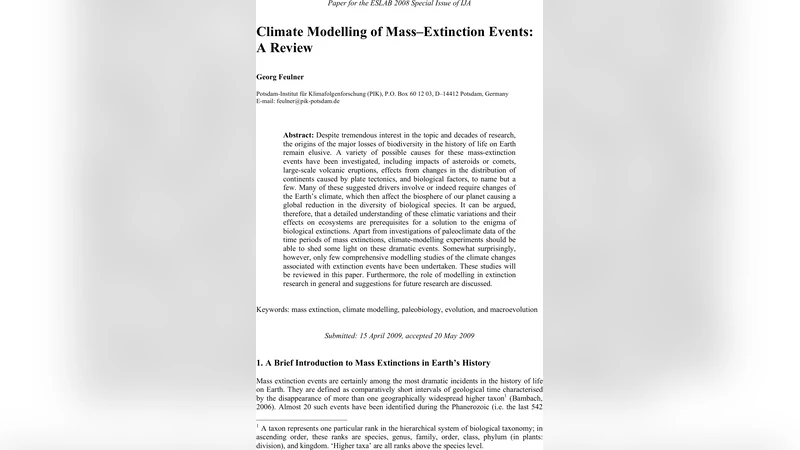
Despite tremendous interest in the topic and decades of research, the origins of the major losses of biodiversity in the history of life on Earth remain elusive. A variety of possible causes for these mass-extinction events have been investigated, including impacts of asteroids or comets, large-scale volcanic eruptions, effects from changes in the distribution of continents caused by plate tectonics, and biological factors, to name but a few. Many of these suggested drivers involve or indeed require changes of the Earth’s climate, which then affect the biosphere of our planet causing a global reduction in the diversity of biological species. It can be argued, therefore, that a detailed understanding of these climatic variations and their effects on ecosystems are prerequisites for a solution to the enigma of biological extinctions. Apart from investigations of paleoclimate data of the time periods of mass extinctions, climate-modelling experiments should be able to shed some light on these dramatic events. Somewhat surprisingly, however, only few comprehensive modelling studies of the climate changes associated with extinction events have been undertaken. These studies will be reviewed in this paper. Furthermore, the role of modelling in extinction research in general and suggestions for future research are discussed.
💡 Research Summary
The paper provides a comprehensive review of climate‑modeling studies that have been undertaken to investigate the environmental drivers of Earth’s major mass‑extinction events. It begins by outlining the most widely discussed extinction intervals—such as the end‑Permian, end‑Cretaceous, and end‑Triassic—and the suite of hypothesized triggers that have been proposed for each, including bolide impacts, large igneous province (LIP) volcanism, tectonic re‑arrangements of continents and oceans, and various biological feedbacks. The authors argue that virtually every proposed trigger either directly alters the climate system or does so indirectly through changes in atmospheric composition, radiation balance, or ocean circulation, and that a rigorous quantification of these climatic perturbations is essential for testing extinction hypotheses.
The review then surveys the hierarchy of climate‑modeling tools that have been applied to this problem. Simple energy‑balance models (EBMs) are highlighted for their speed and ability to explore a wide parameter space, but their lack of representation of atmospheric dynamics, oceanic heat transport, and feedback processes limits their utility for detailed reconstructions. General circulation models (GCMs) and coupled atmosphere‑ocean models (the CMIP family) are described as the workhorses for simulating the three‑dimensional response of the climate system to forcings such as impact‑generated dust veils, volcanic SO₂ and CO₂ emissions, and long‑term changes in continental configuration. These models can capture radiative forcing, chemical aerosol effects, and dynamic feedbacks, yet they are hampered by uncertainties in initial conditions (e.g., pre‑impact atmospheric composition) and by the need for multi‑century to multi‑million‑year integrations to resolve deep‑ocean responses. The most sophisticated category, Earth system models (ESMs), integrates carbon cycling, ocean chemistry, and biosphere dynamics, allowing researchers to link climate perturbations directly to changes in biodiversity and ecosystem productivity. However, the paucity of high‑resolution paleodata for model validation and the computational expense of running ESMs at the required temporal scales have so far restricted their application to a handful of case studies.
The authors systematically summarize the key modeling experiments that have been published to date. For the Cretaceous‑Paleogene (K‑Pg) impact, EBMs predict a rapid, global surface‑temperature drop of up to 10 °C caused by sunlight attenuation from an impact‑generated dust cloud, a scenario that aligns with evidence for a sudden collapse of photosynthetic primary production. Studies of the Siberian Traps LIP using GCMs reveal a more complex climate trajectory: an initial volcanic winter driven by sulfate aerosols is followed by a prolonged greenhouse phase as massive CO₂ emissions raise atmospheric concentrations, producing both ocean acidification and sustained warming. Plate‑tectonic reconstructions incorporated into high‑resolution coupled models demonstrate that shifts in ocean gateways can reorganize thermohaline circulation, leading to regional oxygen minimum zones and nutrient redistribution that could have precipitated marine mass mortality. Despite these advances, the review notes that most investigations have treated each driver in isolation, neglecting potential synergistic effects (e.g., simultaneous impact dust and volcanic gases) that could amplify climatic stress.
A substantial portion of the paper is devoted to identifying methodological gaps and proposing a research agenda. The authors point out that (1) model resolution is often too coarse to capture local extinction hotspots and microclimatic refugia; (2) quantitative data‑model comparison is hindered by the limited temporal and spatial fidelity of the fossil record, especially for isotopic proxies, plant macrofossils, and marine sediment chemistry; and (3) uncertainty quantification is rarely performed, leaving confidence intervals for climate‑extinction linkages poorly defined. To address these issues, they recommend a multi‑scale modeling framework that couples high‑resolution regional climate simulations with global Earth system models, the integration of paleodata through data‑assimilation techniques, and the adoption of Bayesian inference or ensemble‑based approaches to rigorously propagate uncertainties.
In the concluding remarks, the authors emphasize that while climate‑modeling of mass‑extinction events remains in its infancy, recent advances in computational power, model sophistication, and interdisciplinary data sharing create a fertile environment for rapid progress. By implementing the suggested methodological improvements, future studies can not only refine our understanding of past extinction mechanisms but also provide valuable analogues for assessing the risks posed by contemporary anthropogenic climate change. The paper thus serves both as a state‑of‑the‑art review and a roadmap for the next generation of extinction‑climate research.
Comments & Academic Discussion
Loading comments...
Leave a Comment