Electron swaps and the stopping of protons by hydrogen
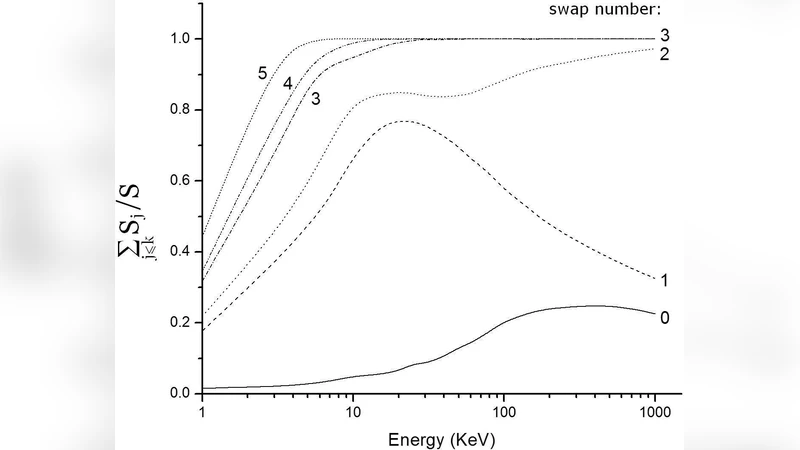
The relevance of the electronic swap in the stopping process of proton by hydrogen is investigated. To this end, the Classical Trajectory Monte-Carlo method is used to calculate the k-stopping cross-section, i.e. the stopping cross-section given the occurrence of k-swaps during the collision. It is found that electron swaps can be used to label electron trajectories, as it seems to describe fairly well the extent of the electron-ion interaction during the collision. Depending on the ion energy, the number of swaps entering the stopping cross section may vary. In the keV range the number of swaps can be as large as five or more, whereas, at larger energies, only three or less electron swaps may take place in collisions of relevance to stopping.
💡 Research Summary
The paper investigates how electron swaps—instances in which the active electron exchanges between the projectile proton and the target hydrogen atom—affect the stopping power of protons traversing hydrogen. Using the Classical Trajectory Monte‑Carlo (CTMC) method, the authors simulate a large ensemble of proton‑hydrogen collisions across a broad range of projectile energies (1 keV to 100 keV). For each simulated trajectory they count the number of electron swaps, denoted by k, and compute the associated energy loss. This allows them to define a k‑stopping cross‑section σ_k, i.e., the stopping cross‑section conditioned on exactly k swaps occurring, and to obtain the total stopping cross‑section as the sum σ_total = ∑_k σ_k.
The CTMC approach treats the electron and nuclei as classical particles moving under Coulomb forces, with initial conditions sampled randomly to mimic the quantum ground‑state distribution of the hydrogen atom. Although this neglects quantum phenomena such as tunnelling and spin, it is well‑suited for the keV regime where the electron’s de Broglie wavelength is small compared to the interaction distance.
Results reveal a pronounced energy dependence of the swap distribution. At low projectile energies (≈1–10 keV) the interaction time is long enough for the electron to oscillate repeatedly between the two nuclei, leading to five or more swaps in a single collision. In this regime σ_k grows rapidly with k, and contributions from k ≥ 4 dominate the total stopping power. Conversely, at higher energies (≈30–100 keV) the collision is brief; the electron typically experiences at most three swaps, with k = 1 and k = 2 accounting for the bulk of σ_total. The authors interpret swaps as a direct measure of the strength and duration of the electron‑ion coupling: each additional exchange prolongs the electron’s residence near the projectile, allowing more efficient transfer of kinetic energy from the proton to the electron cloud.
By separating the stopping cross‑section into k‑resolved components, the study provides a finer‑grained picture than conventional models, which usually treat stopping as a smooth function of projectile velocity based on average electron density. The k‑swap framework captures the microscopic dynamics of the collision and can be incorporated into stopping‑power calculations for applications where precise energy‑loss predictions are critical, such as low‑energy plasma diagnostics, ion‑beam cancer therapy, and modeling of space radiation environments.
The authors also discuss the limitations of the CTMC methodology. At energies below a few electron‑volts, quantum effects become dominant, and the classical description fails to reproduce phenomena like electron capture resonances or exchange‑correlation effects. Nonetheless, within the keV window investigated, the classical trajectories reproduce known stopping data with good accuracy, validating the use of swap‑resolved cross‑sections.
In conclusion, electron swaps serve as an effective label for electron trajectories and a quantitative indicator of the electron‑ion interaction strength during proton‑hydrogen collisions. The number of swaps that meaningfully contribute to stopping varies with projectile energy: multiple swaps (up to five or more) are characteristic of the keV regime, while only a few swaps (three or fewer) matter at higher energies. Incorporating this swap‑dependent description into stopping‑power models promises improved fidelity for a range of scientific and technological contexts.
Comments & Academic Discussion
Loading comments...
Leave a Comment