A Bayesian Approach Accounting for Stochastic Fluctuations in Stellar Cluster Properties
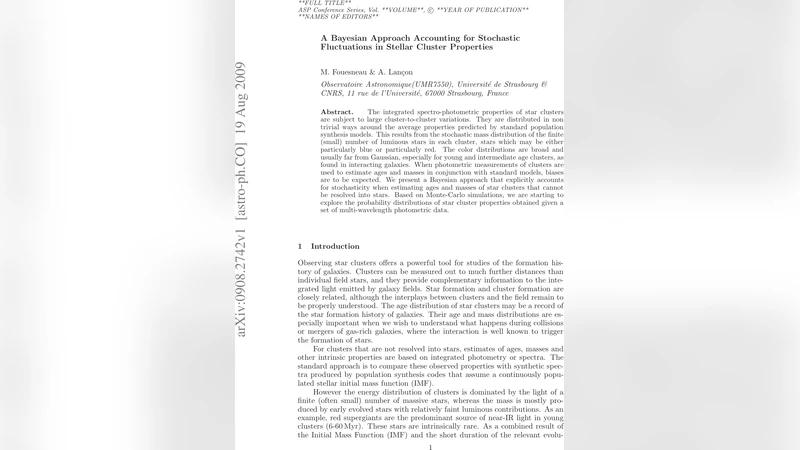
The integrated spectro-photometric properties of star clusters are subject to large cluster-to-cluster variations. They are distributed in non trivial ways around the average properties predicted by standard population synthesis models. This results from the stochastic mass distribution of the finite (small) number of luminous stars in each cluster, stars which may be either particularly blue or particularly red. The color distributions are broad and usually far from Gaussian, especially for young and intermediate age clusters, as found in interacting galaxies. When photometric measurements of clusters are used to estimate ages and masses in conjunction with standard models, biases are to be expected. We present a Bayesian approach that explicitly accounts for stochasticity when estimating ages and masses of star clusters that cannot be resolved into stars. Based on Monte-Carlo simulations, we are starting to explore the probability distributions of star cluster properties obtained given a set of multi-wavelength photometric data.
💡 Research Summary
The paper tackles a long‑standing problem in the analysis of unresolved star clusters: the stochastic sampling of the stellar initial mass function (IMF) in clusters that contain only a modest number of luminous stars. Traditional simple stellar population (SSP) models assume an infinitely populated IMF and therefore predict smooth, average spectral energy distributions (SEDs). In reality, especially for young (10 Myr – 1 Gyr) and low‑mass clusters, the presence or absence of a few blue or red supergiants can shift integrated colours and magnitudes dramatically. These shifts are not Gaussian; the colour distributions are broad, often multimodal, and lead to systematic biases when SSP models are used directly to infer ages, masses, extinctions, or metallicities from multi‑band photometry.
To address this, the authors develop a fully Bayesian inference framework that explicitly incorporates stochastic fluctuations. The method proceeds in three stages. First, a comprehensive library of Monte‑Carlo simulated clusters is generated. For each combination of age (τ), total stellar mass (M), metallicity (Z), and line‑of‑sight extinction (A_V), thousands of realizations are created by randomly drawing stars from a chosen IMF (e.g., Kroupa). Because each realization samples the IMF differently, the library captures the intrinsic dispersion of colours and magnitudes for a given set of physical parameters. The simulations cover a wide wavelength range (far‑UV to near‑IR) and are stored as probability density functions (PDFs) in colour‑magnitude space.
Second, the observed photometric data D (typically a set of fluxes or magnitudes in several filters) are compared to the library. The likelihood L(D|θ) for a parameter vector θ = (τ, M, Z, A_V) is computed by evaluating the distance between the observed fluxes and each Monte‑Carlo realization, taking into account both measurement uncertainties (σ_obs) and the intrinsic stochastic dispersion (σ_stoch) derived from the library. The total error is σ_tot = √(σ_obs² + σ_stoch²). The likelihood is expressed as a product of Gaussian terms over all filters, although the authors note that non‑Gaussian extensions are possible.
Third, priors π(θ) are assigned based on astrophysical knowledge: a power‑law prior for the cluster mass reflecting the observed cluster mass function, a log‑uniform prior for age, a metallicity prior informed by the host galaxy’s chemical evolution, and a modest extinction prior. Bayes’ theorem then yields the posterior probability distribution P(θ|D) ∝ L(D|θ) π(θ). The posterior is explored using Markov Chain Monte Carlo (MCMC) and Nested Sampling algorithms; the latter is favoured for its ability to map multimodal posteriors efficiently.
The authors validate the approach with synthetic tests. They generate “mock” clusters with known parameters, add realistic photometric noise, and then recover the parameters using both the conventional SSP fitting (single‑value χ² minimisation) and the Bayesian stochastic method. In cases where the integrated colour is driven by a few extreme stars, the SSP fit can mis‑estimate ages by factors of 2–5 and masses by >30 %. The Bayesian method, by contrast, produces posterior distributions that encompass the true values and quantifies the uncertainty introduced by stochasticity. The width of the posterior naturally grows for lower‑mass clusters, reflecting the increased intrinsic variance.
A real‑world application is presented for a sample of young clusters in the Antennae galaxies observed with HST in the FUV, U, B, V, and I bands. The Bayesian analysis reveals a broader spread of ages than previously reported, and many clusters previously classified as “very young” are reassigned to older age bins once the stochastic colour variance is accounted for. Adding near‑IR (H, K) photometry further reduces the age–extinction degeneracy, sharpening the posterior peaks.
The paper also discusses limitations and future extensions. The current library assumes a single metallicity (Z ≈ 0.02) and a fixed IMF; expanding to a grid of metallicities and alternative IMFs (top‑heavy, bottom‑light) will improve applicability to diverse galactic environments. Systematic photometric offsets and non‑Gaussian error distributions are not yet incorporated; a hierarchical Bayesian model could treat these as hyper‑parameters. Computationally, generating the Monte‑Carlo library is expensive; the authors suggest GPU acceleration and the use of neural‑network emulators to interpolate between simulated points, which would enable rapid analysis of large cluster catalogs.
In summary, the study provides a rigorous statistical tool that integrates stochastic IMF sampling into the inference of star‑cluster properties. By moving from deterministic SSP fitting to a probabilistic, Bayesian framework, it mitigates systematic biases, delivers realistic uncertainty estimates, and opens the door to more accurate studies of star‑formation histories in interacting and starburst galaxies where low‑mass, young clusters dominate the observed population.
Comments & Academic Discussion
Loading comments...
Leave a Comment