Radio observations of colliding winds in massive stars
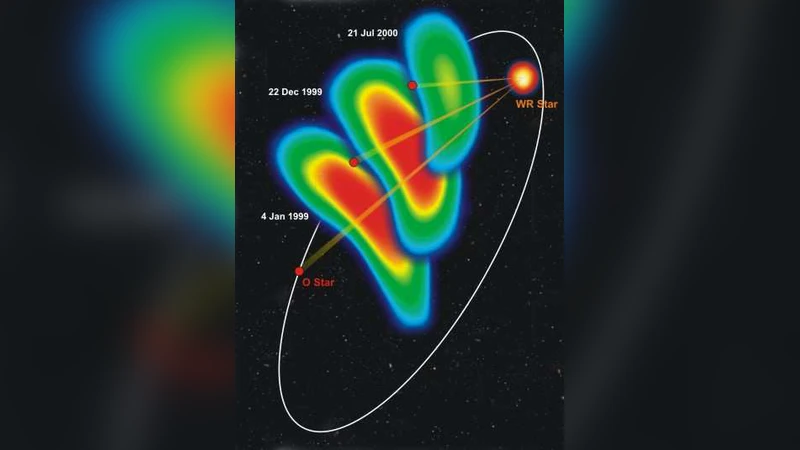
This brief review describes radio observations of colliding winds in massive stars starting with the first direct observational support for the colliding-wind model advanced in the early 1990’s to explain non-thermal radio and thermal X-ray emission in some massive stars. Studies of the well-studied and highly-eccentric WR+O star system WR140 are described along with recent observations of O-star systems. Also discussed is the binary nature of almost all massive stars that exhibit non-thermal behavior and some strategies for finding new systems.
💡 Research Summary
This review paper provides a comprehensive synthesis of radio observations of colliding stellar winds in massive stars, tracing the development of the colliding‑wind paradigm from its early theoretical formulation in the 1990s to the present day. The authors begin by summarizing the first direct observational evidence that supported the model: non‑thermal radio spectra and thermal X‑ray emission in a handful of Wolf‑Rayet (WR) and O‑type stars could not be explained by single‑star wind emission alone. High‑resolution interferometric measurements, especially those obtained with Very Long Baseline Interferometry (VLBI), revealed that the majority of these objects are in fact close binaries, establishing the binary nature as a prerequisite for colliding‑wind phenomena.
The paper devotes considerable attention to the archetypal system WR 140, a highly eccentric (e ≈ 0.88) WR + O binary. Multi‑frequency radio monitoring (1.4–15 GHz) shows dramatic flux variations synchronized with orbital phase: a sharp rise near periastron followed by a rapid decline. This behavior is interpreted as the combined effect of synchrotron emission from relativistic electrons accelerated in the wind‑collision shock and free‑free absorption by the dense stellar winds. Polarization measurements indicate magnetic fields of order 10 mG in the shock region and a particle energy distribution following a power law with index ≈ −2.1. Simultaneous X‑ray observations reveal both thermal emission from the hot (∼10 MK) shocked plasma and a hard, non‑thermal component, confirming that the same shock accelerates particles to high energies.
Beyond WR 140, recent detections of non‑thermal radio emission from pure O‑star binaries such as Cyg OB2 #9 and HD 93129A demonstrate that colliding‑wind shocks can also develop in O + O systems. Although the shocks are generally weaker and the magnetic fields lower, modern, high‑sensitivity radio arrays can still detect the faint synchrotron signatures. In these cases, the radio variability period matches the spectroscopic orbital period, reinforcing the colliding‑wind interpretation.
A key conclusion of the review is that virtually all massive stars exhibiting non‑thermal radio emission are members of binary (or higher‑order) systems. To uncover new colliding‑wind candidates, the authors propose a multi‑wavelength strategy: (1) continuous radio monitoring to identify periodic variability; (2) coordinated optical spectroscopy to track line‑profile changes that trace orbital motion; and (3) contemporaneous X‑ray observations to separate thermal wind emission from non‑thermal high‑energy components. This approach is especially valuable for distant or heavily obscured objects where direct imaging of the binary is impractical.
Looking forward, the authors anticipate that next‑generation facilities such as the Square Kilometre Array (SKA), the next‑generation VLA (ngVLA), and the Athena X‑ray observatory will enable unprecedented spatial resolution and sensitivity. These capabilities will allow direct imaging of the wind‑collision region, precise measurement of magnetic field structures, and detailed studies of particle acceleration mechanisms. Ultimately, such advances will improve our understanding of mass‑loss rates, angular momentum evolution, and the pre‑supernova environments of the most massive stars.
Comments & Academic Discussion
Loading comments...
Leave a Comment