In this paper we first provide a brief history of the handful of X-ray polarization measurements that have been accomplished to date. We then outline new technological developments that indicate more detailed polarization measurements in this important band of the spectrum can, and should be, accomplished in the near future. Finally, we depart somewhat from our original assignment and mention a preliminary result of the most recent observation of the Crab with the Chandra X-Ray Observatory and compare measurement of the X-ray spectral index as a function of pulse phase with optical polarization measurements that will be presented in detail elsewhere in these proceedings.
Deep Dive into High Energy Polarization and the Crab: Historical Remarks.
In this paper we first provide a brief history of the handful of X-ray polarization measurements that have been accomplished to date. We then outline new technological developments that indicate more detailed polarization measurements in this important band of the spectrum can, and should be, accomplished in the near future. Finally, we depart somewhat from our original assignment and mention a preliminary result of the most recent observation of the Crab with the Chandra X-Ray Observatory and compare measurement of the X-ray spectral index as a function of pulse phase with optical polarization measurements that will be presented in detail elsewhere in these proceedings.
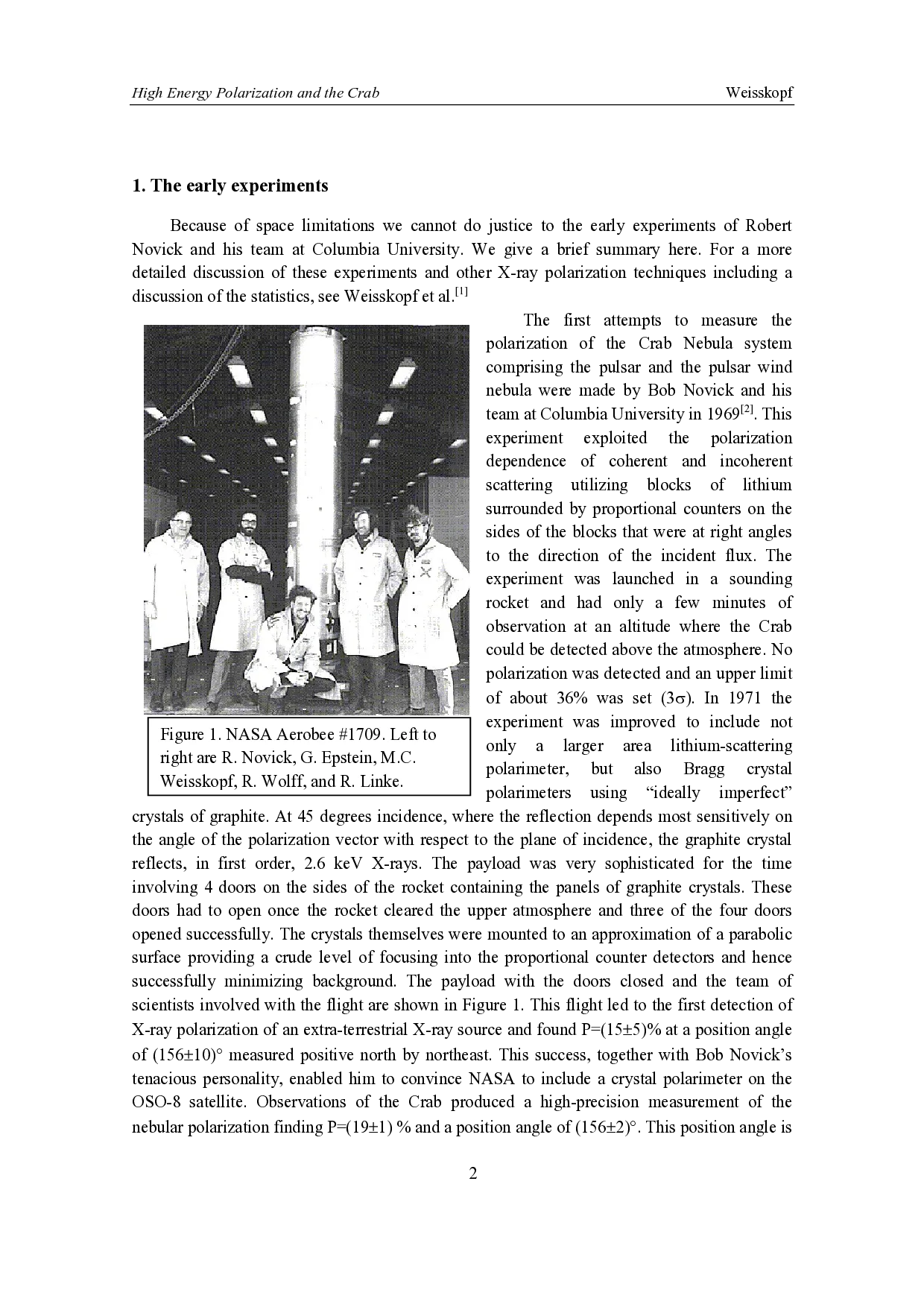
Because of space limitations we cannot do justice to the early experiments of Robert Novick and his team at Columbia University. We give a brief summary here. For a more detailed discussion of these experiments and other X-ray polarization techniques including a discussion of the statistics, see Weisskopf et al. [1] The first attempts to measure the polarization of the Crab Nebula system comprising the pulsar and the pulsar wind nebula were made by Bob Novick and his team at Columbia University in 1969 [2] . This experiment exploited the polarization dependence of coherent and incoherent scattering utilizing blocks of lithium surrounded by proportional counters on the sides of the blocks that were at right angles to the direction of the incident flux. The experiment was launched in a sounding rocket and had only a few minutes of observation at an altitude where the Crab could be detected above the atmosphere. No polarization was detected and an upper limit of about 36% was set (3σ). In 1971 the experiment was improved to include not only a larger area lithium-scattering polarimeter, but also Bragg crystal polarimeters using "ideally imperfect" crystals of graphite. At 45 degrees incidence, where the reflection depends most sensitively on the angle of the polarization vector with respect to the plane of incidence, the graphite crystal reflects, in first order, 2.6 keV X-rays. The payload was very sophisticated for the time involving 4 doors on the sides of the rocket containing the panels of graphite crystals. These doors had to open once the rocket cleared the upper atmosphere and three of the four doors opened successfully. The crystals themselves were mounted to an approximation of a parabolic surface providing a crude level of focusing into the proportional counter detectors and hence successfully minimizing background. The payload with the doors closed and the team of scientists involved with the flight are shown in Figure 1. This flight led to the first detection of X-ray polarization of an extra-terrestrial X-ray source and found P=(15±5)% at a position angle of (156±10)° measured positive north by northeast. This success, together with Bob Novick's tenacious personality, enabled him to convince NASA to include a crystal polarimeter on the OSO-8 satellite. Observations of the Crab produced a high-precision measurement of the nebular polarization finding P=(19±1) % and a position angle of (156±2)°. This position angle is very similar to the nebula's mean position angle as measured at radio frequencies as discussed by Paolo de Bernardis elsewhere in these proceedings.
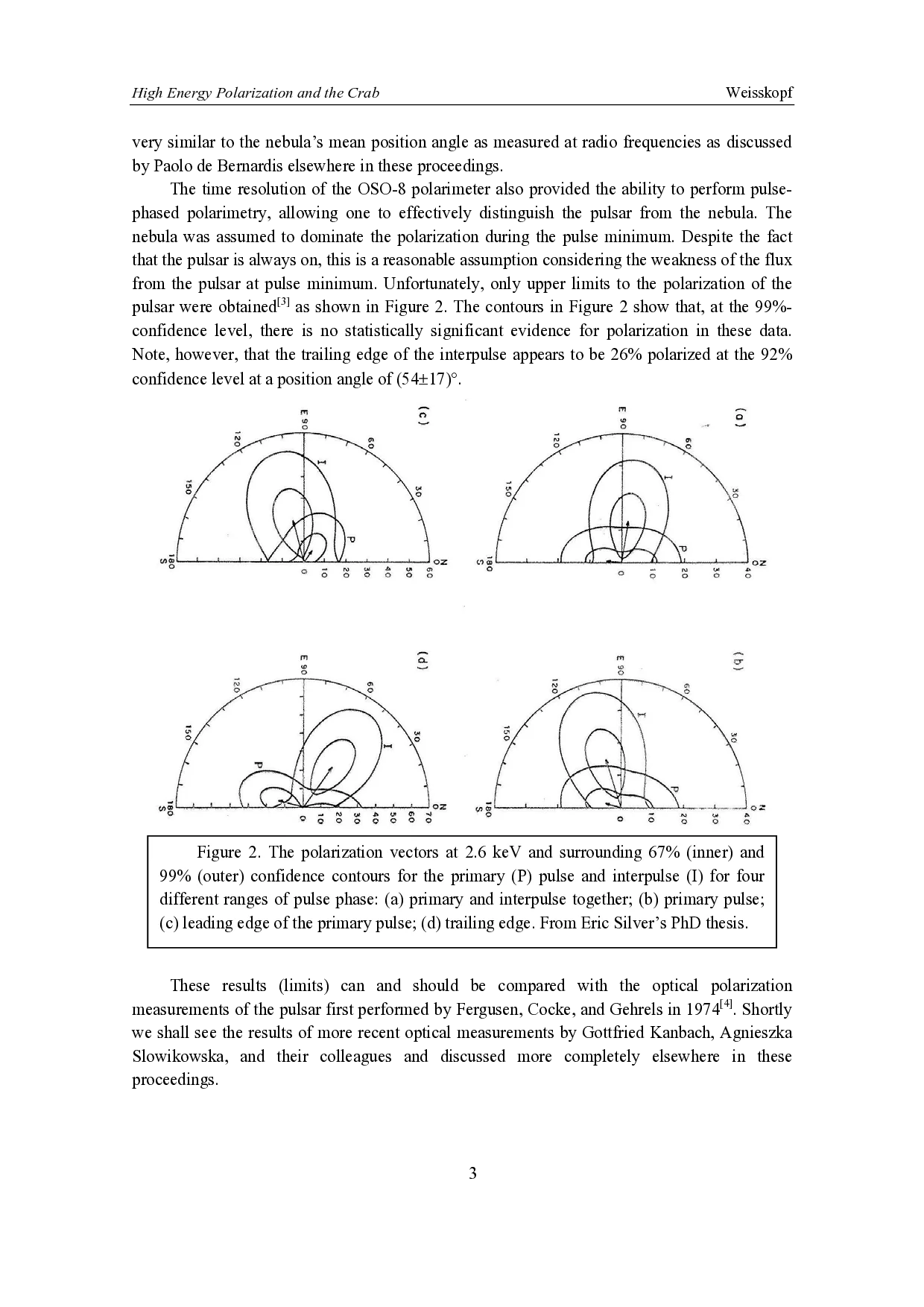
The time resolution of the OSO-8 polarimeter also provided the ability to perform pulsephased polarimetry, allowing one to effectively distinguish the pulsar from the nebula. The nebula was assumed to dominate the polarization during the pulse minimum. Despite the fact that the pulsar is always on, this is a reasonable assumption considering the weakness of the flux from the pulsar at pulse minimum. Unfortunately, only upper limits to the polarization of the pulsar were obtained [3] as shown in Figure 2. The contours in Figure 2 show that, at the 99%confidence level, there is no statistically significant evidence for polarization in these data. Note, however, that the trailing edge of the interpulse appears to be 26% polarized at the 92% confidence level at a position angle of (54±17)°.
These results (limits) can and should be compared with the optical polarization measurements of the pulsar first performed by Fergusen, Cocke, and Gehrels in 1974 [4] . Shortly we shall see the results of more recent optical measurements by Gottfried Kanbach, Agnieszka Slowikowska, and their colleagues and discussed more completely elsewhere in these proceedings. It is a shame that the early OSO-8 experiments were not given enough observing time 1 to perform meaningful measurements of the pulsar, as the X-Ray polarization has the distinct possibility of distinguishing among the models of the X-ray pulse production. Figure 3 illustrates three such possibilities, all of which predict more or less the same pulse shape, but can easily be distinguished by pulse-phased polarimetry.
The sounding rocket and OSO-8 satellite experiments took place over 30 years ago. There are a number of reasons why there haven’t been more sensitive follow up to these early exciting experiments. Polarimeters had been considered both for the Einstein and the Chandra X-ray observatories. The Einstein polarimeter became a casualty of the major descoping of the HEAO program due to problems with the Viking mission in the early 1970’s. The Chandra polarimeter lost all possibility of inclusion in the mission since it was not included in the original payload and servicing was abandoned in order to get Chandra launched. Smaller satellite missions were discouraged but Bob Novick managed to get an X-Ray polarimeter placed on the original Spectrum-X mission. Having funded this effort, the com
…(Full text truncated)…
This content is AI-processed based on ArXiv data.