A bayesian approach to the estimation of maps between riemannian manifolds, II: examples
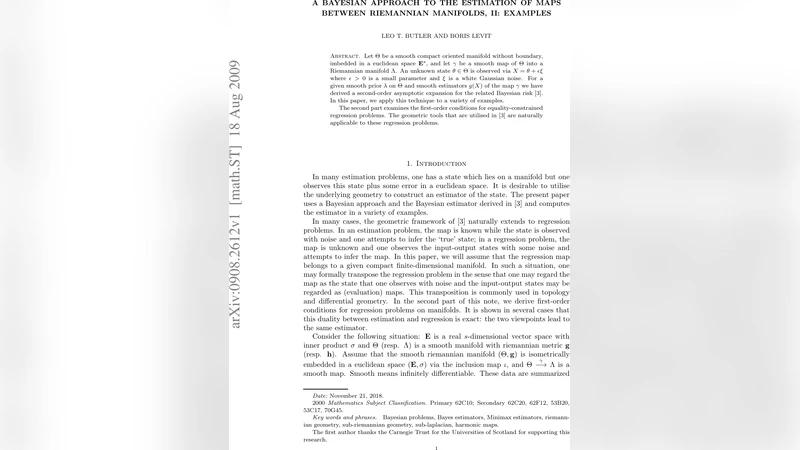
Let M be a smooth compact oriented manifold without boundary, imbedded in a euclidean space E and let f be a smooth map of M into a Riemannian manifold N. An unknown state x in M is observed via X=x+su where s>0 is a small parameter and u is a white Gaussian noise. For a given smooth prior on M and smooth estimators g of the map f we have derived a second-order asymptotic expansion for the related Bayesian risk (see arXiv:0705.2540). In this paper, we apply this technique to a variety of examples. The second part examines the first-order conditions for equality-constrained regression problems. The geometric tools that are utilised in our earlier paper are naturally applicable to these regression problems.
💡 Research Summary
This paper studies the problem of estimating a smooth map f from a compact, oriented, boundary‑free manifold M embedded in a Euclidean space E into a Riemannian target manifold N when the true state x ∈ M is observed through a noisy measurement X = x + s u, where u is white Gaussian noise and s > 0 is a small noise‑scale parameter. Assuming a smooth prior density on M and a smooth estimator g for f, the authors derive a second‑order asymptotic expansion of the Bayesian risk as a power series in s. The first‑order term reproduces the classical least‑squares risk, while the second‑order correction involves intrinsic geometric quantities: the Ricci curvature of M, the Hessian of the prior, and the pull‑back of the Riemannian metric from N. In this way the curvature of the source manifold and the shape of the prior directly affect the statistical efficiency of the estimator.
The theoretical framework is then illustrated through several concrete examples. The first example treats angular estimation on the 2‑sphere S², showing how the constant positive sectional curvature of the sphere reduces the second‑order risk term. The second example examines mapping from a torus, whose curvature varies with position, and demonstrates that the risk correction term adapts locally to the torus geometry. A third example involves higher‑dimensional spheres and product manifolds, where both Ricci curvature and the Laplacian of the prior contribute non‑trivially to the risk expansion.
A substantial part of the paper is devoted to equality‑constrained regression problems. By imposing smooth constraints h(g(x)) = 0, the authors introduce Lagrange multiplier fields on M and derive first‑order optimality conditions for the constrained Bayesian risk. The resulting Euler‑Lagrange equations combine the usual normal equations with curvature‑dependent correction terms, providing a geometric interpretation of constrained estimators that goes beyond classical Euclidean theory.
Finally, the authors discuss practical implementation issues. They outline how to estimate the prior density and noise level from data, how to approximate the second‑order risk term numerically using finite‑element discretizations of the Laplace–Beltrami operator, and how to solve the constrained optimization problem via manifold‑aware gradient descent. The paper thus bridges abstract differential‑geometric analysis with concrete statistical methodology, offering a unified Bayesian treatment of map estimation and constrained regression on Riemannian manifolds.
Comments & Academic Discussion
Loading comments...
Leave a Comment