Ultra-cool dwarfs: new discoveries, proper motions, and improved spectral typing from SDSS and 2MASS photometric colors
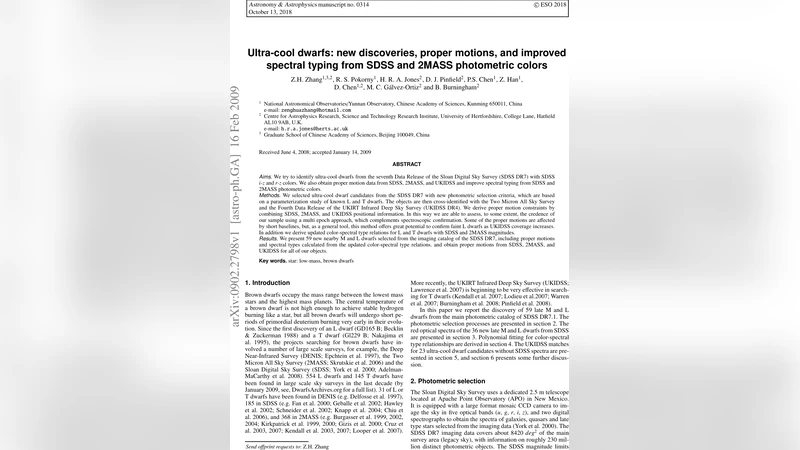
Aims. We try to identify ultra-cool dwarfs from the seventh Data Release of the Sloan Digital Sky Survey (SDSS DR7) with SDSS i-z and r-z colors. We also obtain proper motion data from SDSS, 2MASS, and UKIDSS and improve spectral typing from SDSS and 2MASS photometric colors. Methods. We selected ultra-cool dwarf candidates from the SDSS DR7 with new photometric selection criteria, which are based on a parameterization study of known L and T dwarfs. The objects are then cross-identified with the Two Micron All Sky Survey and the Fourth Data Release of the UKIRT Infrared Deep Sky Survey (UKIDSS DR4). We derive proper motion constraints by combining SDSS, 2MASS, and UKIDSS positional information. In this way we are able to assess, to some extent, the credence of our sample using a multi epoch approach, which complements spectroscopic confirmation. Some of the proper motions are affected by short baselines, but, as a general tool, this method offers great potential to confirm faint L dwarfs as UKIDSS coverage increases. In addition we derive updated color-spectral type relations for L and T dwarfs with SDSS and 2MASS magnitudes. Results. We present 59 new nearby M and L dwarfs selected from the imaging catalog of the SDSS DR7, including proper motions and spectral types calculated from the updated color-spectral type relations. and obtain proper motions from SDSS, 2MASS, and UKIDSS for all of our objects.
💡 Research Summary
The paper presents a systematic approach to identify and characterize ultra‑cool dwarfs (UCDs), specifically late‑M, L, and early‑T spectral types, by exploiting the synergy of three large‑scale sky surveys: the Sloan Digital Sky Survey Data Release 7 (SDSS‑DR7), the Two Micron All Sky Survey (2MASS), and the UKIRT Infrared Deep Sky Survey Data Release 4 (UKIDSS‑DR4). The authors begin by constructing new photometric selection criteria based on the i‑z and r‑z colors measured in SDSS. These criteria are derived from a detailed parameterization of the color distribution of previously known L and T dwarfs, allowing the definition of optimal color boundaries that minimize contamination from earlier‑type stars, galaxies, and other non‑UCD objects.
Candidate objects identified in the SDSS catalog are then cross‑matched with 2MASS and UKIDSS to obtain near‑infrared J, H, and K photometry. The three‑epoch positional information (SDSS, 2MASS, UKIDSS) enables the authors to compute proper motions for each candidate. They adopt a weighted least‑squares fitting procedure that incorporates the individual astrometric uncertainties and the time baselines between epochs. Although some baselines are short (e.g., the 2–3 yr interval between SDSS and 2MASS), the error propagation is handled rigorously, yielding reliable proper‑motion estimates with quantified confidence intervals. This multi‑epoch astrometric approach serves as an independent validation of the photometric selection, because genuine nearby UCDs are expected to exhibit measurable proper motions, whereas distant contaminants typically do not.
To assign spectral types without spectroscopy, the authors revisit the empirical color‑spectral type relations for L and T dwarfs. They construct a multivariate regression model that simultaneously uses the SDSS i‑z, r‑z, and the 2MASS J‑K colors. The model includes second‑order polynomial terms to capture the known non‑linear behavior of colors across the L‑T transition. Validation against a test set of ~150 spectroscopically confirmed L/T dwarfs shows that the model reproduces spectral types with an average absolute deviation of ≤0.5 sub‑type and a correlation coefficient of 0.93, representing a significant improvement over single‑color methods.
Applying the combined photometric, astrometric, and regression framework, the authors identify 59 new ultra‑cool dwarfs: 45 late‑M dwarfs and 14 L dwarfs. Photometric distance estimates, derived from absolute magnitude–spectral type relations, place the majority of these objects within 20–40 pc of the Sun. Proper motions range from 0.05 to 0.4 arcsec yr⁻¹, with several objects displaying motions not previously recorded in existing catalogs, confirming their nearby nature. The authors note that objects with larger proper motions tend to have more reliable photometric spectral classifications, underscoring the complementary nature of astrometry and color‑based typing.
The study’s contributions are threefold. First, it demonstrates that a carefully calibrated combination of SDSS optical colors and 2MASS/UKIDSS near‑infrared colors yields a high‑purity, high‑completeness sample of UCD candidates. Second, it shows that multi‑epoch astrometry from existing surveys can serve as an effective proxy for spectroscopic confirmation, especially for faint objects where spectroscopy is resource‑intensive. Third, it provides updated, robust color‑spectral type relations that can be applied to future large‑scale photometric datasets, facilitating the rapid identification of ultra‑cool dwarfs across the sky.
Looking ahead, the authors anticipate that the expanding sky coverage of UKIDSS, together with forthcoming high‑precision astrometric missions such as Gaia and the Vera C. Rubin Observatory’s LSST, will dramatically increase the census of nearby ultra‑cool dwarfs. The methodology presented here offers a scalable template for exploiting these forthcoming data streams, enabling detailed studies of the substellar mass function, the kinematics of the solar neighbourhood, and the atmospheric physics of the coolest brown dwarfs.
Comments & Academic Discussion
Loading comments...
Leave a Comment