Simple Error Scattering Model for improved Information Reconciliation
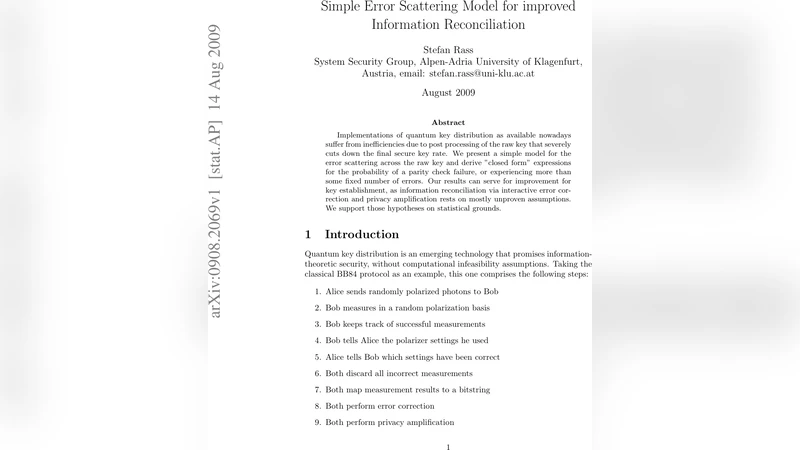
Implementations of quantum key distribution as available nowadays suffer from inefficiencies due to post processing of the raw key that severely cuts down the final secure key rate. We present a simple model for the error scattering across the raw key and derive “closed form” expressions for the probability of a parity check failure, or experiencing more than some fixed number of errors. Our results can serve for improvement for key establishment, as information reconciliation via interactive error correction and privacy amplification rests on mostly unproven assumptions. We support those hypotheses on statistical grounds.
💡 Research Summary
The paper addresses a critical bottleneck in contemporary quantum key distribution (QKD) systems: the inefficiency of post‑processing, especially the information reconciliation (IR) stage, which dramatically reduces the final secure key rate. While many implementations rely on heuristic or simulation‑based parameter choices for error correction, the statistical properties of the raw key’s error distribution have not been rigorously modeled. To fill this gap, the authors propose a “Simple Error Scattering Model” that treats the raw key as a sequence of independent Bernoulli trials with a uniform error probability p, partitioned into blocks of fixed length N. Under this model, the number of errors k in a block follows a binomial distribution P(k)=C(N,k)p^k(1‑p)^{N‑k}.
Two key performance metrics are derived in closed form. First, the probability that a parity check fails for a given block is the sum of probabilities for all odd k, which simplifies to ½
Comments & Academic Discussion
Loading comments...
Leave a Comment