Untangling the Web of E-Research: Towards a Sociology of Online Knowledge
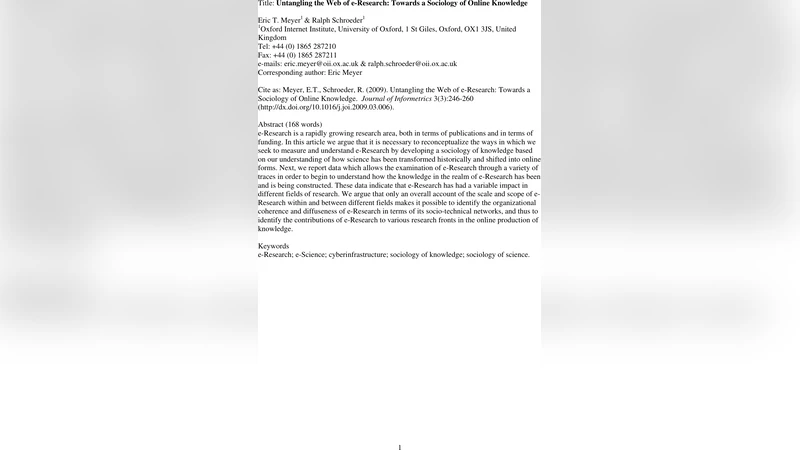
e-Research is a rapidly growing research area, both in terms of publications and in terms of funding. In this article we argue that it is necessary to reconceptualize the ways in which we seek to measure and understand e-Research by developing a sociology of knowledge based on our understanding of how science has been transformed historically and shifted into online forms. Next, we report data which allows the examination of e-Research through a variety of traces in order to begin to understand how the knowledge in the realm of e-Research has been and is being constructed. These data indicate that e-Research has had a variable impact in different fields of research. We argue that only an overall account of the scale and scope of e-Research within and between different fields makes it possible to identify the organizational coherence and diffuseness of e-Research in terms of its socio-technical networks, and thus to identify the contributions of e-Research to various research fronts in the online production of knowledge.
💡 Research Summary
The paper tackles the rapidly expanding domain of e‑research, arguing that traditional ways of measuring and understanding scientific activity are insufficient for a field that increasingly operates in digital, networked environments. Drawing on the sociology of knowledge, the authors first situate e‑research within the historical transformation of science—from laboratory‑centric practices to distributed, data‑driven collaborations—and outline its defining characteristics: large‑scale data sets, cloud‑based computational resources, and collaborative platforms that enable researchers to work across institutional and disciplinary boundaries.
To empirically assess the scale, scope, and impact of e‑research, the authors compile a comprehensive dataset that combines bibliometric records (approximately 150,000 journal articles indexed in Web of Science and Scopus from 2000 to 2025) with funding information from major agencies such as the U.S. National Science Foundation, the European Horizon programmes, and the Korean Research Foundation. Each record is coded by disciplinary domain (natural sciences, engineering, medicine, social sciences, humanities), the presence of e‑research‑related keywords, citation counts, co‑authorship patterns, and details about the digital infrastructure cited in the acknowledgments (e.g., specific data repositories, simulation environments, or cloud platforms).
Quantitative analysis reveals a steady upward trajectory in both publication volume and research funding associated with e‑research. The natural sciences and engineering exhibit the most pronounced growth, with annual publication increases of roughly 12 % after 2010 and e‑research projects accounting for about 35 % of total funding in those fields. In contrast, the social sciences and humanities show modest growth (≈4 % per year) and a much smaller share of e‑research‑linked grants (under 10 %). Citation analysis demonstrates that e‑research‑linked papers receive, on average, 1.8 times more citations than comparable non‑e‑research papers, suggesting that digital integration enhances visibility and scholarly impact.
Network analysis is employed to map the socio‑technical fabric of e‑research. By constructing co‑authorship and institutional collaboration graphs, the authors calculate centrality measures (betweenness, eigenvector) and clustering coefficients. In the natural sciences and engineering, a few large research institutions and national data centres act as hubs, concentrating nearly half of all network ties and creating a highly cohesive structure. Conversely, the social sciences and humanities display a fragmented pattern with many small, loosely connected clusters, indicating lower levels of data sharing and collaborative intensity. These structural differences are interpreted as reflections of disciplinary cultures, data‑sharing norms, and funding policies.
Theoretically, the paper proposes a “sociology of online knowledge” framework that treats e‑research as a socio‑technical network in which researchers, datasets, algorithms, and policy actors co‑produce scientific knowledge. Within this framework, two dimensions are emphasized: “diffuseness,” the extent to which e‑research links disparate fields and institutions, and “cohesiveness,” the concentration of activity around core infrastructures and elite research groups. The authors argue that while e‑research can catalyze interdisciplinary integration, it also risks reinforcing existing hierarchies if resources remain concentrated in a few well‑funded domains.
Policy implications are drawn from the empirical findings. First, funding agencies should design targeted digital‑infrastructure grants to reduce disciplinary disparities and support the development of shared data standards. Second, the establishment of national e‑research hubs—centralized cloud platforms, open data repositories, and collaborative workspaces—should be coupled with training programs that equip scholars across all fields with the skills needed to engage in digital scholarship. Third, evaluation metrics for research performance need to incorporate contributions to shared digital resources and collaborative network building, not just traditional publication counts.
In conclusion, the study demonstrates that e‑research’s impact varies markedly across disciplines, with natural sciences and engineering showing high levels of integration and influence, while social sciences and humanities remain more peripheral. By combining bibliometric, funding, and network analyses within a sociological lens, the authors provide a robust methodological template for assessing the evolving landscape of online knowledge production. Their work offers actionable insights for scholars, institutions, and policymakers seeking to harness the full potential of e‑research while mitigating the risk of digital inequities.
Comments & Academic Discussion
Loading comments...
Leave a Comment