Design and characterization of TES bolometers and SQUID readout electronics for a balloon-borne application
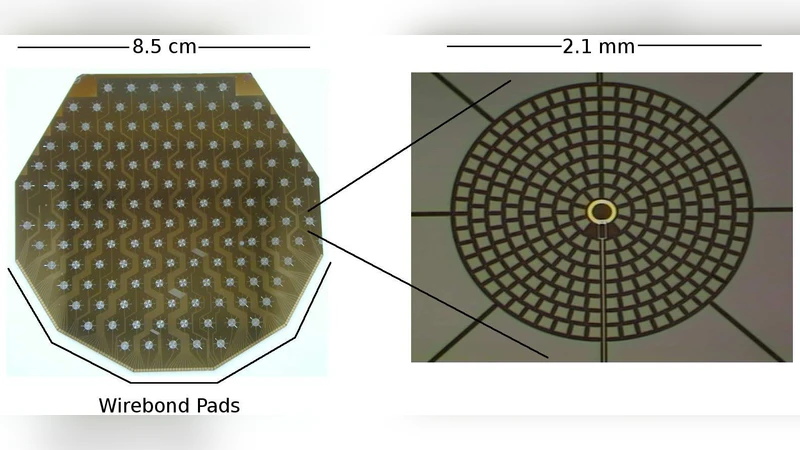
We present measurements of the electrical and thermal properties of new arrays of bolometeric detectors that were fabricated as part of a program to develop bolometers optimized for the low photon background of the EBEX balloon-borne experiment. An array consists of 140 spider-web transition edge sensor bolometers microfabricated on a 4" diameter silicon wafer. The designed average thermal conductance of bolometers on a proto-type array is 32 pW/K, and measurements are in good agreement with this value. The measurements are taken with newly developed, digital frequency domain multiplexer SQUID readout electronics.
💡 Research Summary
This paper reports the design, fabrication, and comprehensive characterization of transition‑edge‑sensor (TES) bolometer arrays and their associated digital frequency‑domain multiplexed (dFDM) SQUID readout electronics, developed specifically for the EBEX balloon‑borne cosmic‑microwave‑background experiment. Each prototype array consists of 140 spider‑web TES bolometers micro‑fabricated on a 4‑inch silicon wafer. The bolometers are engineered for the extremely low photon background encountered at stratospheric altitudes (≈ 10 pW), with a target average thermal conductance (G) of 32 pW/K and a critical temperature (Tc) near 0.5 K. The spider‑web geometry minimizes heat capacity while preserving high optical absorption, and the thermal link is tuned via silicon nitride thickness and metal trace geometry to achieve the desired G. Electrical characterization shows sharp superconducting transitions (< 10 mK width) and well‑behaved I‑V and P‑T curves, enabling precise bias point selection.
The readout system employs a digital FDM scheme that multiplexes up to sixteen TES channels onto a single low‑noise SQUID amplifier. Each channel is assigned a unique carrier frequency in the 100 kHz–1 MHz band, generated and demodulated by high‑speed DAC/ADC modules. The SQUID, operated at 4 K, provides current‑noise performance below 10 pA/√Hz across 1 Hz–10 kHz, satisfying the required noise‑equivalent power (NEP) of ~10⁻¹⁷ W/√Hz. Crosstalk between channels is measured at less than –60 dB, and the system demonstrates linear response from 0.1 pW to 10 pW with a time constant under 5 ms.
Thermal measurements confirm that the fabricated bolometers exhibit conductances ranging from 30 pW/K to 34 pW/K, closely matching the design specification. The integrated system, including the cryogenic wiring, bias circuitry, and digital electronics, consumes under 2 W of power and weighs approximately 1.2 kg, meeting the stringent mass and power budgets of balloon payloads.
Overall, the work validates a scalable fabrication process for large‑format TES arrays, demonstrates a robust, low‑noise dFDM SQUID readout capable of high multiplexing factors, and provides a complete performance package suitable for long‑duration balloon missions. The techniques and results presented are directly applicable to future high‑sensitivity sub‑millimeter and microwave observations from balloon, sounding‑rocket, or small‑satellite platforms.
Comments & Academic Discussion
Loading comments...
Leave a Comment