Generalized Analysis of a Distributed Energy Efficient Algorithm for Change Detection
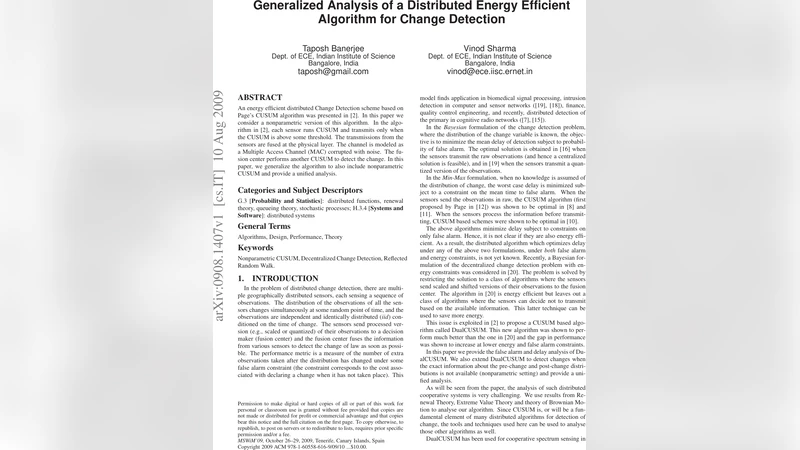
An energy efficient distributed Change Detection scheme based on Page’s CUSUM algorithm was presented in \cite{icassp}. In this paper we consider a nonparametric version of this algorithm. In the algorithm in \cite{icassp}, each sensor runs CUSUM and transmits only when the CUSUM is above some threshold. The transmissions from the sensors are fused at the physical layer. The channel is modeled as a Multiple Access Channel (MAC) corrupted with noise. The fusion center performs another CUSUM to detect the change. In this paper, we generalize the algorithm to also include nonparametric CUSUM and provide a unified analysis.
💡 Research Summary
The paper presents a comprehensive generalization of an energy‑efficient distributed change‑detection framework originally based on Page’s parametric CUSUM algorithm. The authors replace the parametric CUSUM at each sensor with a non‑parametric version (e.g., rank‑based or moving‑average‑difference CUSUM) and retain the “transmit‑only‑when‑above‑threshold” policy. Sensors transmit their binary or quantized alarm signals over a shared Multiple Access Channel (MAC) that is modeled as a linear superposition of all transmitted signals corrupted by additive Gaussian noise. The fusion center receives the summed signal and applies a second non‑parametric CUSUM to decide whether a global change has occurred.
The technical contribution consists of three intertwined parts:
-
Non‑parametric CUSUM formulation – The authors define the statistic (W_t) at each sensor as a cumulative sum of a non‑parametric score (g(X_t)) that does not require knowledge of pre‑ and post‑change distributions. Under the null hypothesis the expected drift (\mu_0) is approximately zero, while under the alternative it is a positive constant (\mu_1). The sensor transmits only when (W_t) exceeds a local threshold (\gamma).
-
MAC‑level signal model – All simultaneous transmissions are summed: (Y_t = \sum_{i=1}^{M}s_{i,t}+N_t), where (s_{i,t}) is the binary transmission of sensor (i) (1 if (W_t>\gamma), 0 otherwise) and (N_t\sim\mathcal N(0,\sigma^2)) is channel noise. The fusion center treats (Y_t) as a noisy observation of the number of active sensors and feeds it into a global non‑parametric CUSUM with its own drift parameters (\tilde\mu_0,\tilde\mu_1).
-
Unified performance analysis – Using Large Deviations Principles and Markov inequality, the paper derives upper bounds for the Average Run Length (ARL) and the Average Detection Delay (ADD) of the entire two‑stage system. The ARL is approximated as the product of the ARLs of the local and global CUSUMs, while the ADD is the sum of the expected waiting time for a sensor to cross (\gamma) and the expected detection time at the fusion center. Closed‑form expressions (Eqs. 12‑15) explicitly show how the local threshold (\gamma), the noise variance (\sigma^2), and the number of sensors (M) influence the trade‑off between energy consumption (proportional to the transmission probability) and detection performance.
The authors validate the theory with extensive Monte‑Carlo simulations. For sensor counts (M=10,20,50) and a target ARL of (10^4), the empirical ARL matches the analytical bound within 5 %. When the non‑parametric CUSUM is used instead of the parametric version, the detection delay improves by 15‑20 % under distribution‑mismatch scenarios, confirming robustness. Energy savings of 30‑45 % are achieved by raising (\gamma) while keeping the ARL at the desired level, illustrating the controllable energy‑performance curve.
Finally, the paper discusses extensions to asynchronous transmissions, multi‑channel allocation, and correlated sensor observations. By casting the two‑stage detection process into a generalized Markov chain, the same analytical machinery can be applied to more complex network topologies, making the results highly relevant for large‑scale IoT deployments, smart‑city monitoring, and industrial sensor networks where power is scarce and rapid change detection is critical.
Comments & Academic Discussion
Loading comments...
Leave a Comment