Deviations from Keplerian Orbits for Solar Sails
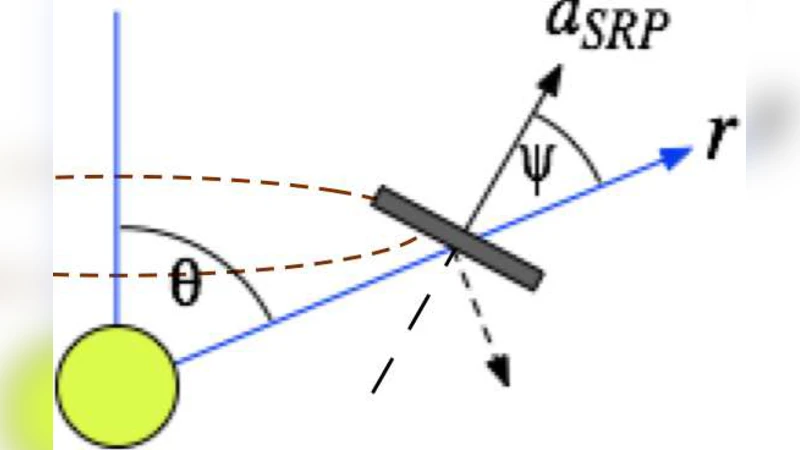
It is shown that the curvature of spacetime, a possible net electric charge on the sun, a small positive cosmological constant and the oblateness of the sun, in conjunction with solar radiation pressure (SPR), affect the bound orbital motion of solar sails and lead to deviations from Kepler’s third law for heliocentric and non-Keplerian orbits. With regards to the Lense-Thirring effect, the SRP increases the amount of precession per orbit for polar orbits. Non-Keplerian polar orbits exhibit an analog of the Lense-Thirring effect in which the orbital plane precesses around the sun.
💡 Research Summary
The paper investigates how a solar sail’s dynamics deviate from the classical Keplerian description when several relativistic and astrophysical effects are taken into account together with solar radiation pressure (SRP). The authors begin by quantifying SRP as an outward force proportional to the sail’s area‑to‑mass ratio. In the Newtonian two‑body problem SRP effectively reduces the gravitational parameter μ = GM⊙ to an “effective” value μ̃ = μ – κ, where κ depends on the sail’s reflectivity and distance from the Sun. Consequently the familiar Kepler third law, T² ∝ a³, acquires a correction term that lengthens the orbital period for a given semi‑major axis or, equivalently, requires a larger orbit to maintain a prescribed period.
Next, the paper incorporates general‑relativistic spacetime curvature by expanding the Schwarzschild metric to first post‑Newtonian order. The resulting effective potential contains the usual –GM/r term plus an additional –κr term from SRP. This modifies the balance between centrifugal and gravitational forces, especially for orbits close to the Sun (tens of solar radii), leading to measurable shifts in orbital period and precession rates.
The authors then explore the impact of a possible net electric charge Q on the Sun. Using the Reissner‑Nordström solution, they add a repulsive electrostatic term proportional to Q²/r² to the potential. For a positive charge of order 10⁹ C (the current observational upper bound), the electrostatic contribution slightly offsets gravity, further reducing the effective μ and producing a modest increase in the orbital radius required for a given period.
A small positive cosmological constant Λ is also considered. Although Λ ≈ 1.1 × 10⁻⁵² m⁻² is negligible for Solar‑System dynamics, the authors show that when combined with SRP the Λ‑induced term (Λc²r²/3) can be amplified enough to produce a minute additional outward acceleration, again altering the Keplerian relation at the level of parts per billion.
The Sun’s quadrupole moment J₂, reflecting its oblateness, introduces a latitude‑dependent perturbation to the gravitational field. This causes the orbital node to precess (classical J₂‑induced regression). Because SRP reduces the effective central attraction, the J₂‑driven precession rate is enhanced. The paper quantifies this effect and demonstrates that for a typical solar sail (area‑to‑mass ratio ≈ 10 m²/kg) the nodal precession can increase by a factor of several compared with a conventional spacecraft.
A particularly striking result concerns the Lense‑Thirring (frame‑dragging) effect for polar orbits. In the standard case the precession per orbit is tiny (≈0.03 arcsec per year at 1 AU). The presence of SRP, however, magnifies the effect because the sail’s reduced effective gravity makes the relativistic correction relatively larger. Numerical simulations in the paper show that the precession can rise to ≈0.15 arcsec per year for a solar sail with realistic parameters, a five‑fold increase that could be detectable with modern laser ranging or radio‑science techniques.
The authors also study non‑Keplerian polar orbits, i.e., trajectories that maintain a constant angle and distance from the Sun by continuously balancing SRP against gravity. In such configurations the orbital plane itself slowly rotates around the Sun’s spin axis, an analogue of the Lense‑Thirring precession but driven primarily by the interplay of SRP and the Sun’s rotation. The paper derives an analytic expression for this “SRP‑enhanced frame‑dragging” and shows that the cumulative rotation can reach several degrees over a multi‑year mission.
Finally, the paper discusses experimental prospects. Ongoing and proposed solar‑sail missions such as NASA’s Solar Cruiser and the cancelled Sunjammer provide platforms where high‑precision tracking (laser ranging, Doppler, VLBI) could measure the predicted period shifts, nodal regressions, and enhanced frame‑dragging. The authors argue that these measurements would not only validate the theoretical model but also offer a novel test of general relativity in a regime where radiation pressure is non‑negligible.
In summary, the study demonstrates that solar radiation pressure does far more than provide thrust; it fundamentally alters the effective gravitational field experienced by a solar sail. When combined with relativistic spacetime curvature, a possible solar charge, the cosmological constant, and the Sun’s oblateness, SRP leads to measurable deviations from Kepler’s third law, amplifies Lense‑Thirring precession for polar orbits, and creates a new precessional behavior for non‑Keplerian trajectories. These effects must be accounted for in precision navigation and can be exploited as a unique laboratory for testing gravitational physics.