Chandra observation of the relativistic binary J1906+0746
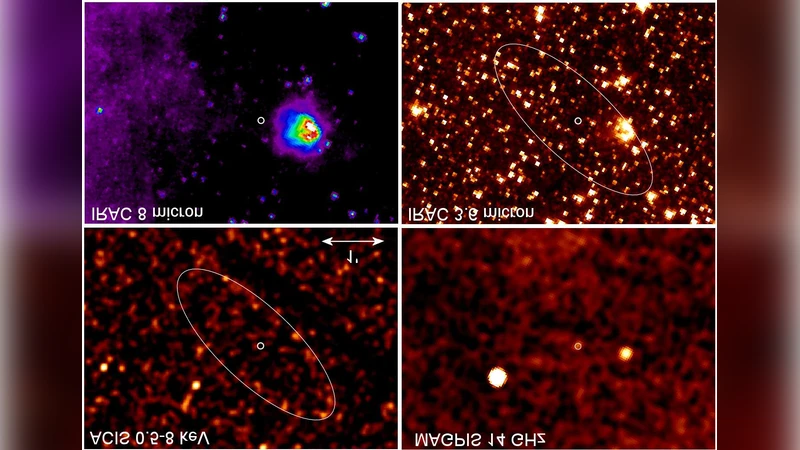
PSR J1906+0746 is a 112-kyr-old radio pulsar in a tight relativistic binary with a compact high-mass companion, at the distance of about 5 kpc. We observed this unique system with the Chandra ACIS detector for 31.6 ks. Surprisingly, not a single photon was detected within the 3" radius from the J1906+0746 radio position. For a plausible range of hydrogen column densities, n_H=(0.5-1)\times10^{22} cm^{-2}, the nondetection corresponds to the 90% upper limit of (3-5)\times10^{30} erg s^{-1} on the unabsorbed 0.5-8 keV luminosity for the power-law model with Gamma=1.0-2.0, and ~10^{32} erg s^{-1} on the bolometric luminosity of the thermal emission from the NS surface. The inferred limits are the lowest known for pulsars with spin-down properties similar to those of PSR J1906+0746. We have also tentatively detected a puzzling extended structure which looks like a tilted ring with a radius of 1.6’ centered on the pulsar. The measured 0.5-8 keV flux of the feature, 3.1\times10^{-14} erg cm^{-2} s^{-1}, implies an unabsorbed luminosity of 1.2\times10^{32} erg s^{-1} (4.5\times10^{-4} of the pulsar’s spin-down power). Although all conventional interpretations of the ring appear to be problematic, the pulsar-wind nebula with an unusually underluminous pulsar remains the most viable interpretation.
💡 Research Summary
PSR J1906+0746 is a young (characteristic age ≈112 kyr) radio pulsar residing in a tight, relativistic binary with a massive compact companion. The system lies at an estimated distance of ~5 kpc, making it a promising target for X‑ray studies of pulsar emission and possible pulsar‑wind nebula (PWN) structures. The authors obtained a 31.6 ks exposure with the Chandra ACIS‑I detector and performed a careful data reduction using CIAO and the latest calibration files.
The most striking result is the complete absence of X‑ray photons within a 3″ radius of the radio timing position. The background level in the vicinity is low (≈0.001 counts s⁻¹), and a Poisson analysis yields a 90 % confidence upper limit of three counts. Assuming a plausible interstellar hydrogen column density of n_H = (0.5–1) × 10²² cm⁻², the authors translate this count limit into flux limits for two spectral models: (i) a non‑thermal power‑law with photon index Γ = 1.0–2.0, giving an unabsorbed 0.5–8 keV luminosity L_X ≤ (3–5) × 10³⁰ erg s⁻¹; and (ii) a thermal blackbody representing emission from the neutron‑star surface, yielding a bolometric luminosity limit of ≈10³² erg s⁻¹. Both limits are among the lowest ever reported for pulsars with spin‑down power Ė ≈ 2.8 × 10³⁵ erg s⁻¹, implying an X‑ray efficiency L_X/Ė ≤ 10⁻⁴, significantly below the typical range (10⁻³–10⁻⁴) observed in other young pulsars.
In addition to the nondetection of the point source, the Chandra image reveals a faint, extended feature that appears as a tilted ring with a radius of about 1.6 arcmin (≈2.3 pc at 5 kpc). The feature contains roughly 45 net counts, corresponding to an observed 0.5–8 keV flux of 3.1 × 10⁻¹⁴ erg cm⁻² s⁻¹ and an unabsorbed luminosity of 1.2 × 10³² erg s⁻¹, i.e., ≈4.5 × 10⁻⁴ of the pulsar’s spin‑down power. Spectral fitting is limited by the low count statistics, but both a power‑law (Γ≈2) and a soft thermal model (kT≈0.3 keV) provide acceptable fits.
The authors discuss several possible origins for the ring‑like emission: a supernova remnant shell, a background galaxy cluster, or a PWN. The morphology—centered on the pulsar and roughly circular—combined with the size and luminosity, makes a PWN the most plausible interpretation, despite the paradox that the pulsar itself appears unusually under‑luminous in X‑rays. In this scenario the pulsar’s wind may be efficiently converting spin‑down energy into nebular emission while the magnetospheric X‑ray output is suppressed, perhaps due to an atypical magnetic geometry, low particle acceleration efficiency, or interaction with an unusually dense ambient medium.
The paper therefore establishes PSR J1906+0746 as the most X‑ray faint pulsar known among objects with comparable spin‑down parameters, and it uncovers a tentative extended X‑ray structure that could represent a highly under‑luminous PWN. These findings challenge standard models of pulsar magnetospheric emission and PWN evolution, suggesting that additional factors—such as magnetic inclination, wind composition, or local interstellar conditions—play a critical role. The authors conclude that deeper X‑ray observations, complemented by high‑resolution radio imaging and gamma‑ray studies, are essential to confirm the nature of the ring and to understand why this relativistic binary pulsar deviates so dramatically from the established X‑ray efficiency trends.
Comments & Academic Discussion
Loading comments...
Leave a Comment