Double-diffusive instabilities of a shear-generated magnetic layer
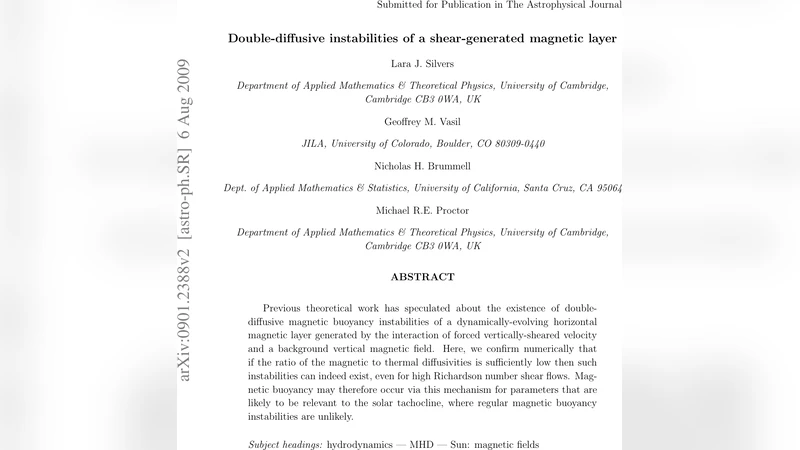
Previous theoretical work has speculated about the existence of double-diffusive magnetic buoyancy instabilities of a dynamically evolving horizontal magnetic layer generated by the interaction of forced vertically sheared velocity and a background vertical magnetic field. Here we confirm numerically that if the ratio of the magnetic to thermal diffusivities is sufficiently low then such instabilities can indeed exist, even for high Richardson number shear flows. Magnetic buoyancy may therefore occur via this mechanism for parameters that are likely to be relevant to the solar tachocline, where regular magnetic buoyancy instabilities are unlikely.
💡 Research Summary
This paper investigates whether a horizontal magnetic layer, generated by the interaction of a forced vertical shear flow and a background vertical magnetic field, can become unstable through a double‑diffusive magnetic buoyancy mechanism. Classical magnetic buoyancy theory predicts that strong shear (high Richardson number) stabilizes the layer, making buoyant rise unlikely in regions such as the solar tachocline. However, when the magnetic diffusivity (η) is much smaller than the thermal diffusivity (κ), temperature perturbations diffuse rapidly while magnetic perturbations persist, opening a pathway for a double‑diffusive instability.
Using three‑dimensional, fully compressible magnetohydrodynamic simulations, the authors impose a linear vertical shear Vz = S x on a uniform vertical field Bz₀. The shear continuously creates a horizontal magnetic component By, forming a thin magnetic sheet. They systematically vary the Richardson number (Ri = N²/S²) from 5 to 20 and the diffusivity ratio η/κ from 10⁻² down to 10⁻⁴. The results show that for η/κ ≲ 10⁻³, the magnetic layer becomes unstable even when Ri > 10, i.e., in regimes traditionally considered stable. The instability initially manifests as small‑scale temperature and magnetic perturbations; rapid thermal diffusion prevents pressure buildup, while the slowly diffusing magnetic field supplies a buoyancy force that amplifies the disturbances.
Growth rates increase as η/κ decreases and as the shear strength S grows, confirming the double‑diffusive nature of the process. In the nonlinear stage, the perturbations develop into buoyant plumes that are stretched by the shear, eventually disrupting the magnetic sheet and producing localized, strong buoyancy‑driven upflows. These dynamics suggest a viable route for magnetic flux emergence in the solar tachocline, where estimated parameters (η/κ ≈ 10⁻⁴–10⁻⁵, Ri ≈ 10–100) fall within the regime identified by the simulations.
The study thus demonstrates that double‑diffusive magnetic buoyancy can operate under realistic solar conditions, offering a potential explanation for the emergence of magnetic structures in regions where conventional buoyancy instabilities are suppressed. The authors recommend future work with higher Reynolds numbers and more realistic solar stratification to explore the coupling of this mechanism to the global solar dynamo and activity cycle.
Comments & Academic Discussion
Loading comments...
Leave a Comment