Combinatorial Bethe ansatz and generalized periodic box-ball system
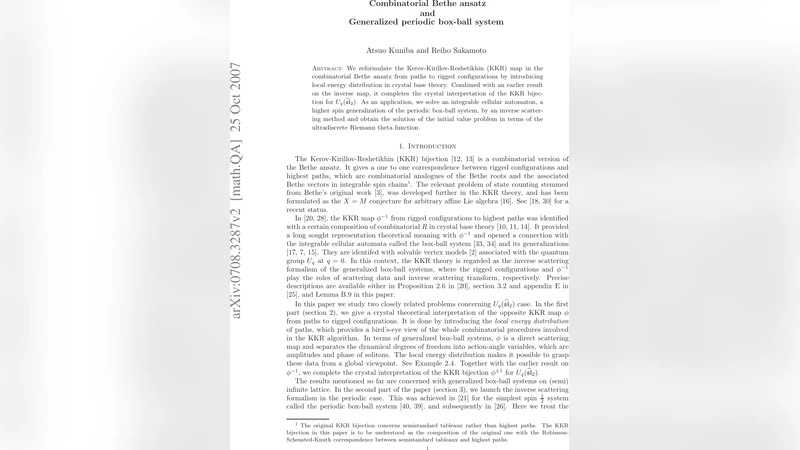
We reformulate the Kerov-Kirillov-Reshetikhin (KKR) map in the combinatorial Bethe ansatz from paths to rigged configurations by introducing local energy distribution in crystal base theory. Combined with an earlier result on the inverse map, it completes the crystal interpretation of the KKR bijection for U_q(\hat{sl}_2). As an application, we solve an integrable cellular automaton, a higher spin generalization of the periodic box-ball system, by an inverse scattering method and obtain the solution of the initial value problem in terms of the ultradiscrete Riemann theta function.
💡 Research Summary
The paper revisits the Kerov‑Kirillov‑Reshetikhin (KKR) bijection that underlies the combinatorial Bethe ansatz for the quantum affine algebra (U_q(\widehat{\mathfrak{sl}}_2)). Traditionally, the KKR map sends a crystal path—an element of a tensor product of fundamental (B^{1,1}) crystals—to a rigged configuration, a pair consisting of a Young diagram and integer “riggings”. The original construction relies on a global energy function and its conservation, making both the forward and inverse maps rather implicit.
The authors introduce a new tool called the local energy distribution. For each adjacent pair of tensor factors in a path they define a local energy (e) using the crystal’s combinatorial (R)-matrix. By assigning these local energies to the vertices of a rectangular lattice, they obtain a fine‑grained picture of how energy flows through the path. The crucial observation is that the cumulative local energy attached to a box of the Young diagram coincides exactly with the rigging assigned to that box. Consequently, the forward KKR map can be written as an explicit algorithm: scan the path, compute local energies, and fill the rigged configuration box‑by‑box.
Having a transparent forward map enables the authors to construct a direct inverse algorithm. Starting from a rigged configuration, they read the riggings in reverse order, reconstruct the corresponding local energy levels, and then recover each tensor factor of the original path by “energy back‑tracking”. This procedure respects the same local energy conservation used in the forward direction, thereby establishing a genuine bijection that is fully interpreted within crystal theory.
Armed with this refined bijection, the paper tackles a higher‑spin generalization of the periodic box‑ball system (PBBS), an integrable cellular automaton originally introduced by Takahashi and Satsuma. In the classic PBBS each site holds at most one ball (spin‑½), and the dynamics are encoded by the combinatorial (R)-matrix of (U_q(\widehat{\mathfrak{sl}}2)). The authors extend the model to arbitrary spin (s\in\frac{1}{2}\mathbb{Z}{\ge0}), allowing multiple balls per site and a richer set of scattering rules derived from the ultradiscrete (R)-matrix. The system remains periodic and conserves the total number of balls, preserving integrability.
The main achievement is an explicit solution of the initial‑value problem for this generalized PBBS. By translating the initial configuration into a rigged configuration via the forward KKR map, the time evolution becomes a simple linear shift of the riggings. This linear motion is then expressed in terms of an ultradiscrete Riemann theta function, the tropical analogue of the classical theta function. The theta function’s modular parameters are identified with the conserved quantities (the shape of the Young diagram), while its phase parameters encode the initial riggings. Consequently, the state of the system at any discrete time (t) is obtained by evaluating the ultradiscrete theta function at a linearly shifted argument, and then applying the inverse KKR map to retrieve the crystal path (i.e., the ball configuration).
Thus the paper provides a complete inverse‑scattering framework for a high‑spin periodic cellular automaton: the scattering data are the rigged configurations, the evolution is linear in the tropical Jacobian, and the reconstruction uses the newly established explicit inverse KKR algorithm.
Beyond the immediate application, the work deepens the bridge between crystal bases, combinatorial Bethe ansatz, and tropical geometry. The local energy distribution offers a systematic way to read off riggings from paths, suggesting possible extensions to other affine types or to models with more complicated boundary conditions. Moreover, the appearance of the ultradiscrete Riemann theta function hints at a broader correspondence between integrable discrete dynamics and tropical analogues of classical algebro‑geometric objects, opening avenues for future research in both mathematical physics and combinatorial representation theory.
Comments & Academic Discussion
Loading comments...
Leave a Comment