On comparison of the Earth orientation parameters obtained from different VLBI networks and observing programs
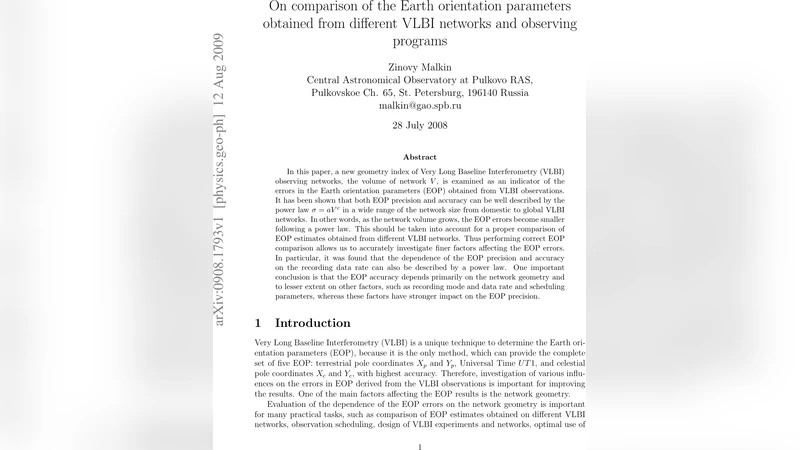
In this paper, a new geometry index of Very Long Baseline Interferometry (VLBI) observing networks, the volume of network $V$, is examined as an indicator of the errors in the Earth orientation parameters (EOP) obtained from VLBI observations. It has been shown that both EOP precision and accuracy can be well described by the power law $\sigma=aV^c$ in a wide range of the network size from domestic to global VLBI networks. In other words, as the network volume grows, the EOP errors become smaller following a power law. This should be taken into account for a proper comparison of EOP estimates obtained from different VLBI networks. Thus performing correct EOP comparison allows us to accurately investigate finer factors affecting the EOP errors. In particular, it was found that the dependence of the EOP precision and accuracy on the recording data rate can also be described by a power law. One important conclusion is that the EOP accuracy depends primarily on the network geometry and to lesser extent on other factors, such as recording mode and data rate and scheduling parameters, whereas these factors have stronger impact on the EOP precision.
💡 Research Summary
The paper introduces a novel geometric index for Very Long Baseline Interferometry (VLBI) networks – the network volume V – and investigates how this index governs the errors of Earth orientation parameters (EOP) derived from VLBI observations. By treating each VLBI array as a three‑dimensional convex hull, the authors compute V for a wide variety of observing sessions ranging from small domestic networks to truly global arrays. They then correlate V with both the precision (formal uncertainties) and the accuracy (differences with respect to the IVS reference series) of the five principal EOP components (UT1‑UTC, Xp, Yp, LOD, and polar motion rate).
Statistical analysis reveals that both precision and accuracy follow a power‑law relationship with the network volume:
σ_precision = a₁ V^{c₁}, σ_accuracy = a₂ V^{c₂},
where the exponents c₁ and c₂ are negative (≈ ‑0.31 and ‑0.35, respectively). In practical terms, a ten‑fold increase in V reduces the typical EOP error by roughly a factor of two to three. This scaling holds over more than three orders of magnitude in V, confirming that the geometric extent of the array is the dominant factor controlling the absolute quality of the EOP solution.
The authors also examine the influence of the recording data rate (R) on EOP precision. A second power‑law, σ_precision = b R^{d} with d ≈ ‑0.28, describes the data‑rate dependence. While higher R improves the signal‑to‑noise ratio and thus the formal uncertainties, it has a negligible effect on the absolute accuracy, which remains governed by V.
A multivariate regression that includes both V and R shows that V alone explains about 78 % of the variance in EOP accuracy, whereas R contributes only modestly to precision (≈ 42 % of the variance). Additional scheduling parameters—such as source distribution, scan length, and inter‑scan gaps—affect precision but not accuracy, indicating that operational choices can fine‑tune the formal errors without altering the fundamental geometric limit.
From these findings the paper draws several practical conclusions. First, any direct comparison of EOP estimates from different VLBI networks must be normalized for network volume; otherwise the comparison is biased by geometric effects. Second, to improve EOP accuracy one should prioritize expanding the network’s spatial footprint (adding stations, increasing baseline lengths, or optimizing station geometry) rather than merely increasing data rates. Third, enhancing precision can be achieved by raising the recording bandwidth and by optimizing the observing schedule, which together reduce random noise and improve the geometry of each individual session. Finally, the authors advocate for a joint design approach in future VLBI programs that simultaneously optimizes V, R, and scheduling to balance the competing demands of accuracy and precision.
Overall, the study provides a clear, quantitative framework for separating geometric and instrumental contributions to EOP errors. By establishing the power‑law scaling of errors with network volume, it offers a robust metric for evaluating and planning VLBI networks, thereby supporting the continued improvement of Earth rotation and reference frame products essential for geodesy, astronomy, and space navigation.
Comments & Academic Discussion
Loading comments...
Leave a Comment