Antenna-coupled TES bolometer arrays for CMB polarimetry
We describe the design and performance of polarization selective antenna-coupled TES arrays that will be used in several upcoming Cosmic Microwave Background (CMB) experiments: SPIDER, BICEP-2/SPUD. The fully lithographic polarimeter arrays utilize planar phased-antennas for collimation (F/4 beam) and microstrip filters for band definition (25% bandwidth). These devices demonstrate high optical efficiency, excellent beam shapes, and well-defined spectral bands. The dual-polarization antennas provide well-matched beams and low cross polarization response, both important for high-fidelity polarization measurements. These devices have so far been developed for the 100 GHz and 150 GHz bands, two premier millimeter-wave atmospheric windows for CMB observations. In the near future, the flexible microstrip-coupled architecture can provide photon noise-limited detection for the entire frequency range of the CMBPOL mission. This paper is a summary of the progress we have made since the 2006 SPIE meeting in Orlando, FL.
💡 Research Summary
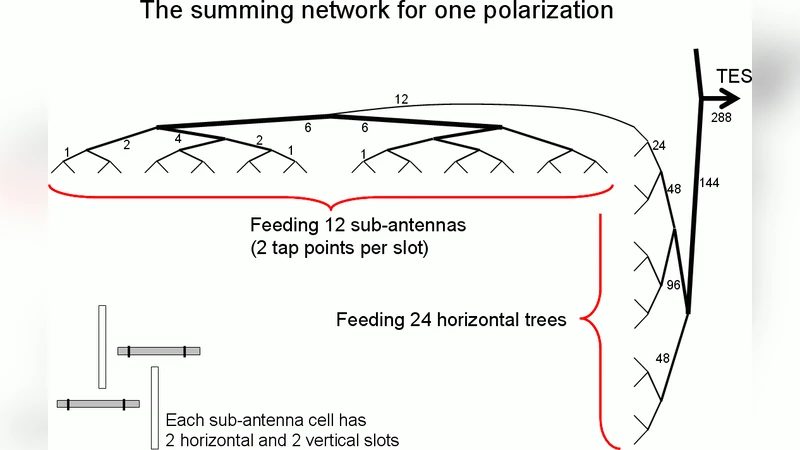
The paper presents the design, fabrication, and performance evaluation of antenna‑coupled transition‑edge‑sensor (TES) bolometer arrays intended for upcoming Cosmic Microwave Background (CMB) polarization experiments such as SPIDER and BICEP‑2/SPUD. The authors adopt a fully lithographic approach in which planar phased‑array antennas, microstrip transmission lines, and band‑defining filters are integrated on a single silicon wafer together with the superconducting TES detectors. Each pixel contains two orthogonal slot‑type antenna elements that collect the two linear polarizations simultaneously. The antennas are arranged in 4 × 4 or 8 × 8 sub‑arrays to produce a well‑collimated F/4 beam. The microstrip network includes a 25 % fractional‑bandwidth band‑pass filter tuned to either the 100 GHz or 150 GHz atmospheric windows, providing clean spectral definition while preserving high optical throughput.
The TES devices are fabricated from an Al‑Ti bilayer with a transition temperature (Tc) of approximately 0.5 K and a normal‑state resistance near 30 mΩ. Thermal isolation is achieved with low‑conductivity SiN membranes, enabling the detectors to operate near the photon‑noise limit. Measured noise‑equivalent powers (NEP) are on the order of 1 × 10⁻¹⁷ W/√Hz, indicating that the detectors are photon‑noise dominated under typical loading conditions. Optical efficiency measurements show values exceeding 70 %, and beam mapping confirms that the full‑width‑half‑maximum (FWHM) matches the design within 2 % with negligible side‑lobes. Cross‑polarization leakage is suppressed to better than –35 dB, and the two polarization channels exhibit beam mismatches of less than 0.5 %, both of which are critical for high‑fidelity CMB polarization measurements.
Fabrication relies on a single‑step lithographic process that defines the antenna slots, microstrip lines, filter structures, and TES islands in one wafer run. This approach dramatically reduces assembly complexity, improves repeatability, and is scalable to arrays containing thousands of detectors. The authors also discuss the integration of the readout electronics, noting that the low impedance of the TES and the planar nature of the interconnects are compatible with existing time‑division or frequency‑division multiplexing schemes.
Performance testing includes cryogenic optical measurements, Fourier‑transform spectroscopy to verify band placement, and polarization angle calibration using a rotating wire grid. The results demonstrate that the antenna‑coupled architecture meets the stringent requirements for next‑generation CMB polarimetry: high optical efficiency, well‑controlled beam shapes, low systematic polarization leakage, and photon‑noise‑limited sensitivity.
Looking forward, the authors outline a roadmap to extend the technology across the full CMB frequency range (30 GHz to 300 GHz) required for future satellite missions such as CMB‑POL. They propose incorporating multiple band‑pass filters on a single microstrip line to enable multi‑band operation per pixel, and they emphasize the need for further optimization of the antenna geometry to maintain beam quality at higher frequencies. Additionally, scaling to larger focal planes will demand advances in multiplexed readout and thermal management, topics the team plans to address in subsequent work.
In summary, this study validates antenna‑coupled TES bolometer arrays as a versatile, high‑performance solution for precise CMB polarization measurements, offering a path toward the ultra‑low‑systematics instruments needed to detect the faint B‑mode signal from primordial gravitational waves.
Comments & Academic Discussion
Loading comments...
Leave a Comment