No FIP fractionation in the active stars AR Psc and AY Cet
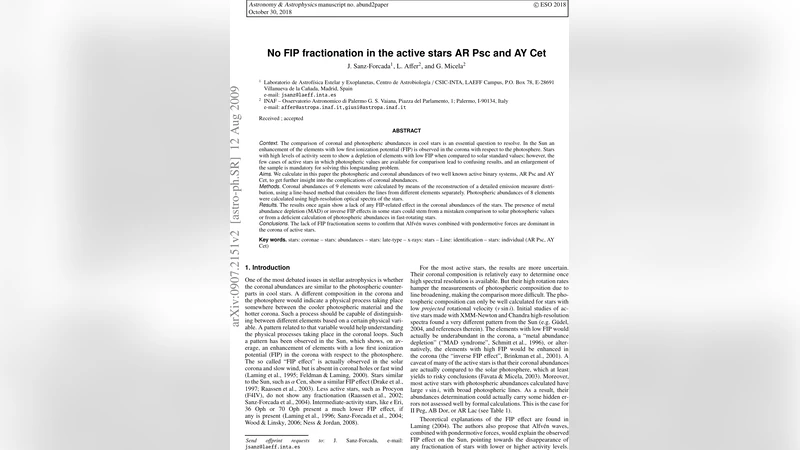
Context: The comparison of coronal and photospheric abundances in cool stars is an essential question to resolve. In the Sun an enhancement of the elements with low first ionization potential (FIP) is observed in the corona with respect to the photosphere. Stars with high levels of activity seem to show a depletion of elements with low FIP when compared to solar standard values; however the few cases of active stars in which photospheric values are available for comparison lead to confusing results, and an enlargement of the sample is mandatory for solving this longstanding problem. Aims: We calculate in this paper the photospheric and coronal abundances of two well known active binary systems, AR Psc and AY Cet, to get further insight into the complications of coronal abundances. Methods: Coronal abundances of 9 elements were calculated by means of the reconstruction of a detailed emission measure distribution, using a line-based method that considers the lines from different elements separately. Photospheric abundances of 8 elements were calculated using high-resolution optical spectra of the stars. Results: The results once again show a lack of any FIP-related effect in the coronal abundances of the stars. The presence of metal abundance depletion (MAD) or inverse FIP effects in some stars could stem from a mistaken comparison to solar photospheric values, or from a deficient calculation of photospheric abundances in fast-rotating stars. Conclusions: The lack of FIP fractionation seems to confirm that Alfven waves combined with pondermotive forces are dominant in the corona of active stars.
💡 Research Summary
The paper addresses the long‑standing problem of elemental fractionation between stellar coronae and photospheres, focusing on the first ionization potential (FIP) effect that is well documented in the Sun. In the solar case, low‑FIP elements (e.g., Fe, Mg, Si) are enhanced in the corona relative to the photosphere, whereas many active stars have been reported to show an inverse FIP (or “metal abundance depletion”, MAD) where low‑FIP elements appear depleted. However, most of those reports rely on comparisons with solar photospheric abundances rather than on star‑specific photospheric measurements, and the few active stars for which both coronal and photospheric abundances are available have yielded contradictory results. To clarify the situation, the authors performed a simultaneous, high‑precision determination of coronal and photospheric abundances for two well‑studied, highly active RS CVn binaries: AR Psc and AY Cet.
Observational data and methodology
Coronal abundances were derived from high‑resolution X‑ray spectra obtained with XMM‑Newton’s Reflection Grating Spectrometer (RGS) and Chandra’s Low Energy Transmission Grating Spectrometer (LETGS). The authors employed a line‑based reconstruction of the emission measure distribution (EMD), treating each element separately. This approach mitigates temperature‑bias effects that can arise in global spectral fitting, because the contribution functions of individual lines are explicitly accounted for. Nine elements (Fe, O, Ne, Mg, Si, S, Ar, Ca, Ni) were measured, and the CHIANTI atomic database was used to convert line fluxes into elemental abundances.
Photospheric abundances were obtained from high‑resolution optical spectra (e.g., HARPS, UVES). Eight elements (Fe, Si, Ca, Ti, Ni, Na, Al, Mg) were analyzed using LTE spectral synthesis with the MOOG code and ATLAS9 model atmospheres. Both target stars are relatively rapid rotators (v sin i ≈ 30–45 km s⁻¹), which broadens lines and introduces blending. The authors addressed these issues by employing multi‑line synthesis, careful continuum placement, and rotational broadening kernels, thereby reducing systematic uncertainties that have plagued earlier studies of fast‑rotating active stars.
Results
The derived coronal abundances are essentially identical to the photospheric values for both stars. Low‑FIP elements such as Fe, Mg, and Si show no significant enhancement or depletion in the corona; high‑FIP elements (Ne, O) also match their photospheric counterparts within the error bars. Consequently, no statistically meaningful FIP bias—neither the classic solar‑type enhancement nor the inverse FIP reported for some active stars—is present. The authors emphasize that when the comparison is made against the star’s own photospheric composition rather than the solar standard, the apparent “MAD” or inverse FIP signatures disappear.
Interpretation
The lack of any FIP‑related fractionation is interpreted in the context of the Alfvén‑wave ponderomotive force model (Laming 2004, 2015). In this framework, upward‑propagating Alfvén waves generate a ponderomotive force that can preferentially accelerate ions of low FIP, producing the solar FIP effect. For very active stars, the wave amplitudes are larger and the coronal magnetic topology is more complex, which can reduce or nullify the selective acceleration. The observations of AR Psc and AY Cet therefore support the idea that, in highly active coronae, the ponderomotive force acts more uniformly on all elements, erasing the FIP bias.
Conclusions and outlook
The study demonstrates that, for the two active binaries examined, coronal abundances do not exhibit any FIP fractionation when accurate, star‑specific photospheric abundances are used. This finding suggests that previous reports of inverse FIP or metal depletion in active stars may stem from inappropriate solar reference values or from systematic errors in photospheric abundance determinations for fast rotators. The results bolster the Alfvén‑wave ponderomotive force model as the dominant mechanism governing elemental transport in active stellar coronae. The authors recommend extending this dual‑diagnostic approach to a larger sample of active stars to test the universality of the phenomenon and to refine theoretical models of wave‑driven fractionation.
Comments & Academic Discussion
Loading comments...
Leave a Comment