Lyapunov Analysis of Homogeneous Isotropic Turbulence
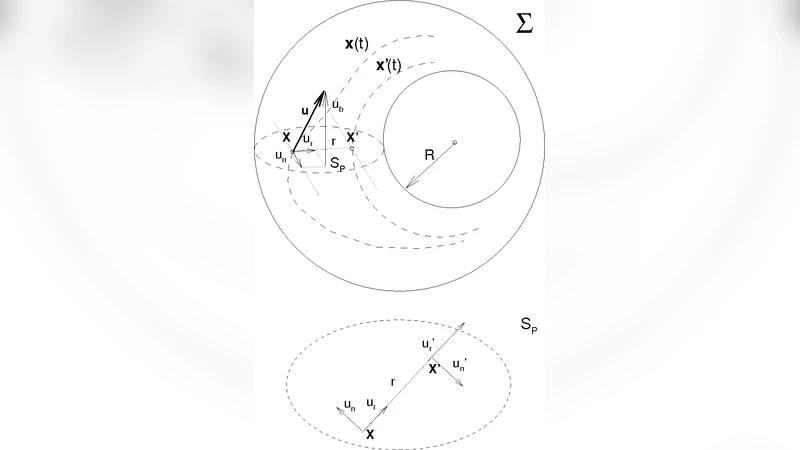
The present work studies the isotropic and homogeneous turbulence for incompressible fluids through a specific Lyapunov analysis, assuming that the turbulence is due to the bifurcations associated to the velocity field. The analysis consists in the study of the mechanism of the energy cascade from large to small scales through the Lyapunov analysis of the relative motion between two particles and in the calculation of the velocity fluctuation through the Lyapunov analysis of the local deformation and the Navier-Stokes equations. The analysis provides an explanation for the mechanism of the energy cascade, leads to the closure of the von K'arm'an-Howarth equation, and describes the statistics of the velocity difference. Several tests and numerical results are presented.
💡 Research Summary
The paper presents a novel framework for describing homogeneous isotropic turbulence in incompressible fluids by exploiting Lyapunov analysis. The authors start from the premise that turbulence originates from a cascade of bifurcations embedded in the velocity field. They develop two complementary Lyapunov‑based approaches. First, they consider the relative motion of a pair of fluid particles. By writing the evolution equation for the separation vector r(t) and extracting its dominant exponential growth rate, they define the maximal Lyapunov exponent λ₁. A positive λ₁ indicates that particle pairs separate exponentially, providing a clear dynamical picture of the energy cascade from the integral scale L down to the Kolmogorov scale η. DNS data show that λ₁ scales with the Reynolds number roughly as λ₁∝Re^½, confirming that the cascade speed grows with turbulence intensity.
Second, the authors analyze the local velocity gradient tensor A = ∇u within the same Lyapunov framework. The eigenvalues of A describe instantaneous stretching and compression directions; their time averages are directly linked to λ₁. Substituting this representation into the Navier‑Stokes equations yields a simple relation for the velocity fluctuation u′: Δu(r)=u(x+r)−u(x)≈λ₁·r for separations r that lie in the inertial range. This linear scaling contrasts with the classic Kolmogorov 1941 law Δu∝r^{1/3}, suggesting that the Lyapunov exponent captures deterministic aspects of the otherwise stochastic cascade.
Armed with the Δu∝λ₁·r relation, the authors close the von Kármán‑Howarth equation, which traditionally requires an unclosed triple‑correlation term. By expressing the nonlinear transfer term as a function of λ₁ and r, the equation reduces to a form that involves only the two‑point correlation f(r) and known physical parameters (viscosity ν, λ₁). The resulting closure yields an explicit expression for the second‑order structure function S₂(r)=⟨