Subgroup classification in Out(F_n)
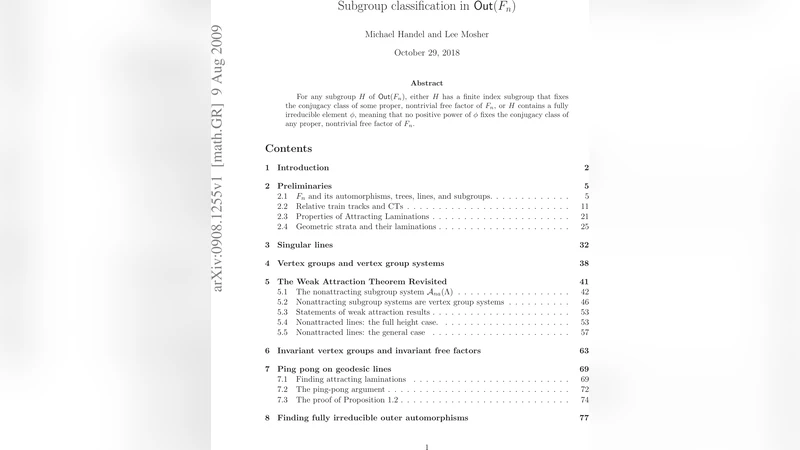
For any subgroup H of Out(F_n), either H has a finite index subgroup that fixes the conjugacy class of some proper, nontrivial free factor of F_n, or H contains a fully irreducible element phi, meaning that no positive power of phi fixes the conjugacy class of any proper, nontrivial free factor of F_n.
💡 Research Summary
The paper establishes a clean dichotomy for arbitrary subgroups of the outer automorphism group of a free group, Out(Fₙ). The main theorem states that for any subgroup H ⊂ Out(Fₙ) one of the following holds: (1) H contains a finite‑index subgroup that fixes the conjugacy class of a proper, non‑trivial free factor of Fₙ, or (2) H contains a fully irreducible element φ (i.e. an iwip), meaning that no positive power of φ stabilises the conjugacy class of any proper, non‑trivial free factor.
The authors begin by reviewing the necessary background: the geometry of the free factor complex FSₙ, its Gromov‑hyperbolic nature, and the dynamics of Out(Fₙ) on this complex. They recall that a fully irreducible (iwip) element acts on FSₙ with north‑south dynamics, having a unique attracting and repelling point on the boundary, and that such elements are the analogue of pseudo‑Anosov mapping classes for free groups.
The proof splits into two complementary cases. In the “non‑reducible” case, the authors assume that H acts on FSₙ without fixing any simplex. Using the Bestvina‑Feighn‑Handel theory of relative train‑track maps, they construct an element of H with a primitive transition matrix. This element is shown to be fully irreducible: every positive power fails to preserve any proper free factor, because the associated train‑track map expands every edge in a way that forces any invariant free factor to intersect the whole graph. The construction exploits the hyperbolicity of FSₙ to guarantee the existence of a north‑south pair of fixed points on the boundary, which in turn yields the desired iwip.
In the “reducible” case, the authors suppose that H does have a bounded orbit in FSₙ. By analyzing the combinatorial structure of the complex, they locate a simplex that is invariant under a finite‑index subgroup H₀ of H. The simplex corresponds to a proper free factor A ⊂ Fₙ, and the invariance of the simplex translates into the statement that H₀ fixes the conjugacy class of A. This argument uses the fact that FSₙ is locally finite and that stabilisers of simplices are precisely the subgroups of Out(Fₙ) that preserve the associated free factor up to conjugacy.
The paper then discusses several consequences. First, the existence of an iwip in H implies that H contains a free subgroup of rank two, providing a new proof of a Tits‑alternative‑type result for subgroups of Out(Fₙ). Second, the dichotomy clarifies the relationship between algebraic properties of subgroups (finite‑index fixing of a free factor) and their geometric dynamics on FSₙ. Finally, the authors note that the theorem fits into a broader program of classifying subgroups of Out(Fₙ) via their actions on various hyperbolic complexes (free factor complex, free splitting complex, etc.), and they suggest that similar dichotomies may hold for other complexes associated with free groups.
Overall, the work delivers a sharp structural classification for subgroups of Out(Fₙ), bridging combinatorial group theory, low‑dimensional topology, and geometric group theory, and it opens avenues for further exploration of subgroup dynamics in the broader context of automorphism groups of free groups.
Comments & Academic Discussion
Loading comments...
Leave a Comment