Uniform convexity and the splitting problem for selections
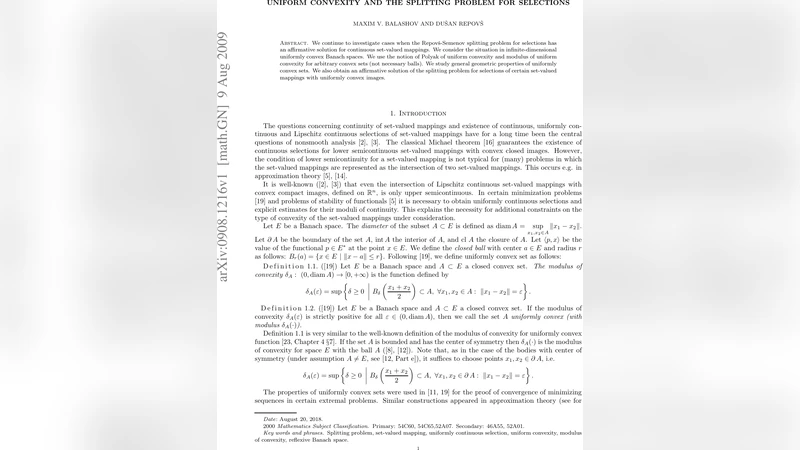
We continue to investigate cases when the Repov\v{s}-Semenov splitting problem for selections has an affirmative solution for continuous set-valued mappings. We consider the situation in infinite-dimensional uniformly convex Banach spaces. We use the notion of Polyak of uniform convexity and modulus of uniform convexity for arbitrary convex sets (not necessary balls). We study general geometric properties of uniformly convex sets. We also obtain an affirmative solution of the splitting problem for selections of certain set-valued mappings with uniformly convex images.
💡 Research Summary
The paper addresses the Repovš‑Semenov splitting problem for continuous set‑valued mappings in infinite‑dimensional uniformly convex Banach spaces. The classical splitting problem asks whether a continuous selection (f) of a set‑valued map (F:X\to 2^{Y}) can be written as a convex combination of two continuous functions, i.e. (f(x)=\lambda f_{1}(x)+(1-\lambda)f_{2}(x)) for a fixed (\lambda\in(0,1)). While affirmative answers are known in finite‑dimensional settings or when the values of (F) are simple convex bodies such as balls, the infinite‑dimensional case remains largely open because ordinary convexity does not provide enough geometric control.
The authors adopt Polyak’s notion of uniform convexity for arbitrary convex sets, extending the familiar concept of uniform convexity of the norm. For a convex set (C) they define a modulus of uniform convexity (\phi_{C}(\varepsilon)) that quantifies how deep the midpoint of any two points at distance at least (\varepsilon) lies inside (C). This framework allows them to treat non‑ball convex bodies on the same footing as the unit ball of a uniformly convex space.
Section 2 develops basic geometric properties of uniformly convex sets. They prove that a positive, continuous modulus guarantees interior ball conditions, that intersections of uniformly convex sets with a common modulus remain uniformly convex, and that the support function of such a set is Lipschitz continuous. These results supply the quantitative estimates needed later for constructing continuous selections.
The main theorem (Section 4) states: let (X) be an infinite‑dimensional uniformly convex Banach space, and let (F:X\to 2^{Y}) be a continuous set‑valued map whose values are non‑empty, closed, uniformly convex subsets of a Banach space (Y) sharing a common modulus (\phi). Then (F) admits a continuous selection (f), and for any fixed (\lambda\in(0,1)) there exist continuous functions (f_{1},f_{2}:X\to Y) such that (f(x)=\lambda f_{1}(x)+(1-\lambda)f_{2}(x)) for all (x\in X).
The proof proceeds in two stages. First, using the modulus (\phi) they construct a sequence of continuous approximations ({f_{n}}) that converge strongly to a selection (f). The uniform convexity yields a distance‑reduction inequality (|u-v|\le\phi^{-1}(\delta)) for points (u,v) whose midpoint lies (\delta) inside the set, guaranteeing that the approximating sequence is Cauchy in the norm topology. Second, they define a splitting operator (T_{\lambda}) that, for each (x), picks two points inside (F(x)) whose convex combination with weights (\lambda) and (1-\lambda) equals the given point. The operator is built from the midpoint construction used in the first step and inherits continuity from the uniform convexity of the values. Setting (f_{1}=T_{\lambda}\circ f) and (f_{2}=T_{1-\lambda}\circ f) yields the desired decomposition.
To illustrate applicability, the authors discuss several concrete uniformly convex bodies: the unit ball in a Hilbert space, the unit ball in (L^{p}) spaces for (1<p<\infty), and more general strictly convex norms. In each case the modulus can be computed explicitly, and the theorem guarantees that any continuous set‑valued map with such images can be split. Potential applications include infinite‑dimensional optimization problems with convex constraints, variational inequalities where the feasible set is uniformly convex, and certain game‑theoretic models where strategy sets possess uniform convexity.
The paper concludes by highlighting that the introduction of a uniform convexity modulus for arbitrary convex sets provides a powerful tool for extending selection theory to infinite dimensions. Open directions suggested include relaxing the uniform convexity requirement (e.g., to locally uniformly convex sets), investigating stochastic set‑valued maps, and exploring connections with metric regularity and error bounds in variational analysis.