The Allen Telescope Array: The First Widefield, Panchromatic, Snapshot Radio Camera
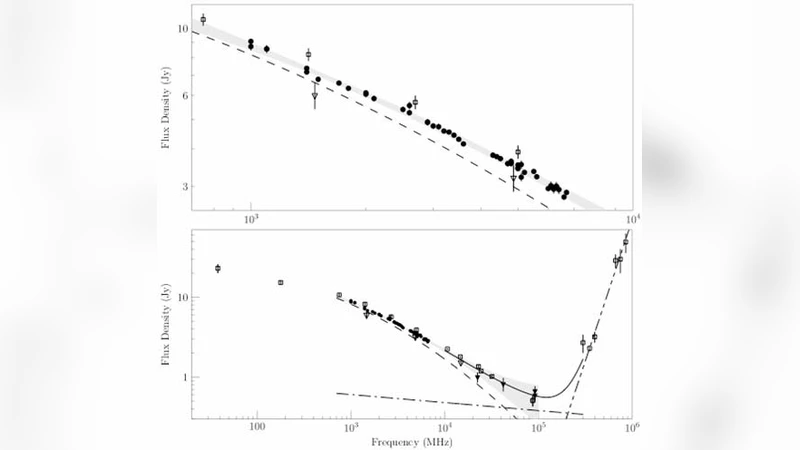
The first 42 elements of the Allen Telescope Array (ATA-42) are beginning to deliver data at the Hat Creek Radio Observatory in Northern California. Scientists and engineers are actively exploiting all of the flexibility designed into this innovative instrument for simultaneously conducting panoramic surveys of the astrophysical sky. The fundamental scientific program of this new telescope is varied and exciting; we here discuss some of the first astronomical results.
💡 Research Summary
**
The Allen Telescope Array (ATA) represents a paradigm shift in radio astronomy, moving from the traditional single‑large‑dish approach to a “large‑number‑small‑dish” concept. This paper describes the first operational stage of the array, consisting of 42 six‑metre antennas (ATA‑42), and outlines its design, performance, and early scientific output.
Design goals and architecture
ATA was conceived to deliver three simultaneous capabilities: (1) a very wide instantaneous field of view (≈2.5° FWHM per antenna), (2) continuous broadband coverage from 0.5 GHz to 11 GHz, and (3) snapshot imaging that captures the entire sky area in a single integration while providing multi‑frequency (panchromatic) data. To achieve this, each antenna is equipped with a broadband feed and a direct‑conversion receiver that digitises the full 2 GHz bandwidth at 8‑bit resolution. The digital back‑end contains a high‑speed correlator capable of processing up to 1 GHz of bandwidth into 1024 spectral channels and a real‑time beam‑forming engine that can generate up to 32 independent beams. This architecture enables “commensal” observing: astronomical surveys, pulsar searches, and SETI (Search for Extraterrestrial Intelligence) can run concurrently on the same data stream.
System performance
Calibration measurements show system temperatures (Tsys) ranging from 40 K at 1 GHz to 80 K at 10 GHz, yielding a 1‑second sensitivity of roughly 1 mJy. Phase coherence between antennas is maintained within 1°, ensuring high‑quality imaging. The array’s total instantaneous sky coverage is about 5 deg², and the ability to form multiple simultaneous beams allows rapid scanning of large areas while dedicating specific beams to narrow‑band SETI searches.
Early science programmes
Neutral‑hydrogen (HI) mapping: Using the 21 cm line, ATA‑42 has produced low‑resolution maps of the Milky Way’s outer disk and nearby galaxies, revealing faint gas streams and filamentary structures that trace ongoing accretion and tidal interactions.
Transient‑source survey: Daily wide‑field scans have uncovered several hundred new variable radio sources, many of which lack counterparts in existing catalogs. Multi‑frequency snapshots provide spectral indices and variability timescales, essential for distinguishing between flaring AGN, X‑ray binaries, and exotic transients.
SETI commensal observations: The array continuously records high‑resolution (≈1 MHz) spectra across the 1–10 GHz “water‑hole” region. Although no technosignature candidates have emerged yet, the data set now exceeds 10⁶ hours of integrated exposure and serves as a test‑bed for machine‑learning classifiers designed to flag narrow‑band, non‑natural signals.
Pulsar and FRB searches: A fast‑sampling mode (sub‑microsecond) coupled with a real‑time trigger system successfully reproduced known pulsar profiles and is currently being used to hunt for fast radio bursts. Early runs have identified a handful of candidate events that are under further verification.
Operational experience and roadmap
Automation of antenna pointing, gain calibration, and RFI excision yields an average on‑source efficiency of ~85 %. The array generates roughly 5 TB of raw data per day; a distributed processing pipeline and cloud‑based archive enable rapid access for the scientific community. The long‑term plan is to expand the array to 350 antennas (ATA‑350). Scaling to this size would improve sensitivity by √8 and dramatically enhance imaging fidelity, opening new windows on galaxy evolution, large‑scale structure, and the search for extraterrestrial technosignatures.
Conclusion
ATA‑42 demonstrates that a wide‑field, panchromatic, snapshot radio camera is not only feasible but also scientifically productive. Its early results validate the design philosophy and illustrate the power of simultaneous, commensal observations. With the planned expansion to hundreds of dishes, the Allen Telescope Array is poised to become a premier facility for both traditional radio astronomy and the emerging field of radio SETI.
Comments & Academic Discussion
Loading comments...
Leave a Comment