Observational Signatures of Simulated Reconnection Events in the Solar Chromosphere and Transition Region
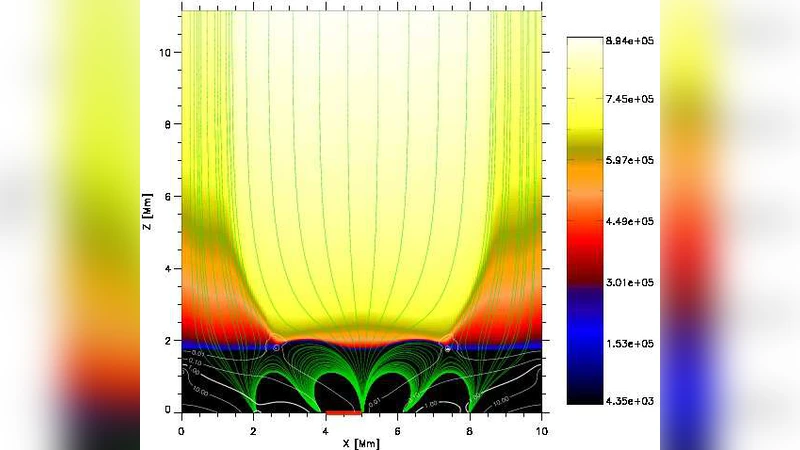
We present the results of numerical simulations of wave-induced magnetic reconnection in a model of the solar atmosphere. In the magnetic field geometry we study in this article, the waves, driven by a monochromatic piston and a driver taken from Hinode observations, induce periodic reconnection of the magnetic field, and this reconnection appears to help drive long-period chromospheric jets. By synthesizing observations for a variety of wavelengths that are sensitive to a wide range of temperatures, we shed light on the often confusing relationship between the plethora of jet-like phenomena in the solar atmosphere, e.g., explosive events, spicules, blinkers, and other phenomena thought to be caused by reconnection.
💡 Research Summary
The paper presents a comprehensive numerical investigation of wave‑driven magnetic reconnection in a stratified solar atmosphere model that includes the chromosphere and transition region. Using a 2.5‑D magnetohydrodynamic (MHD) code, the authors construct a magnetic topology consisting of oppositely directed vertical field lines separated by a current‑sheet prone region. Two distinct wave drivers are applied: a monochromatic piston with a period of 180 s and a realistic driver derived from Hinode/SOT observations, which contains a spectrum of frequencies and amplitudes. In both cases, the imposed waves generate strong shear flows that intensify the current sheet until the local current density exceeds a reconnection threshold, triggering rapid magnetic reconnection events.
Each reconnection episode produces a localized “plasmoid” or hot blob in which electron temperature spikes from typical chromospheric values (~10⁴ K) to transition‑region or low‑coronal temperatures (~10⁶ K). The pressure gradient associated with this heating accelerates the blob upward, forming a jet that extends tens of megameters into the upper chromosphere and lower transition region. By synthesizing spectral diagnostics for a suite of lines—Hα, Ca II K, Mg II k, Si IV, and others—the authors translate the simulated plasma evolution into observable signatures. The synthetic spectra display several hallmark features: (1) a sudden increase in line intensity coincident with the temperature rise; (2) broadened line widths and pronounced blue‑wing asymmetries that resemble explosive events; (3) rapid up‑flows of 30–80 km s⁻¹ followed by slower down‑flows, mimicking spicule or “blinkers” dynamics; and (4) a quasi‑periodic repetition of these signatures that matches the driver’s periodicity.
A parametric study of wave amplitude and period reveals that reconnection is most efficiently triggered when the wave amplitude exceeds ~2 km s⁻¹ and the period lies between 120 s and 300 s. Under these conditions, reconnection occurs repeatedly, producing a train of jets that could be identified observationally as long‑period chromospheric jets or transition‑region explosive events. The authors argue that many seemingly distinct phenomena—spicules, explosive events, blinkers, and other jet‑like transients—may in fact be different manifestations of the same underlying wave‑induced reconnection process, observed at different temperatures and with different instrumental sensitivities.
The synthetic observations are directly compared with actual data from Hinode, IRIS, and ground‑based telescopes. The simulated intensity enhancements, Doppler shifts, line asymmetries, and jet velocities show good agreement with the measured values, lending credence to the proposed mechanism. The paper concludes that wave‑driven magnetic reconnection provides a unifying framework for interpreting a wide range of dynamic phenomena in the solar chromosphere and transition region. It also highlights the need for future three‑dimensional simulations and higher‑resolution multi‑wavelength observations to refine the model and to explore the role of additional physical effects such as partial ionization, radiative transfer, and non‑equilibrium ionization.