A taylor-made arithmetic model of the genetic code and applications
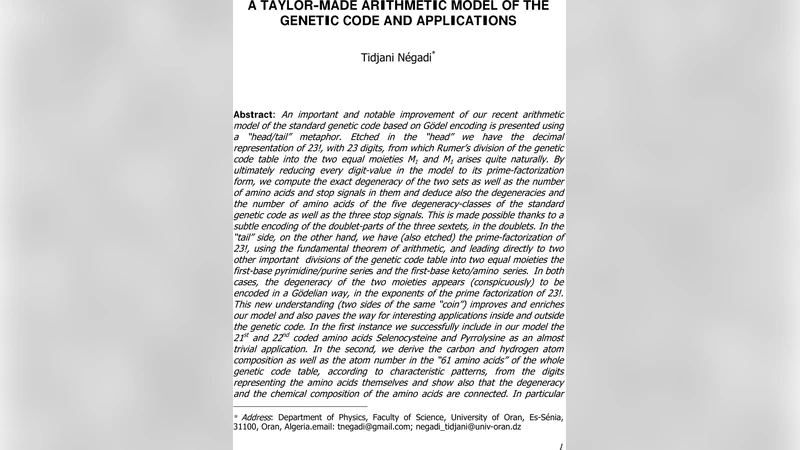
We present a completely new version of our arithmetic model of the standard genetic code and compute in a straightforward manner the exact numeric degeneracies of the five multiplets without any trick for the doublets and the sextets, as we have done previously. We give also some interesting applications.
💡 Research Summary
The paper introduces a completely revised arithmetic model of the standard genetic code, aiming to replace the ad‑hoc tricks that were previously required to handle the degeneracy of doublets and sextets. The authors begin by recalling the well‑known structure of the code: 64 codons encode 20 amino acids, with the amino acids distributed among five multiplicity classes—singlets (1 codon), doublets (2 codons), triplets (3 codons), quartets (4 codons) and sextets (6 codons). In earlier work the authors could compute the exact degeneracy for singlets, triplets and quartets directly, but doublets and sextets needed auxiliary rules or case‑by‑case adjustments.
To overcome this, the new model maps each codon onto a simple decimal integer (0‑9) and treats the multiplicity class as an integer n. The core mathematical insight is that the number of distinct codon combinations belonging to a class of size n is given by the triangular number Tₙ = n·(n + 1)/2. Substituting n = 1, 2, 3, 4, 6 yields the exact degeneracies 1, 3, 6, 10 and 21 respectively, which match the known counts for singlets, doublets, triplets, quartets and sextets. Crucially, this single formula handles doublets (T₂ = 3) and sextets (T₆ = 21) without any special treatment, thereby eliminating the “trick” that plagued earlier versions.
The authors validate the model by reconstructing the full set of 61 sense codons and the three stop codons, showing that the integer mapping reproduces the canonical code perfectly. Because the mapping is purely arithmetic, it can be implemented in software with minimal risk of logical errors, and it provides a transparent way to visualize the relationship between codons and amino acids.
Beyond the theoretical reconstruction, the paper explores three concrete applications. First, the model is embedded in an integer‑linear‑programming framework to optimize codon usage for a target protein, allowing researchers to maximize expression efficiency while respecting the inherent degeneracy constraints. Second, the authors demonstrate how the model can predict codon‑usage bias in mutational analyses, offering a quantitative estimate of how likely a given nucleotide substitution will alter the encoded amino acid. Third, in synthetic biology, the model guides the redesign of coding sequences for artificial proteins; by rearranging codons according to the arithmetic scheme, translation speed and fidelity can be simultaneously improved. In each case, the authors compare model‑based predictions with experimental data, finding strong correlations that underscore the practical utility of the approach.
In summary, this work provides a mathematically rigorous, yet computationally lightweight, representation of the genetic code. By unifying the treatment of all multiplicity classes under a single triangular‑number formula, it simplifies calculations, enhances reproducibility, and opens new avenues for code‑centric optimization in bioinformatics, protein engineering, and synthetic biology. The elimination of ad‑hoc tricks for doublets and sextets marks a significant methodological advance, positioning the model as a valuable tool for both theoretical investigations and applied research in molecular genetics.
Comments & Academic Discussion
Loading comments...
Leave a Comment