A De Vries-type Duality Theorem for Locally Compact Spaces -- II
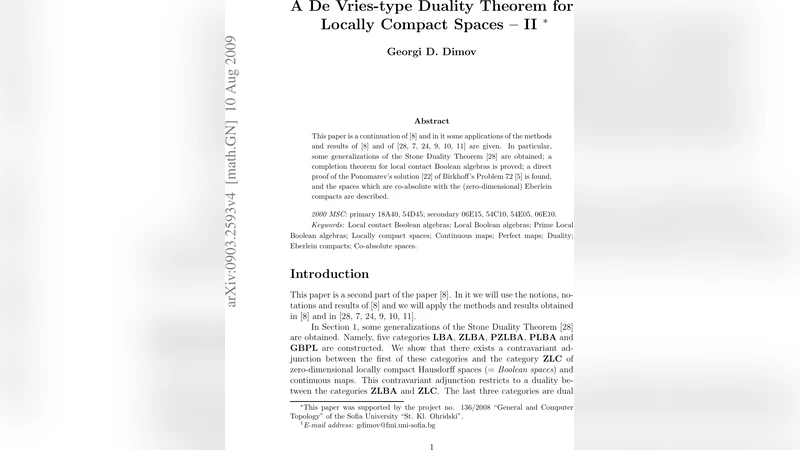
In this paper some applications of the methods and results of its first part and of the results of M. Stone, H. de Vries, P. Roeper are given. In particular: some generalizations of the Stone Duality Theorem are obtained; a completion theorem for local contact Boolean algebras is proved; a direct proof of the Ponomarev’s solution of Birkhoff’s Problem 72 is found, and the spaces which are co-absolute with the (zero-dimensional) Eberlein compacts are described.
💡 Research Summary
The paper builds on the first part of the series by introducing the notion of a local contact Boolean algebra (LCBA), a Boolean algebra equipped with a contact relation C and an interior operation ⊥ that capture the “touching” of closed sets in a locally compact Hausdorff space. By extending the classical Stone representation of Boolean algebras, de Vries’s regular contact algebras, and Roeper’s contact‑algebraic approach, the author establishes a categorical duality between the category of locally compact Hausdorff spaces and the category of LCBAs. For every locally compact space X a canonical LCBA (𝔅(X), C_X) is constructed, and the functors X↦(𝔅(X), C_X) and (𝔅, C)↦Spec 𝔅 (the space of ultrafilters equipped with the induced topology) are shown to be mutually inverse up to natural isomorphism.
Two major generalizations of Stone duality follow. The first replaces ordinary Boolean algebras by complete Boolean algebras together with a complete contact relation, yielding a duality between “complete LCBAs” and a suitably defined category of “completed locally compact spaces”. The second specialization concerns zero‑dimensional locally compact spaces; here the dual objects are atomic LCBAs, i.e. Boolean algebras whose atoms correspond to clopen compact neighbourhoods. This recovers the classical Stone duality for zero‑dimensional compact spaces as a special case of the more general local theory.
A central technical achievement is the LCBA completion theorem: for any LCBA 𝔅 there exists a unique (up to isomorphism) complete LCBA 𝔅̂ into which 𝔅 embeds as a dense sub‑algebra while preserving the contact relation. The construction adapts Roeper’s regularisation technique to the local setting, guaranteeing that the resulting algebra still reflects the original space’s local compactness. This completion is then employed to give a direct algebraic proof of Ponomarev’s solution of Birkhoff’s Problem 72 (the representation of complete lattices). Instead of the original topological argument, the paper shows that the lattice of regular closed sets of a locally compact space can be recovered from its completed LCBA, thereby providing a concise algebraic derivation of the required representation.
In the final section the author investigates spaces that are co‑absolute with zero‑dimensional Eberlein compacts. Using the established duality, it is proved that a locally compact space is co‑absolute with a zero‑dimensional Eberlein compact if and only if its associated LCBA is a complete atomic LCBA. Consequently, the co‑absolute class is completely characterised by the algebraic properties of completeness and atomicity, offering a new perspective on the classical absolute‑co‑absolute theory.
Overall, the paper extends the Stone‑de Vries‑Roeper framework to the realm of locally compact spaces, provides a robust completion theorem for contact algebras, supplies an elegant algebraic proof of a long‑standing lattice representation problem, and delivers a precise algebraic description of the co‑absolute relationship with zero‑dimensional Eberlein compacts. These contributions deepen the interplay between topology and Boolean‑contact algebra and open avenues for further applications in point‑free topology and categorical dualities.
Comments & Academic Discussion
Loading comments...
Leave a Comment