Cone structure of $L^2$-Wasserstein spaces
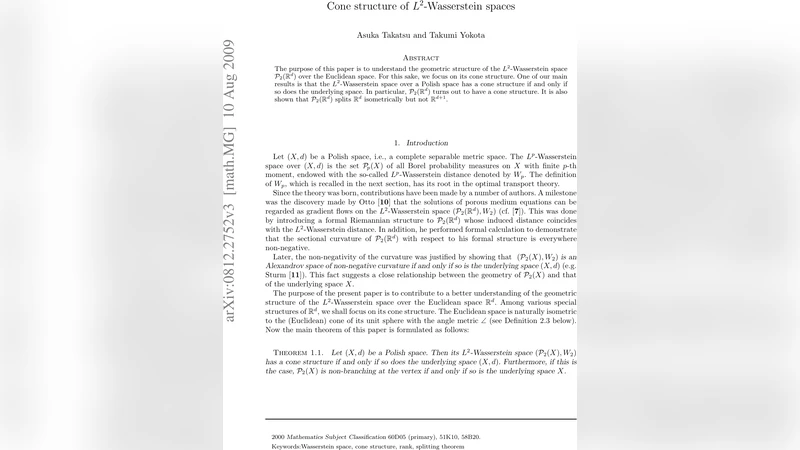
The purpose of this paper is to understand the geometric structure of the $L^2$-Wasserstein space $\pp$ over the Euclidean space.For this sake, we focus on its cone structure.One of our main results is that the $L^2$-Wasserstein space over a Polish space has a cone structure if and only if so does the underlying space.In particular, $\pp$ turns out to have a cone structure.It is also shown that $\pp$ splits $\R^d$ isometrically but not $\R^{d+1}$.
💡 Research Summary
The paper investigates the geometric nature of the $L^2$‑Wasserstein space $\mathcal{P}_2(X)$, focusing on its cone (metric‑cone) structure. After recalling the basic definitions of the $W_2$ distance, optimal transport plans, and the notion of a metric cone, the authors prove a striking equivalence: $\mathcal{P}2(X)$ possesses a cone structure if and only if the underlying Polish space $X$ does. The proof proceeds in two directions. Assuming $X$ is a cone with apex $o$, any geodesic $\gamma{ox}$ from $o$ to $x\in X$ induces a $W_2$‑geodesic on measures via push‑forward, showing that scaling in $X$ lifts to scaling in $\mathcal{P}_2(X)$. Conversely, if $\mathcal{P}2(X)$ is a cone, the family of Dirac measures ${\delta_x}{x\in X}$ embeds $X$ isometrically into $\mathcal{P}_2(X)$; the cone operations on Dirac masses then force $X$ itself to satisfy the cone axioms.
Specialising to Euclidean space, the authors observe that $\mathbb{R}^d$ is trivially a cone (with the origin as apex), hence $\mathcal{P}_2(\mathbb{R}^d)$ is also a cone. They then establish an isometric splitting theorem: every probability measure $\mu\in\mathcal{P}_2(\mathbb{R}^d)$ can be uniquely decomposed into its barycenter $m(\mu)=\int x,d\mu(x)$ and a centred measure $\tilde\mu$ with zero mean. This yields an isometry \
Comments & Academic Discussion
Loading comments...
Leave a Comment