Spitzer Observations of Spacecraft Target 162173 (1999 JU3)
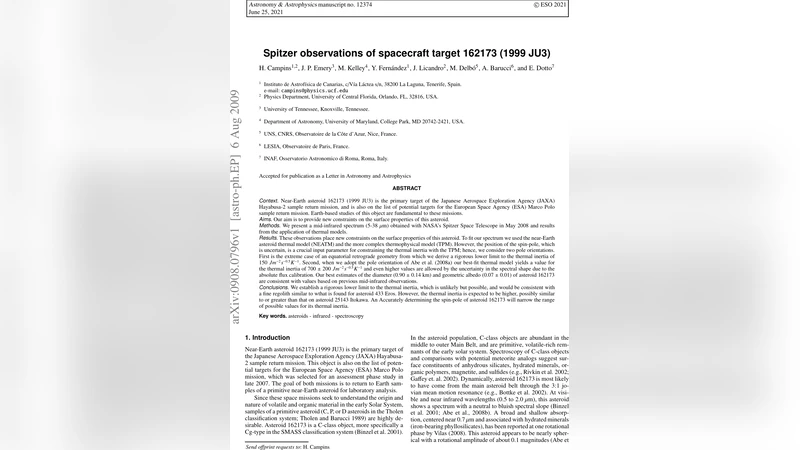
Near-Earth asteroid 162173 (1999 JU3) is the primary target of the Hayabusa-2 sample return mission, and a potential target of the Marco Polo sample return mission. Earth-based studies of this object are fundamental to these missions. We present a mid-infrared spectrum (5-38 microns) of 1999 JU3 obtained with NASA’s Spitzer Space Telescope in May 2008. These observations place new constraints on the surface properties of this asteroid. To fit our spectrum we used the near-Earth asteroid thermal model (NEATM) and the more complex thermophysical model (TPM). However, the position of the spin-pole, which is uncertain, is a crucial input parameter for constraining the thermal inertia with the TPM; hence, we consider two pole orientations. In the extreme case of an equatorial retrograde geometry we derive a lower limit to the thermal inertia of 150 J/m^2/K/s^0.5. If we adopt the pole orientation of Abe et al. (2008a) our best-fit thermal model yields a value for the thermal inertia of 700+/-200 J/m^2/K/s^0.5 and even higher values are allowed by the uncertainty in the spectral shape due to the absolute flux calibration. The lower limit to the thermal inertia, which is unlikely but possible, would be consistent with a fine regolith similar to wthat is found for asteroid 433 Eros. However, the thermal inertia is expected to be higher, possibly similar to or greater than that on asteroid 25143 Itokawa. Accurately determining the spin-pole of asteroid 162173 will narrow the range of possible values for its thermal inertia.
💡 Research Summary
The paper presents a mid‑infrared (5–38 µm) spectrum of the near‑Earth asteroid 162173 (1999 JU3) obtained with NASA’s Spitzer Space Telescope in May 2008. This asteroid is the primary target of the Hayabusa‑2 sample‑return mission and a candidate for the Marco Polo mission, making a detailed characterization of its surface properties essential for mission planning.
Observations were carried out with Spitzer’s Infrared Spectrograph (IRS) using the Short‑Low and Long‑Low modules, providing continuous coverage across the thermal emission peak. Standard pipeline processing, background subtraction, and absolute flux calibration (≈5 % uncertainty) were applied to produce a high‑quality spectrum.
To interpret the data the authors employed two thermal models. The first, the Near‑Earth Asteroid Thermal Model (NEATM), treats the body as a sphere with a single temperature and adjusts a beaming parameter (η) to match observed fluxes. NEATM fitting yields a geometric albedo of ~0.07 and η≈0.9, indicating a dark, low‑albedo surface with efficient thermal emission.
The second, more sophisticated approach, is a Thermophysical Model (TPM) that incorporates rotation period (≈7.6 h), assumed shape (spherical), surface roughness, and, critically, the spin‑pole orientation. Because the pole direction of 1999 JU3 is not well constrained, the authors explore two extreme scenarios: (1) an equatorial retrograde geometry (pole near the equator) and (2) the pole solution proposed by Abe et al. (2008), which places the pole at moderate latitude (~‑50°).
For the equatorial retrograde case the TPM requires a minimum thermal inertia of 150 J m⁻² K⁻¹ s⁻½ to reproduce the observed spectrum. This low value is comparable to that of asteroid 433 Eros and would be consistent with a fine, dust‑rich regolith covering the surface. However, this geometry is considered unlikely given other constraints on the asteroid’s spin state.
When the Abe pole is adopted, the best‑fit thermal inertia rises dramatically to 700 ± 200 J m⁻² K⁻¹ s⁻½, with the upper bound extending to ~1000 J m⁻² K⁻¹ s⁻½ when absolute flux calibration uncertainties are taken into account. Such values are similar to or exceed the thermal inertia measured for asteroid 25143 Itokawa, implying a surface dominated by coarse rocks, boulders, or a relatively thick, compacted regolith.
Thermal inertia is a direct proxy for surface grain size and cohesion: low inertia indicates sub‑millimeter particles loosely bound, whereas high inertia points to centimeter‑ to decimeter‑scale blocks and stronger inter‑particle contacts. Consequently, the thermal inertia range derived here has immediate implications for Hayabusa‑2. A low‑inertia surface would facilitate sampling with a touch‑and‑go device, while a high‑inertia terrain would demand more robust anchoring or drilling strategies.
The authors also discuss the derived albedo and emissivity. The low albedo (≈0.07) confirms a carbon‑rich, dark surface, while the high emissivity (≈0.9–1.0 across the observed wavelengths) indicates efficient radiative cooling, a factor that influences temperature gradients and, therefore, the thermal inertia calculation itself.
In the discussion, the paper emphasizes that the dominant source of uncertainty in the thermal inertia estimate is the unknown spin‑pole orientation. Accurate pole determination—through radar imaging, light‑curve inversion, or future spacecraft observations—would dramatically narrow the allowed inertia range, yielding a more precise picture of the regolith thickness and particle size distribution.
The study concludes that Spitzer’s mid‑infrared spectroscopy provides the first robust constraints on the thermal properties of 1999 JU3. While a low‑inertia, fine‑grained regolith cannot be ruled out, the most plausible scenario points to a surface with thermal inertia comparable to Itokawa, suggesting a relatively rocky environment. These findings are critical for refining landing site selection, sampling tool design, and thermal models used in mission simulations for Hayabusa‑2 and any future missions targeting this asteroid.
Comments & Academic Discussion
Loading comments...
Leave a Comment