The Future of Nuclear Energy: Facts and Fiction Chapter I: Nuclear Fission Energy Today
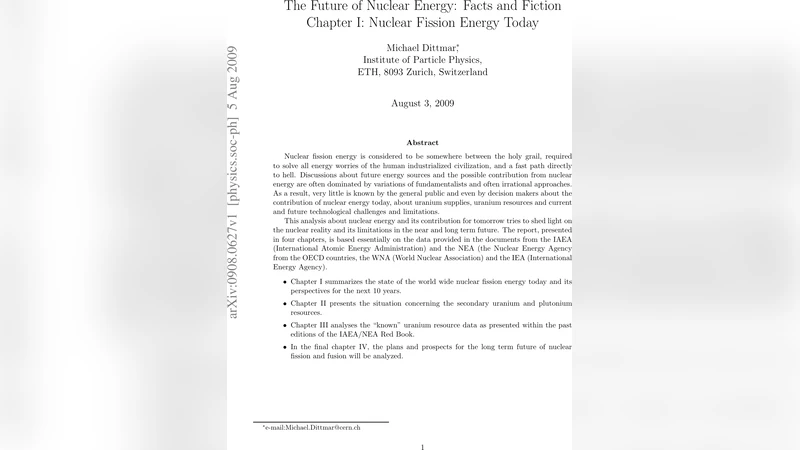
Nuclear fission energy is considered to be somewhere between the holy grail, required to solve all energy worries of the human industrialized civilization, and a fast path directly to hell. Discussions about future energy sources and the possible contribution from nuclear energy are often dominated by variations of fundamentalists and often irrational approaches. As a result, very little is known by the general public and even by decision makers about the contribution of nuclear energy today, about uranium supplies, uranium resources and current and future technological challenges and limitations. This analysis about nuclear energy and its contribution for tomorrow tries to shed light on the nuclear reality and its limitations in the near and long term future. The report, presented in four chapters, is based essentially on the data provided in the documents from the IAEA (International Atomic Energy Administration) and the NEA (the Nuclear Energy Agency from the OECD countries, the WNA (World Nuclear Association) and the IEA (International Energy Agency).
💡 Research Summary
The paper provides a comprehensive, data‑driven assessment of the current state of nuclear fission energy and its realistic prospects for the future. Drawing primarily on the latest statistics from the International Atomic Energy Agency (IAEA), the Nuclear Energy Agency (NEA), the World Nuclear Association (WNA) and the International Energy Agency (IEA), the analysis quantifies the global fleet of operating reactors (approximately 440 units in 2023), their combined capacity (about 390 GW), and the share of electricity they generate (roughly 10 % of worldwide consumption). It highlights the uneven distribution of nuclear power across nations, with France, the United States, China and Russia accounting for the majority of installed capacity.
On the supply side, the report notes that annual uranium mining output is near 7,500 tonnes, sourced mainly from Kazakhstan, Canada, Australia and Namibia. Confirmed reserves are estimated at around 8 million tonnes, which, at current consumption rates, would sustain production for at least a century. However, the proportion of high‑grade ore is declining, prompting a need for technologies that can economically process lower‑grade deposits, expand re‑processing capabilities, and explore unconventional sources such as seawater extraction.
Technologically, the paper distinguishes between the limits of existing Light‑Water Reactors (LWRs) and the promise of Generation IV concepts—high‑temperature gas‑cooled reactors (HTGRs), sodium‑cooled fast reactors (SFRs), and molten‑salt reactors (MSRs). While fast reactors could dramatically improve uranium utilization and reduce waste volume, they face challenges related to coolant chemistry, material corrosion, and complex licensing. HTGRs offer high thermal efficiency and potential integration with hydrogen production, but require advanced high‑temperature alloys.
Waste management remains a critical bottleneck. Most spent fuel is stored in interim facilities; only a few countries (notably Finland and Sweden) have commissioned deep‑geological repositories. Political opposition, high costs, and long‑term safety assurances impede broader deployment of permanent disposal solutions. The authors argue that transparent stakeholder engagement and robust regulatory frameworks are essential to gain public acceptance.
Economically, nuclear power is characterized by high upfront capital costs and long construction lead times (5–10 years), which elevate financial risk compared to variable renewables. Nevertheless, once operational, nuclear plants enjoy low fuel costs and provide baseload electricity independent of weather conditions. The paper recommends cost‑reduction strategies such as standardized reactor designs, modular construction, government loan guarantees, and risk‑sharing mechanisms to improve the investment case.
Finally, the analysis stresses the importance of societal perception. Post‑Fukushima safety concerns have heightened public skepticism, making rigorous safety standards, independent oversight, and proactive communication indispensable. Education initiatives and continuous dialogue with local communities are presented as vital tools for rebuilding trust.
In conclusion, the authors contend that nuclear energy can play a meaningful role in decarbonizing the global power sector, but only if five interlinked challenges—resource supply, technological advancement, economic competitiveness, waste disposal, and social acceptance—are addressed in a coordinated manner. Short‑term actions should focus on extending the life and improving the safety of existing reactors; medium‑term goals involve commercializing Generation IV systems and expanding re‑processing; long‑term strategies require sustainable uranium sourcing and the establishment of universally accepted deep‑geological repositories.
Comments & Academic Discussion
Loading comments...
Leave a Comment