Basis Reduction, and the Complexity of Branch-and-Bound
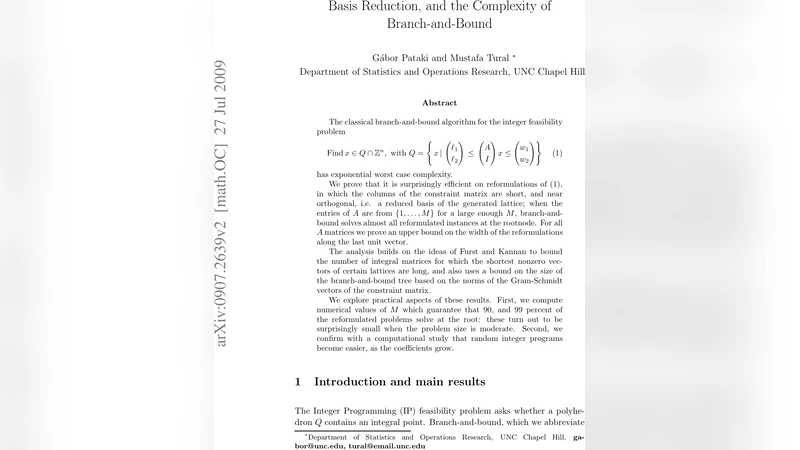
The classical branch-and-bound algorithm for the integer feasibility problem has exponential worst case complexity. We prove that it is surprisingly efficient on reformulated problems, in which the columns of the constraint matrix are short, and near orthogonal, i.e. a reduced basis of the generated lattice; when the entries of A (the dense part of the constraint matrix) are from {1, …, M} for a large enough M, branch-and-bound solves almost all reformulated instances at the rootnode. We also prove an upper bound on the width of the reformulations along the last unit vector. The analysis builds on the ideas of Furst and Kannan to bound the number of integral matrices for which the shortest vectors of certain lattices are long, and also uses a bound on the size of the branch-and-bound tree based on the norms of the Gram-Schmidt vectors of the constraint matrix. We explore practical aspects of these results. First, we compute numerical values of M which guarantee that 90, and 99 percent of the reformulated problems solve at the root: these turn out to be surprisingly small when the problem size is moderate. Second, we confirm with a computational study that random integer programs become easier, as the coefficients grow.
💡 Research Summary
The paper investigates the classical branch‑and‑bound (B&B) algorithm for the integer feasibility problem, whose worst‑case running time is exponential. The authors show that when the constraint matrix is first transformed into a reduced lattice basis—i.e., its columns are short and nearly orthogonal—the algorithm becomes dramatically more efficient, often terminating at the root node. The key technical contribution is a two‑part analysis. First, they bound the “width” of the reformulated problem along the last unit vector using the Gram‑Schmidt norms of the matrix columns; if this width is ≤ 1, the root node already contains a feasible integer point, so the B&B tree collapses to a single node. Second, they apply the Furst‑Kannan counting technique to estimate how many integer matrices have a long shortest lattice vector. By showing that, for matrices whose entries are drawn uniformly from {1,…,M}, the proportion of “bad” matrices (those violating the width condition) decays rapidly as M grows, they derive explicit thresholds for M that guarantee that 90 % or 99 % of randomly generated instances are solved at the root. These thresholds turn out to be surprisingly small for moderate problem sizes (e.g., n≈30, m≈15).
The theoretical results are complemented by a computational study. The authors first compute the minimal M values needed to achieve the 90 % and 99 % success rates for various dimensions, confirming that modest coefficient magnitudes already suffice. Then they generate random integer programs, solve them with a standard B&B implementation both before and after applying a lattice‑basis reduction (LLL or KZ), and record the size of the search tree. As the coefficient bound M increases, the average tree size shrinks dramatically, and the majority of instances are indeed solved at the root after reduction. This empirical evidence supports the claim that “larger coefficients make the problem easier” in the context of reduced‑basis reformulations.
Finally, the paper discusses practical implications. Basis reduction can be incorporated as a lightweight preprocessing step in existing integer programming solvers, potentially yielding large speed‑ups without altering the core B&B logic. Moreover, the approach is compatible with other techniques such as cutting planes or heuristic branching rules, suggesting a fertile avenue for hybrid algorithms. The authors conclude that lattice‑theoretic insights provide a powerful tool for demystifying the complexity of B&B and for designing more robust integer programming methods.
Comments & Academic Discussion
Loading comments...
Leave a Comment