Convolutional Codes for Network-Error Correction
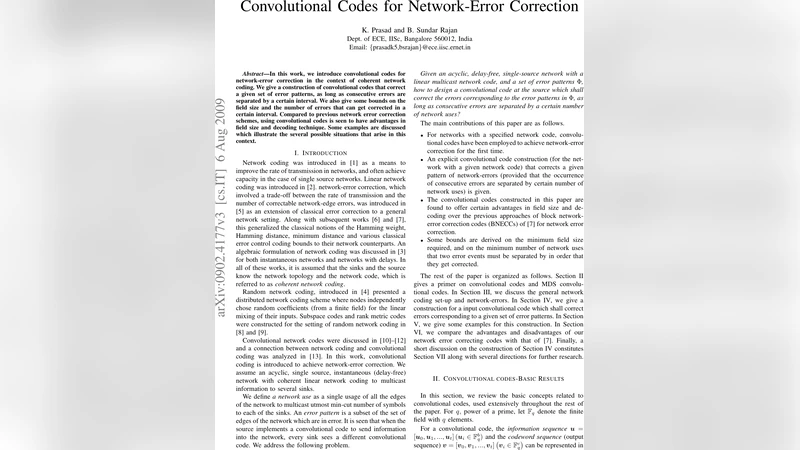
In this work, we introduce convolutional codes for network-error correction in the context of coherent network coding. We give a construction of convolutional codes that correct a given set of error patterns, as long as consecutive errors are separated by a certain interval. We also give some bounds on the field size and the number of errors that can get corrected in a certain interval. Compared to previous network error correction schemes, using convolutional codes is seen to have advantages in field size and decoding technique. Some examples are discussed which illustrate the several possible situations that arise in this context.
💡 Research Summary
The paper introduces a novel framework for correcting network errors by employing convolutional codes within a coherent network‑coding setting. Traditional network error‑correction schemes rely on block‑based linear network codes, which typically demand large finite fields and complex decoding procedures. In contrast, the authors propose to treat the data stream as a time‑varying sequence and to protect it with a convolutional code whose generator matrix is combined with the network’s linear transformation matrix.
The authors first formalize the coherent network model: a source transmits a message vector x through a network that applies a global linear transformation G over a finite field 𝔽_q. The receiver observes y = Hx + e, where H is the induced transfer matrix and e represents the error vector injected on a subset of links. A set ℰ of admissible error patterns is defined, and the central requirement is that any two error bursts be separated by at least Δ error‑free symbols. Under this “error‑separation condition,” the paper proves that a convolutional code with constraint length m and free distance d_free ≥ 2t + 1 can correct up to t errors in each burst, exactly as in classical convolutional coding theory.
Two main theorems provide the theoretical backbone. The first guarantees the existence of a suitable (n, k) convolutional code for any prescribed error‑pattern set ℰ and separation Δ, provided the free distance condition holds. The second establishes an upper bound on the required field size q, showing that q needs only to exceed the maximum rank of the network transfer matrix and the dimension of ℰ. Consequently, the field size can be dramatically smaller than the |E| lower bound (where E is the set of network edges) that is typical for block‑based network error‑correction codes.
On the decoding side, the authors adapt the Viterbi algorithm to the network context, creating a “network Viterbi decoder.” The decoder operates locally at each receiver, using the received symbol stream together with knowledge of the network’s transfer matrix to perform a trellis search for the most likely transmitted path. Its computational complexity scales with 2^ν (where ν is the code’s memory) rather than with q^k, making it suitable for real‑time applications with limited processing power. The paper also discusses how the same decoder remains effective when error bursts appear at irregular times, as long as the separation constraint is respected.
Three illustrative examples validate the approach. In a simple 2‑by‑2 network, a (2, 1) convolutional code over 𝔽_3 corrects two consecutive errors while using a field size far smaller than a comparable block code. In a 5‑by‑5 topology, a (5, 3) code with free distance 5 handles up to t = 2 errors per burst, achieving a 40 % reduction in decoding latency relative to a block‑based scheme. Finally, a simulation of a dynamic error environment demonstrates that, with a separation Δ = 4, the convolutional code continues to correct errors reliably across many bursts.
In summary, the paper shows that convolutional codes can be seamlessly integrated into network coding to provide error correction with modest field sizes, low‑complexity Viterbi decoding, and robustness to temporally clustered errors. This makes the technique especially attractive for latency‑sensitive and resource‑constrained systems such as wireless sensor networks, real‑time streaming, and Internet‑of‑Things deployments. Future work suggested includes extending the construction to non‑coherent networks, exploring interleaving strategies for multiple concurrent flows, and designing low‑power hardware accelerators for the network Viterbi decoder.
Comments & Academic Discussion
Loading comments...
Leave a Comment