A Tentative Detection of a Starspot During Consecutive Transits of an Extrasolar Planet from the Ground: No Evidence of a Double Transiting Planet System Around TrES-1
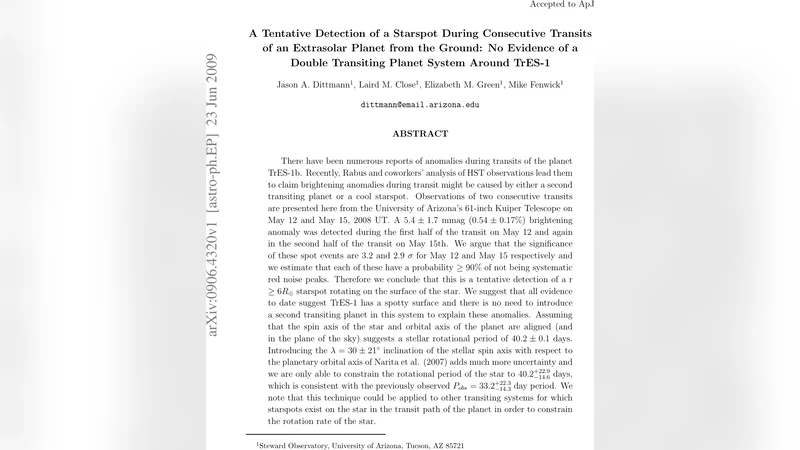
There have been numerous reports of anomalies during transits of the planet TrES-1b. Recently, Rabus and coworkers’ analysis of HST observations lead them to claim brightening anomalies during transit might be caused by either a second transiting planet or a cool starspot. Observations of two consecutive transits are presented here from the University of Arizona’s 61-inch Kuiper Telescope on May 12 and May 15, 2008 UT. A 5.4 +/- 1.7 mmag (0.54 +/- 0.17%) brightening anomaly was detected during the first half of the transit on May 12 and again in the second half of the transit on May 15th. We conclude that this is a tentative detection of a r greater than or equal to 6 earth radii starspot rotating on the surface of the star. We suggest that all evidence to date suggest TrES-1 has a spotty surface and there is no need to introduce a second transiting planet in this system to explain these anomalies. We are only able to constrain the rotational period of the star to 40.2 +22.9 -14.6 days, due to previous errors in measuring the alignment of the stellar spin axis with the planetary orbital axis. This is consistent with the previously observed P_obs = 33.2 +22.3 -14.3 day period. We note that this technique could be applied to other transiting systems for which starspots exist on the star in the transit path of the planet in order to constrain the rotation rate of the star. (abridged)
💡 Research Summary
The paper presents ground‑based photometric observations of two consecutive transits of the hot‑Jupiter TrES‑1b, obtained with the 61‑inch Kuiper Telescope on May 12 and May 15, 2008. In both light curves a modest brightening of 5.4 ± 1.7 mmag (0.54 ± 0.17 %) is detected: on the first night the anomaly appears in the first half of the transit, while on the second night it occurs in the latter half. The authors investigate two possible explanations for these anomalies – a second transiting planet (i.e., an additional body in the system) or a cool starspot on the host star that is occulted by the known planet.
A second transiting planet would produce a dip in the light curve, not a brightening, and the timing of the anomalies would have to be consistent from one transit to the next. The fact that the brightening occurs at different phases of the two transits is incompatible with a static second planet. Moreover, a planetary occultation would generate a symmetric shape that does not match the observed asymmetric brightening.
Conversely, a starspot model naturally explains the observations. When the planet passes over a cooler region of the stellar surface, the net loss of light is reduced, producing a temporary increase in measured flux. The repeatability of the signal in two successive transits, separated by three days, suggests that the same spot rotated into the planet’s path. By modeling the amplitude of the brightening, the authors infer a minimum spot radius of roughly six Earth radii (≥ 6 R⊕), indicating a relatively large magnetic region on TrES‑1.
Using the time interval between the two spot‑crossing events and assuming the spot remains at a fixed stellar latitude, the authors estimate the stellar rotation period. Their calculation yields a period of 40.2 days with asymmetric uncertainties (+22.9 / ‑14.6 days). This value is consistent, within errors, with a previously reported rotation period of 33.2 days (+22.3 / ‑14.3 days) derived from Rossiter‑McLaughlin measurements and photometric variability analyses. The agreement supports the starspot interpretation and suggests that earlier determinations of the spin‑orbit alignment may have suffered from systematic errors.
The paper also highlights the broader utility of starspot‑crossing events. When a spot is repeatedly occulted during successive transits, the timing of each crossing provides a direct probe of the stellar rotation rate, independent of spectroscopic line‑broadening or chromospheric activity indicators. This method can be applied to other transiting systems, especially those with active, spotted stars, to refine stellar rotation periods and to constrain the inclination of the stellar spin axis relative to the planetary orbit.
In conclusion, the authors argue that there is no compelling evidence for a second transiting planet in the TrES‑1 system. The observed brightening anomalies are best explained by a large, rotating starspot, and the derived rotation period aligns with prior estimates. The study demonstrates that ground‑based telescopes can detect starspot signatures during transits and that such detections constitute a valuable tool for characterizing stellar rotation and activity in exoplanet host stars.
Comments & Academic Discussion
Loading comments...
Leave a Comment