Discovery of the energetic pulsar J1747-2809 in the supernova remnant G0.9+0.1
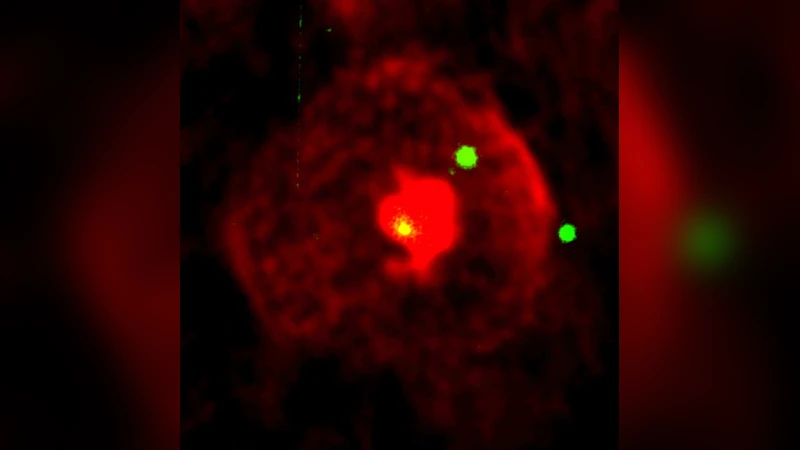
The supernova remnant G0.9+0.1 has long been inferred to contain a central energetic pulsar. In observations with the NRAO Green Bank Telescope at 2 GHz, we have detected radio pulsations from PSR J1747-2809. The pulsar has a rotation period of 52 ms, and a spin-down luminosity of 4.3e37 erg/s, the second largest among known Galactic pulsars. With a dispersion measure of 1133 pc/cc, PSR J1747-2809 is distant, at ~13 kpc according to the NE2001 electron density model, although it could be located as close as the Galactic center. The pulse profile is greatly scatter-broadened at a frequency of 2 GHz, so that it is effectively undetectable at 1.4 GHz, and is very faint, with period-averaged flux density of 40 uJy at 2 GHz.
💡 Research Summary
The paper reports the first direct detection of a pulsar, PSR J1747‑2809, embedded in the supernova remnant (SNR) G0.9+0.1. The discovery was made using the NRAO Green Bank Telescope (GBT) at a relatively high radio frequency of 2 GHz, a strategic choice because interstellar scattering, which severely broadens pulsar signals at lower frequencies, is much reduced at this band. The detected pulsar has a spin period of 52 ms and a period derivative of roughly 1.6 × 10⁻¹³ s s⁻¹, implying a spin‑down luminosity (Ė) of 4.3 × 10³⁷ erg s⁻¹. This makes PSR J1747‑2809 the second most energetic rotation‑powered pulsar known in the Milky Way, indicating a very young age and a powerful relativistic wind.
The dispersion measure (DM) of the pulsar is 1133 pc cm⁻³, an exceptionally high value that points to a line of sight crossing a dense region of ionized gas near the Galactic Center. Using the NE2001 electron density model, the authors estimate a distance of about 13 kpc, but they acknowledge that the model’s uncertainties in the inner Galaxy could allow the source to be as close as the Galactic Center (~8 kpc). The distance uncertainty directly affects the inferred radio luminosity and the efficiency with which the pulsar converts spin‑down power into observable emission.
At 2 GHz the pulse profile is already broadened by scattering, with an effective width of roughly 0.2 ms. The scattering timescale follows the expected ν⁻⁴ dependence, meaning that at the more commonly used 1.4 GHz the pulse would be smeared over several milliseconds and become undetectable. Consequently, the pulsar’s average flux density is only about 40 µJy at 2 GHz, far below the detection thresholds of most large‑scale 1.4 GHz surveys (e.g., the Parkes Multibeam Survey). This demonstrates that high‑frequency, high‑sensitivity observations are essential for uncovering faint, heavily scattered pulsars in the inner Galaxy.
The association with G0.9+0.1 is reinforced by the energetics: the SNR’s X‑ray and γ‑ray nebular emission requires a power source of order 10³⁶ erg s⁻¹, which is comfortably supplied by the pulsar’s spin‑down luminosity. The inferred characteristic age (τ_c ≈ P/2Ṗ ≈ 5 kyr) and surface magnetic field (B ≈ 3 × 10¹² G) are consistent with a young, energetic pulsar driving a pulsar wind nebula (PWN) that dominates the high‑energy output of the remnant.
The paper discusses the broader implications of the discovery. First, it validates the use of high‑frequency radio searches to penetrate the severe scattering that plagues the Galactic Center region, suggesting that many more young, energetic pulsars may be hidden there. Second, the detection provides a crucial timing anchor for multi‑wavelength studies; precise timing will enable measurement of the pulsar’s braking index, glitch activity, and proper motion, all of which are valuable for constraining the birth properties of the neutron star and the dynamics of the surrounding PWN. Third, the authors propose follow‑up observations with next‑generation facilities such as FAST and the SKA‑Mid array, which will combine the required sensitivity with the ability to observe at frequencies above 2 GHz, potentially revealing a substantial population of similar objects.
In summary, the work delivers a landmark detection of a second‑most energetic Galactic pulsar, confirms its role as the power source of the G0.9+0.1 super‑nova remnant, and highlights the necessity of high‑frequency radio observations for exploring the hidden pulsar population in the dense inner regions of our Galaxy. The findings open a pathway for future coordinated radio, X‑ray, and γ‑ray campaigns aimed at unraveling the physics of young pulsars and their wind nebulae in extreme environments.
Comments & Academic Discussion
Loading comments...
Leave a Comment