Speckle Suppression Through Dual Imaging Polarimetry, and a Ground-Based Image of the HR 4796A Circumstellar Disk
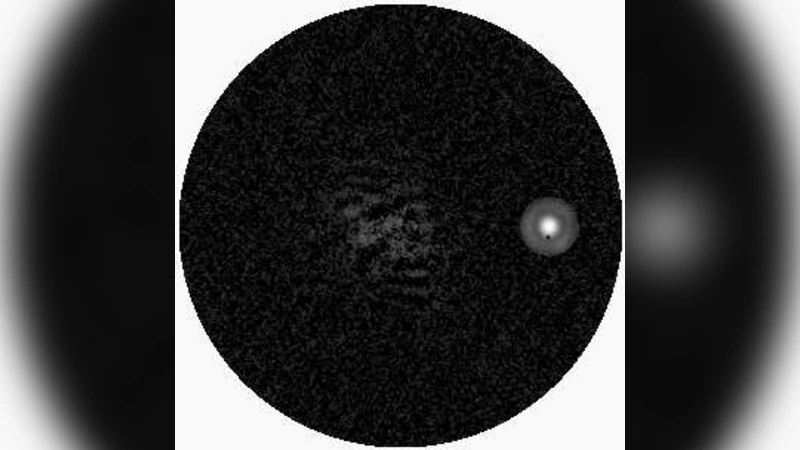
We demonstrate the versatility of a dual imaging polarimeter working in tandem with a Lyot coronagraph and Adaptive Optics to suppress the highly static speckle noise pattern–the greatest hindrance to ground-based direct imaging of planets and disks around nearby stars. Using a double difference technique with the polarimetric data, we quantify the level of speckle suppression, and hence improved sensitivity, by placing an ensemble of artificial faint companions into real data, with given total brightness and polarization. For highly polarized sources within 0.5 arcsec, we show that we achieve 3 to 4 magnitudes greater sensitivity through polarimetric speckle suppression than simply using a coronagraph coupled to a high-order Adaptive Optics system. Using such a polarimeter with a classical Lyot coronagraph at the 3.63m AEOS telescope, we have obtained a 6.5 sigma detection in the H-band of the 76 AU diameter circumstellar debris disk around the star HR 4796A. Our data represent the first definitive, ground-based, near-IR polarimetric image of the HR 4796A debris disk and clearly show the two outer ansae of the disk, evident in Hubble Space Telescope NICMOS/STIS imaging. We derive a lower limit to the fractional linear polarization of 29% caused by dust grains in the disk. In addition, we fit simple morphological models of optically thin disks to our data allowing us to constrain the dust disk scale height to 2.5{+5.0}{-1.3} AU and scattering asymmetry parameter (g=0.20^{+.07}{-.10}). These values are consistent with several lines of evidence suggesting that the HR 4796A disk is dominated by a micron-sized dust population, and are indeed typical of disks in transition between those surrounding the Herbig Ae stars to those associated with Vega-like stars.
💡 Research Summary
The authors present a novel method for suppressing the quasi‑static speckle noise that limits ground‑based high‑contrast imaging. By integrating a dual‑imaging polarimeter with a Lyot coronagraph and a high‑order adaptive optics (AO) system, they exploit the fact that speckles are essentially unpolarized while many astrophysical signals (scattered light from disks, reflected light from planets) are polarized. The instrument records two orthogonal linear polarization states simultaneously; a double‑difference (polarimetric subtraction) removes the common speckle pattern and leaves only the polarized component.
To quantify the gain, artificial point sources with known total flux and linear polarization fraction were injected into real AO‑corrected coronagraphic data. Within 0.5 arcsec of the star, the polarimetric processing yields a 3–4 mag improvement in detection limits compared with conventional coronagraphic imaging, corresponding to a factor of 15–40 in contrast. The improvement is strongest for highly polarized sources, confirming that the technique preferentially enhances the very signals of interest.
The system was deployed on the 3.63 m AEOS telescope. In H‑band (1.6 µm) observations of HR 4796A, the authors achieved a 6.5σ detection of the well‑known 76 AU debris ring, clearly resolving the two outer ansae that had previously been seen only with HST NICMOS/STIS. The polarized intensity image indicates a lower limit of 29 % linear polarization for the scattered light, implying that the dust grains are non‑spherical and dominated by micron‑size particles.
A simple optically thin disk model was fitted to the data. The best‑fit vertical scale height is 2.5 AU, with asymmetric scattering parameter g ≈ 0.20 (±0.07/0.10). The modest forward‑scattering (g > 0) and high polarization are consistent with a population of sub‑micron to micron‑size silicate/carbonaceous grains, typical of disks transitioning from the protoplanetary (Herbig Ae) phase to the debris (Vega‑like) phase.
Technically, the dual‑beam polarimeter uses two synchronized detectors to capture the orthogonal polarization channels simultaneously, minimizing temporal variations caused by atmospheric turbulence or AO residuals. Residual speckles after subtraction are mainly due to any intrinsic stellar polarization, which can be calibrated out with standard stars. The authors argue that this approach scales to larger apertures (e.g., 30‑m class telescopes) and will be valuable for future high‑contrast instruments that aim to combine imaging and polarimetry.
In summary, the paper demonstrates that polarimetric speckle suppression can dramatically improve contrast at small angular separations, enabling ground‑based detection of faint, polarized circumstellar structures. The successful imaging of HR 4796A’s debris disk validates the method and provides new constraints on dust grain properties, scale height, and scattering behavior, thereby advancing our understanding of disk evolution and offering a powerful tool for future exoplanet and disk studies.
Comments & Academic Discussion
Loading comments...
Leave a Comment