Chandra Localizations and Spectra of INTEGRAL Sources in the Galactic Plane: The Cycle 9 Sample
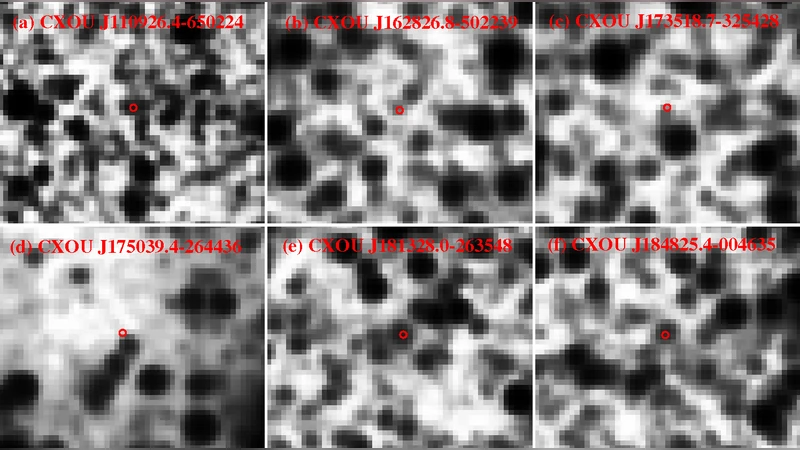
We report on 0.3-10 keV X-ray observations by the Chandra X-ray Observatory of the fields of 22 sources that were discovered as hard X-ray (20-100 keV) sources by the INTEGRAL satellite (IGR sources). The purpose of the Chandra observations is to localize the sources and to measure their soft X-ray spectra in order to determine the nature of the sources. We find very likely Chandra counterparts for 18 of the 22 sources. We discuss the implications for each source, considering previous results and new optical or IR identifications, and we identify or suggest identifications for the nature of 16 of the sources. Two of the sources, IGR J14003-6326 and IGR J17448-3232, are extended on arcminute scales. We identify the former as a pulsar wind nebula (PWN) with a surrounding supernova remnant (SNR) and the latter as a SNR. In the group of 242 IGR sources, there is only one other source that has previously been identified as a SNR. We confirm a previous identification of IGR J14331-6112 as an High-Mass X-ray Binary (HMXB), and we suggest that IGR J17404-3655, IGR J16287-5021, IGR J17354-3255, IGR J17507-2647, IGR J17586-2129, and IGR J13186-6257 are candidate HMXBs. Our results indicate or confirm that IGR J19267+1325, IGR J18173-2509, and IGR J18308-1232 are Cataclysmic Variables (CVs), and we suggest that IGR J15529-5029 may also be a CV. We confirm that IGR J14471-6414 is an Active Galactic Nucleus (AGN), and we also suggest that IGR J19443+2117 and IGR J18485-0047 may be AGN. Finally, we found Chandra counterparts for IGR J11098-6457 and IGR J18134-1636, but more information is required to determine the nature of these two sources.
💡 Research Summary
This paper presents a systematic Chandra X‑ray follow‑up of 22 hard‑X‑ray sources (IGR J‑designated) originally discovered by the INTEGRAL satellite in the 20–100 keV band. The primary goals were to obtain sub‑arcsecond positions and to characterize the soft‑X‑ray (0.3–10 keV) spectra, thereby enabling reliable identification of the underlying astrophysical objects. Each field was observed with the ACIS‑I detector for roughly 5 ks, providing sufficient counts to fit simple absorbed power‑law models and to assess source morphology.
Out of the 22 targets, 18 yielded a highly probable Chandra counterpart, giving an 82 % success rate. Two of the counterparts (IGR J14003‑6326 and IGR J17448‑3232) appear extended on arcminute scales. Detailed imaging shows that IGR J14003‑6326 consists of a compact core surrounded by a ∼2′ shell; its hard spectrum (Γ≈1.5) and high absorption (N_H≈10^22 cm⁻²) are consistent with a young pulsar wind nebula embedded in a supernova remnant. IGR J17448‑3232 exhibits a ∼3′ circular shell with a softer power‑law (Γ≈2.2) and similarly high N_H, leading to its classification as a pure supernova remnant. These two objects add to the very small number of INTEGRAL‑identified SNRs (only one other known among the ∼242 IGR sources).
For the remaining point‑like sources, the authors combined the Chandra spectral parameters (photon index, column density) with existing optical/infrared identifications to assign a likely class. The high‑mass X‑ray binary (HMXB) category includes the previously confirmed IGR J14331‑6112 and six new candidates (IGR J17404‑3655, IGR J16287‑5021, IGR J17354‑3255, IGR J17507‑2647, IGR J17586‑2129, IGR J13186‑6257). These candidates share the hallmarks of HMXBs: large intrinsic absorption (N_H well above the Galactic line‑of‑sight value) and hard power‑law spectra (Γ≈1–2), often accompanied by infrared colors typical of massive OB companions.
Three sources (IGR J19267+1325, IGR J18173‑2509, IGR J18308‑1232) are firmly identified as cataclysmic variables (CVs) based on their low absorption (N_H≈10^21 cm⁻²), hard spectra (Γ≈1–1.5), and supporting optical data. IGR J15529‑5029 shows similar X‑ray characteristics and is therefore proposed as an additional CV candidate.
Active galactic nuclei (AGN) are represented by the confirmed IGR J14471‑6414, whose optical redshift and heavily absorbed X‑ray spectrum (N_H≈10^23 cm⁻²) match an obscured Seyfert classification. Two further sources, IGR J19443+2117 and IGR J18485‑0047, exhibit high N_H and power‑law indices consistent with AGN, and their infrared colors further support this interpretation.
Two detections (IGR J11098‑6457 and IGR J18134‑1636) remain ambiguous: while Chandra has pinpointed a counterpart, there is insufficient multi‑wavelength information to determine whether they are HMXBs, CVs, AGN, or another class. The authors recommend deeper optical/IR spectroscopy and possibly longer X‑ray monitoring to resolve their nature.
The study demonstrates the essential role of Chandra in refining the positions of INTEGRAL hard X‑ray sources, reducing the error circles from several arcminutes to sub‑arcsecond scales, and thereby enabling reliable cross‑identifications. The high detection fraction underscores that most IGR sources have detectable soft X‑ray emission, even when heavily absorbed. The identification of a new SNR/PWN system and several new HMXB candidates expands the known population of high‑energy Galactic objects, while the confirmation of CVs and AGN illustrates the diverse extragalactic and Galactic contributors to the INTEGRAL catalog.
Overall, the paper provides a valuable census of the nature of INTEGRAL sources in the Galactic plane, refines the demographics of hard X‑ray emitters, and sets the stage for future multi‑wavelength campaigns aimed at the remaining unidentified objects.